
Tuakau College
Waikato
Tuakau College Curriculum
124 subjects available for 2026/2027.
Subjects for Year 8 Students
Year 9 Business Studies
9BUS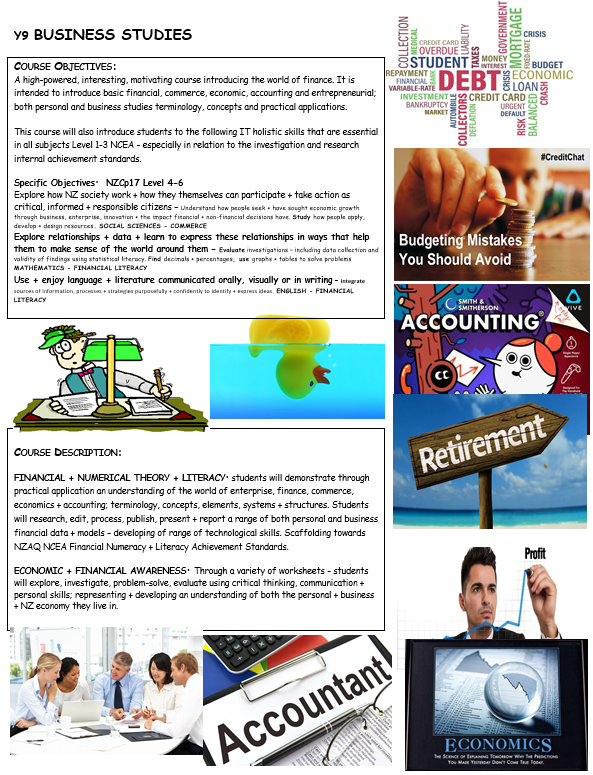
Year 9 Design and Visual Communication
9DVCIn Design and Visual Communication during Year 9 you will learn the fundamentals of freehand sketching and instrumental drawing techniques in order to develop simple design briefs, such as product and character design. Some technical terminology is introduced with basic techniques that will help you communicate your ideas visually.
Year 9 Digital Technology
9DTE- Digital Design & Web: You will design and build multi-page websites using Google Sites and create interactive "Pick-a-Path" stories using Google Slides.
- Creative Media: You will produce personal video montages and explore basic 2D animation.
- Programming & 3D Design: You'll be introduced to the logic of coding with visual, block-based programming on platforms like Scratch or Sphero robots. You will also learn the basics of 3D modelling by designing simple objects like a keyring in Tinkercad.
Year 9 Drama
9DRAYear 9 Drama teaches students foundational skills in performance practices. Drama is about gaining confidence in voice, movement and character and can compliment students with strengths in Kapa Haka, music or public speaking.
Students will devise performances that clearly demonstrate the status of their character in the context of their story. They will learn how to improvise comedic scenes within the context of Theatresports games and activities.
Students will also use a scripted text to develop a performance that will be presented for an audience.
Year 9 English
9ENGYear 9 English begins to develop the skills that will be required within the senior school, while also offering a responsive curriculum that meets student interests. The use of digital tools to show understanding and create meaning is a key focus, so that students’ digital fluency is honed, preparing them not only for subsequent schooling but later life.
Our programme offers equal exposure to the two strands of the Curriculum: Making meaning and creating meaning. Students will become more sophisticated in their understanding of applied language choices, techniques and writing styles. There will be an increased focus on awareness around writer’s meaning and intention. Students will become aware of subtleties in communication and develop greater ability to express themselves through this subject.
Alongside students completing assessments in English, their reading comprehension and vocabulary will be measured using ASTTLE and PAT testing, which are standardized tests that support feedback on students’ ability to work to expected levels.
Year 9 Fabric Technology
9FABThe course is designed to give you the knowledge and skills to work safely with the equipment and develop independent practice. The context of sportswear will enable you to construct an item of your choice by using good quality sweatshirting fabric to complete this. The project will focus on research and design to develop your ideas and promote creativity.
At the end of this course students will have completed a 'Sportswear' unit with a practical, workbook completion and evaluation of their final product. All products created will be taken home.
Students taking this subject must have covered shoes at all times. Long hair tied back, all hair secured off the face.
Year 9 Food Technology
9FTEYou will learn about designing food products to meet the needs of identified consumer groups by analysing existing products and developing your own criteria for a given food product type. You will follow the design process to develop a solution to a given design brief. On successful completion of your Design Workbook, you will have the opportunity to create food products based on your research.
Students taking this subject must wear covered shoes during all practical lessons (NO sandals allowed), additionally all long hair must be tied behind the face.
By the end of this course students will have completed a 'Working with others' topic, a 'Safety at the Plate' topic, a 'Nourish your body' topic and a 'Develop a healthier frozen dessert product' topic.
Year 9 Health
9HEAThe focus of this course is on your well-being and ways to enhance it. You will learn many ways to look after yourself by identifying different influences in your life that have a positive effect on you. This course will help you to make good decisions that will have a positive outcome for you, others near you and the community/society.
Year 9 Horticulture
9HORThis course introduce students to Agricultural and Horticultural Sciences. Agricultural and Horticultural Science is the study of primary production. It covers the interconnectedness of all aspects of the production of a primary product, which include people, soils, water, climate, husbandry, economics, plants and animals. Students firstly learn about the range of Primary Industries in New Zealand. They then explore ecosystem biodiversity, soil sciences, propagating methods and lastly, nursery production. These aspects will provide the foundation for students who intend to continue with Horticulture in Year 10 and NCEA.
Year 9 Literacy and Numeracy Support
9LANWelcome to 9LAN! Literacy and Numeracy Support class is available to any students who would like some extra help with Literacy and Numeracy. In Year 10 students will sit the NCEA Literacy and Numeracy Exams, this class will help to prepare you for these. If you have received an email advising you to take this course, please take this advice!
The first term introduces financial literacy, including banking, credit and debit cards and what happens when you get a job. It also touches on basic communication and making decisions when purchasing snacks.
The second term has more of a focus on vocabulary building, comparing and contrasting and exploring what is happening within the community and the wider world.
*If time permits, a trip to the Tip Top Factory may occur during the first or second term.
Year 9 Mathematics
9MATThe Year 9 Mathematics course is based on Phase 4 of the New Zealand Curriculum and covers the following strands:
- Number
- Algebra
- Geometry
- Measurement
- Statistics
- Probability
The aim of this course is for all students to confidently master the knowledge and skills outlined in Phase 4. We acknowledge, however, that some students will be at Phase 3. Throughout the year, students will develop the ability to think creatively, critically, strategically, and logically. They will learn to structure and organise their thinking, carry out procedures with accuracy and flexibility, process and communicate information clearly, and engage with mathematical challenges.
Mathematics is a core subject that all students study for a minimum of three years. At the senior level, our department offers a diverse range of pathways, allowing students to work toward national qualifications that align with their individual strengths and goals. Our focus is on providing all learners with the essential mathematical skills and credentials needed for further education, training, or employment.
Year 9 Media Studies
9MEDIf you love watching TV comedies, scrolling through TikTok, or making your own videos, Media Studies might be the perfect subject for you.
This course is all about understanding the media we use every day — from sitcoms and ads to social media. You'll learn how comedy works on TV, what makes an advert stick in your head, and how social media influences the way we see the world.
But it’s not all theory — you’ll also get the chance to create your own 30-second advert from start to finish. That means planning, filming, and editing your own content just like the pros.
Media Studies is creative, practical, and a great way to build skills in communication, teamwork, and critical thinking — all while having a bit of fun with the stuff you already enjoy.
Year 9 Music
9MUSIn Term One of Year 9 music you will learn the basics of the main band instruments (keyboard, ukulele and guitar) before focusing on one instrument to participate in a group performance of a song. You will then learn the basics of Music Technology - using software to create your own music from scratch.
In Term Two you will choose between a group performance project or a music tech project.
Year 9 Physical Education
9PEDThis course is designed to encourage you to enjoy movement, to learn about the movement culture, and to develop positive attitudes towards regular participation in physical activities. You will be expected to actively participate in lessons.
You will be involved in learning and performing skills related to the following areas; Athletics and Swimming (participate in and demonstrate safe practices for swimming and athletic activities) and participate in a range of challenges to improve confidence. Students will be given the opportunity to work on their teamwork, collaboration and communication skills as well as be encouraged to find movement they enjoy.
Year 9 Science
9SCI‘We need a scientifically literate nation to meet current and emerging social, economic and environmental opportunities and challenges. The more we know about science, the more likely we are to be able to respond to the critical issues facing us locally and globally’ (Scienceonline, 2020).
In order to achieve this, you will be introduced to scientific knowledge, learn skills and practices that scientists use everyday while they investigate the natural and physical world. Therefore, your science class becomes a place for you to be scientists.
Each of the topic studied (mentioned below) focuses on a specific scientific technique or way of thinking and you will learn to use these techniques in a number of different contexts. Year 9 is a stepping stone towards NCEA and this class will provide you with information and skills to be prepared for Year 10 and beyond.
Each topic will have a summative written assessment and there will be common practical assessments also.
Year 9 Social Studies
9SOSYou will study people and their activities both in different times and different places. You will collect, process and present information.
You will engage critically with social issues. You will gain knowledge, skills and experience that will help you to understand, participate in and contribute to the communities in which you live and work in. Students will be required to purchase two learning workbooks for homework tasks.
All topics will have homework tasks, student workbooks and Formative and Summative assessments.
Year 9 Spanish
9SPAThis course is suitable for beginners and will provide an experience of the Spanish language. You will gain new ways of thinking about, questioning and interpreting the world and your place in it. You will acquire knowledge, skills and attitudes that will equip you for living in a world of diverse people, languages and cultures. You will gain access to a broader field of knowledge and extend your creativity and critical thinking.
Beside being able to interpret higher meaning in own language and in Spanish, numeracy skills are also enhanced as students learn to manipulate Spanish in mathematical concepts.
By the end of this course students will have completed an 'Everyday life situations' topic, a 'School' topic with an in class assessment, a 'My Family' topic with a group presentation and an 'At Home' topic with in class research and a PowerPoint presentation.
Year 9 Te Reo Māori
9TERHe taaonga te reo, he taaonga ngaa tikanga, he taaonga anoo ngaa tamariki. Our language and our culture are treasures as are our children.
Te Reo Māori is one of 3 official languages of Aotearoa. It emphasises the inseparable links between language, culture and identity. As students learn Te Reo Māori, they also deepen their knowledge and understanding of Tikanga Māori (Cultural Practices).
To learn Te Reo Māori, students must have an open mind and a positive attitude towards tikanga Māori. They will need to learn to use all the ara reo (language modes): Whakarongo (Listening), Paanui (Reading), Koorero (Speaking), Tuhituhi (Writing).
By learning Te Reo and becoming increasingly familiar with tikanga, Maaori students strengthen their identities, while non- Māori journey towards shared cultural understandings. All who learn Te Reo Māori help to secure its future as a living, dynamic and rich language. As they learn, they come to appreciate that diversity is a key to unity. It will also broaden their entrepreneurial and employment options to include work in an ever-increasing range of social, legal, educational, business and professional settings.
At the end of this course students will have completed a 'Te mita o te reo' unit (pronunciation of the language), a 'Te Arapu Maaori' unit (Maaori alphabet) and a 'Ko wai ahau? Who am I?' unit (Identity, Pepeha and Whakapapa).
Year 9 Visual Art
9ARTThe Year 9 Visual Art course focuses primarily on developing and extending students' drawing and mixed media skills using a range of techniques and processes. Students will also investigate Maori and Celtic Art from the past and present, developing their knowledge and identifying their contexts in which they were made, viewed and valued.
Students will investigate traditional forms of Maori art such as flax weaving (raranga harakeke), taniko and tukutuku pattern, koru and kowhaiwhai pattern, pounamu, bone carving, carving patterns and korowai cloaks. This theme is extended to incorporate Celtic Art and NZ native birds. Students will use a range of media to develop their practical skills, to enable the development of their own ideas to produce final artwork.
At the end of this course students will have completed a 'Woven Art and Maori Cloak' unit, with an assessment.

Year 9 Wood Technology
9WTEStudents learn to design and manufacture products that meet the needs of clients and stakeholders. Focus is given to developing each student's skill in the use of machines, tools and processes to manipulate a range of materials including wood, metals and plastics. Development of key competencies including time management, planning, drawing and communication of design ideas
In this course students learn to design and manufacture products that meet the needs of clients and stakeholders. Focus is given to developing each student's skill in the use of machines, tools and processes.
The skill focus is mainly on:
- Using hand tools, equipment and machinery
- Marking out and measuring
- Accuracy and precision
- Preparing cutting lists
This course establishes workshop practices such as:
- Collaboration
- Following strict safety codes of practice
- Independence
There is a major practical component to this course which is a Storage Box.
Subjects for Year 9 Students
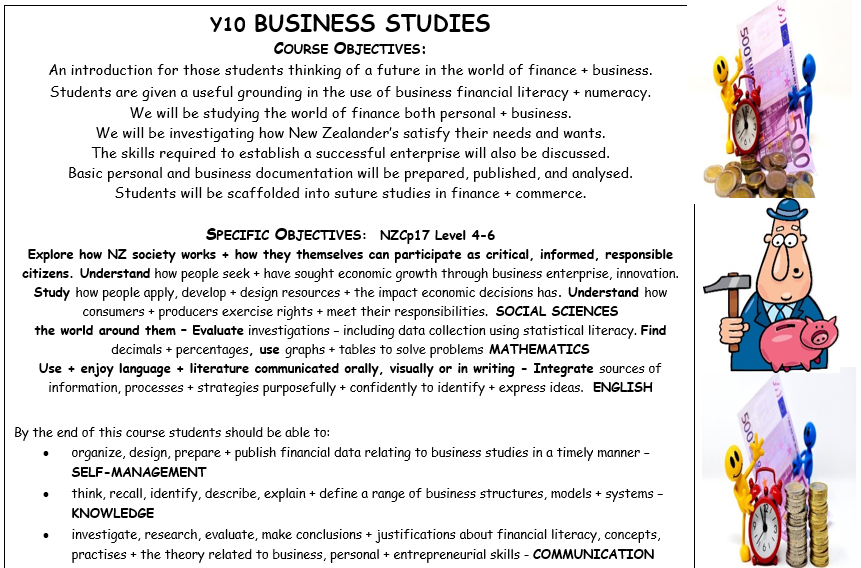
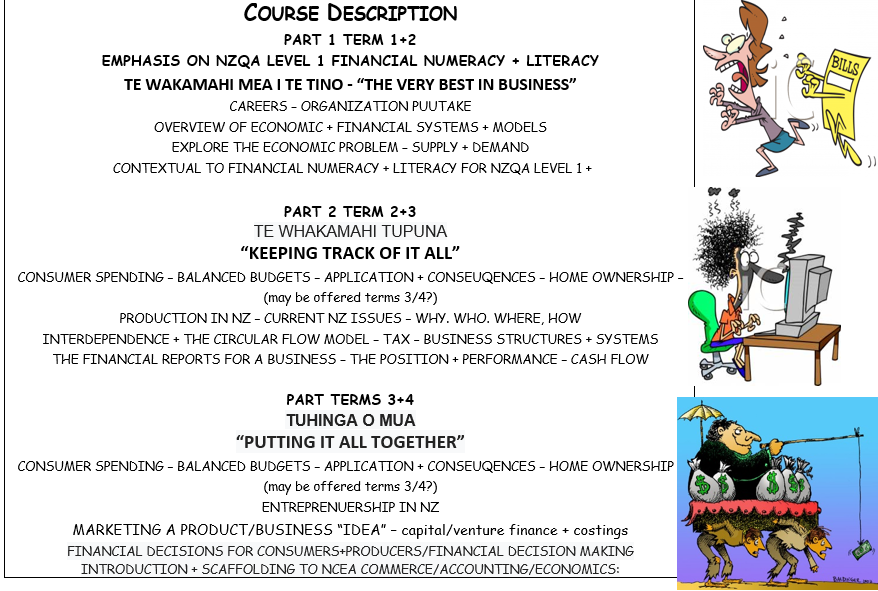
Year 10 Business Studies
10BUSAn introduction for those students thinking of a future in the world of finance + business. Students are given a useful grounding in financial theory + numeracy.
Year 10 Design and Visual Communication
10DVCIn Design and Visual Communication during Year 10 you will learn the fundamentals of freehand sketching and instrumental drawing techniques in order to develop a range of creative design briefs, such as product and spatial design. Technical terminology is reinforced with techniques that will assist in the visual communication of your ideas and cultivate problem-solving skills.
Year 10 Digital Technology
10DTE- Programming & Physical Computing: You will be introduced to text-based programming with Python to create functional programs that solve problems. You will also program microcontrollers (like a Micro:bit) to create simple interactive devices.
- Web Development: You will learn to design and develop websites using the core languages of the web: HTML and CSS.
- Creative Media & 3D Modelling: You will advance your creative skills by producing short videos or 3D animations using software like Blender.
Year 10 Drama
10DRAYear 10 Drama teaches students advanced skills in performance practices with emphasis on choreography, ensemble awareness and genre performance studies. You will be learning not only how to control tone, convey character, and movement, but also how to devise your own scripts, developing unique voices for Aotearoa.
Year 10 English
10ENGYear 10 English is focused on consolidating the foundational work honed in Year 9, to prepare them for NCEA Level One the following year. As a taste tester, we offer four NCEA Level One English credits at the end of Year 10 to not only ready them for their Senior years, but build their confidence ahead of beginning Year 11.
We expect students to be able to name multiple writing techniques, identify them in their own and others' work, and discuss grammar confidently. At this stage, it is expected that students can discuss multiple reasons behind writers' and directors' choices. Students are expected to be sophisticated in their communication with others and in presentations.
Alongside honing English skills, we also nurture the use of digital tools. Students are expected to become fluent with the use of Google apps while showing their understanding of texts and creating meaning for reader engagement.
Alongside students completing assessments in English, their reading comprehension and vocabulary will be measured using ASTTLE and PAT testing, which are standardised tests that support feedback on students' ability to work to expected levels.
Year 10 Fabric Technology
10FABThe course is designed to further develop and build on the skills you learnt in Year 9 or earlier. There will be various contexts throughout the year to expose you to various fabrics and their performance properties. Each project will require research and design to develop your ideas and promote creativity.
At the end of this course students will have completed a 'Sports bag' unit and a 'Relaxing into a beanbag' unit - both with practical assessments, workbook completion and evaluation of the final product. Products made will be taken home.
Students taking this course must wear covered shoes (NO sandals). Hair must be tied back and kept off the face.
Year 10 Food Technology
10FTEStudents will learn to research, design and develop food products following the design process as a food technologist. As this is a 12 month course, it is essential for students to have a strong interest in learning about new ingredients and flavour profiles to create food products. The course focuses on the development of food products through research, analysis of existing products and design work. A high level of self-discipline will be required as kitchen safety will be a priority at all times. Students taking this subject must wear covered shoes during all practical lessons (NO sandals allowed), additionally all long hair must be tied behind the face.
By the end of this course students will have completed the following three food units. Developing a Canteen Lunch Product, Exploring Foods from Multi-cultures and Developing a Unique Sweet Product. Students will also complete a class trip to the Auckland Chelsea Sugar Bay Factory.
Year 10 Health
10HEAHealth at Year 10 will cover some aspects from Year 9 but in more detail. Focus on current and relative issues that teenagers go through or experience will be addressed with solutions to create healthy and positive well-beings and environments will be identified. It is important that you are actively involved in all activities and demonstrate maturity in order to develop your views and consider others.
Year 10 Horticulture
10HORStudents in this course will develop a range of skills at NZQA Level 1 level. These skills will include plant anatomy and reproduction, researching plant propagation, preparing garden beds and planting, seed sowing in containers and outside, proper use of equipment and health and safety.
Throughout this course students will establish and care for a garden plot, prepare and sow outdoor seedbeds, conduct general garden maintenance, grow and pot up plants from stem cuttings and more.
Year 10 Literacy and Numeracy Support
10LANWelcome to 10LAN! Literacy and Numeracy Support class is available to any students who would like some extra help with Literacy and Numeracy. In Year 10 students will sit the NCEA Literacy and Numeracy Exams, this class will help to prepare you for these. If you have received an email advising you to take this course, please take this advice!
You will be offered additional support in preparation for the NCEA Literacy and Numeracy assessments in a smaller and relaxed environment. On top of this, the class is given opportunities to gain NCEA Level One credits through unit standards throughout the year. These standards are beneficial to help students become successful contributing members of society.
Year 10 Mathematics
10MATThe Year 10 Mathematics course is aligned with Phase 4 of the New Zealand Curriculum and builds on the following strands:
- Number
- Algebra
- Geometry
- Measurement
- Statistics
- Probability
The course is designed for students to consolidate and master the skills and knowledge in Phase 4. We also recognise that some students may already be working within Phase 5, and the programme provides opportunities for extension to support their continued progress.
Throughout the course, students will develop the ability to think creatively, critically, strategically, and logically. They will learn to organise and structure their thinking, carry out procedures with accuracy and flexibility, process and communicate information clearly, and engage confidently with mathematical challenges.
Mathematics is a core subject studied by all students for a minimum of three years. At senior level, our department offers a wide range of course options, enabling students to pursue national qualifications aligned with their strengths and aspirations. Our goal is to ensure all students are equipped with the mathematical understanding and qualifications they need for future study, training, or employment.
Year 10 Media Studies
10MEDMedia is everywhere — in the shows we watch, the ads we scroll past, and the films we love. In Year 10 Media Studies, you'll learn to see it all through a new lens.
You’ll start by looking at how people and places are represented in New Zealand advertising — then create your own Public Service Announcement to send a message that matters. From there, you’ll dive into the world of science fiction films, exploring what makes the genre tick, from aliens and dystopias to special effects and storytelling.
Later in the year, you’ll become a media industry insider, researching how television is made and how it reaches audiences. Then it’s your turn to get creative — planning and producing your very own film trailer, where you bring everything you’ve learned into one exciting project.
This course is packed with chances to analyse, create, and collaborate. Whether you’re into filmmaking, storytelling, design, or just love thinking about the media world we live in — Year 10 Media is where it all comes together.
Year 10 Music
10MUSIn Year 10 music you will focus on the three aspects of music: performance, composition and musicology. In Term One you will develop your performance skills further in group and solo performance projects. In Term Two you will focus on composition (songwriting or beat-making) to create your own music. In Term Three you will choose from performance or composition and also learn about the Music Industry and Sound Technology. In Term Four you will participate in a class concert putting all these skills together. Throughout the course you will be learning to listen to and analyse how music is put together.
Year 10 Physical Education
10PEDYou will participate in a wide variety of health enhancing sporting and recreational activities. A focus will be on developing interpersonal skills, fairplay, teamwork and leadership. You will be expected to Actively Participate in classes.
You will be involved in learning and performing skills related to the following areas: Athletics, Badminton, Uni-hoc, Adventure Based Learning, Modified Games, Skill Learning, Traditional Game, Aquatics and have an opportunity to enhance your leadership skills when you teach your class.
Year 10 Science
10SCI‘We need a scientifically literate nation to meet current and emerging social, economic and environmental opportunities and challenges. The more we know about science, the more likely we are to be able to respond to the critical issues facing us locally and globally’ ( Scienceonline, 2020).
In order to achieve this, your journey as a scientist in class continues to build on the knowledge and skills acquired in Year 9. Your topics for the year builds on, and introduces a new specific scientific technique and way of thinking. These skills and practices are used by scientists everyday while they investigate the natural and physical world. You will learn to apply these techniques in a number of different contexts, which will prepare you for NCEA Level 1 and beyond.
All topics will have summative written assessments and common practical assessments as well.
Year 10 Social Studies
10SOSThis course is the study of people and their activities both in different times and different places. You will collect, process and present information.
You will engage critically with social issues. You will gain knowledge, skills and experience that will help you to understand, participate in and contribute to the communities in which you live and work in. Students will be required to purchase three learning workbooks during the course of the year for homework tasks.
All topics have homework tasks, student workbooks and Formative and Summative assessments.
Year 10 Spanish
10SPAThis course is suitable for students wanting to advance their language studies for travel and career purposes.
You will gain new ways of thinking about, questioning and interpreting the world and your place in it. You will extend your knowledge, skills and attitudes that will equip you for living in a world of diverse people, languages and cultures. You will gain access to a broader field of knowledge and so extend your creativity and critical thinking.
Beside being able to interpret higher meaning in own language and in Spanish, numeracy skills are also enhanced as students learn to manipulate Spanish in mathematical concepts.
By the end of this course students will have completed a 'Travelling around Spain' topic and a 'Teenagers' topic with written assessments, interaction (group work) and a spoken presentation.
Year 10 Te Reo Māori
10TERHe taaaonga te reo, he taonga ngaa tikanga, he taaonga anoo ngaa tamariki. Our language and our culture are treasures as are our children.
Te Reo Māori is one of three official languages of Aotearoa. It emphasises the inseparable links between language, culture, and identity. As students learn Te Reo Māori, they also deepen their knowledge and understanding of Tikanga Māori (Cultural Practices).
To learn Te Reo Māori, students must have an open mind and a positive attitude towards the Māori People and their culture. They will need to learn to use all the ara reo (language modes): Whakarongo (Listening), Paanui (Reading), Koorero (Speaking) and Tuhituhi (Writing).
By learning Te Reo and becoming increasingly familiar with tikanga, Māori students strengthen their identities, while non-Māori journey towards shared cultural understandings. All who learn Te Reo Māori help to secure its future as a living, dynamic and rich language. As they learn, they come to appreciate that diversity is a key to unity. It will also broaden their entrepreneurial and employment options to include work in an ever-increasing range of social, legal, educational, business, and professional settings.
At the end of this course students will have completed a 'Taku Whaanau' unit (Whakapapa/Pepeha), a 'Manu Koorero' unit (Matariki), a 'Kingitanga' unit and a 'Te Marae/Ngaa Atua/Ngaa Pakiwaitara' unit.
Year 10 Visual Art
10ARTThe Year 10 Visual Art course focuses on developing and extending students' drawing and mixed media skills using a range of techniques and processes. Students will investigate Oceania Art from the past and present, developing their knowledge and identifying the contexts in which artworks were made, viewed and valued. Term 3 will extend students' understanding of pattern making and mixed media through developing a larger Mandala painting. Term 4 will further develop students' knowledge of the elements and principles of Art. Practical work will be generated from artist models who use collage and printmaking processes and techniques.
Students will investigate Traditional forms of Oceania Art: Tapa, Tattoo, Tivaevae and patterns from different cultures. As the year progresses we will extend into Mandala Art, still life and portraiture. Students will develop an understanding of contemporary artists' work from the past and present and identify the contexts in which they were made, viewed and valued. Students will experiment with a range of media to develop their Practical Skills to further the development of their own ideas to produce finished artworks.
The course provides a foundation for NCEA Level 1 Visual Art.
At the end of this course students will have completed a 'Multicultural pattern and Contemporary Art' unit, a 'Mandala Art' unit and a 'Mixed Media and Collage' unit. These units will be asses by research, artist analysis, developing ideas and practical work.

Year 10 Wood Technology
10WTEStudents learn to design and manufacture products that meet the needs of clients and stakeholders. Focus is given to developing each student's skill in the use of machines, tools and processes to manipulate a range of materials including wood, metals and plastics. Development of key competencies including time management, planning, drawing and communication of design ideas
In this course students learn to design and manufacture products that meet the needs of clients and stakeholders. Focus is given to developing each student's skill in the use of machines, tools and processeses.
The skill focus is mainly on:
- Using hand tools, equipment and machinery
- Marking out and measuring
- Accuracy and precision
- Preparing cutting lists
This course establishes workshop practices such as:
- Collaboration
- Following strict safety codes of practice
- Independence
There is a major practical component to this course which is construction of Breakfast Tray.
Subjects for Year 10 Students
L1 Agricultural and Horticultural Science
11AHS11HRT1 is a hands-on subject where students develop practical skills both in the classroom and in the Nursery. This course is assessed through Achievement Standards and includes some written project work. Students explore how various factors—such as light, water, air, and soil—affect plant growth, with a focus on the role of photosynthesis. The course also covers soil properties and effective soil management techniques in depth. This course will enable students to progress into 12HRT.
L1 Art Painting
11ARTVisual arts is a subject that allows ākonga (students) to express and develop their creativity, while developing their knowledge and skills. Ākonga create their own artworks while learning about the work of other artists and the cultural and social contexts that these artworks reflect. Ākonga can study Visual Arts to gain qualifications or to explore their interest in art.
This is the first of the NCEA Art courses. It enables ākonga to develop ideas and creative approaches to making artworks in a range of fields. Ākonga’ work is informed by their research of New Zealand and International artists from Māori, Polynesian and European traditions. Ākonga can work towards an individual standard or multiple standards including developing a body of work for the external folio standard.
This year's theme explores portraiture and cultural identity, in a specific setting or space. Students can explore self-portraiture, as well as portraits of family (whaanau) members, posed to include objects of personal significance, patterns/symbols, flora and birds. Cultural identity is part of a person’s identity, relating to nationality, ethnicity, language, values, religion, social class, generation, locality, or any kind of social group that has its own distinct culture.

L1 Building Construction
11BCNBuilding Construction is most relevant to those considering undertaking trade training. In this course students will make a range of prescribed projects, supported by relevant theory. Assessment will address the standards listed below, but others can be added if these better meet the learning outcomes of the students.
L1 Commerce
11COM
Commerce is the use and exploration of accounting, economic, and business concepts + models to make sense of our society and solve economic problems.
In this subject, the learner – ākonga - will build the knowledge, skills, and values they need to navigate, and participate in, the economic world. They will learn how make sustainable decisions, and analyse the flow-on effects + impacts.
Students will engage critical thinking analysis, explore different perspectives and develop their understanding of the role of Commerce in society.
The coverage of this course includes: Consumer + producer financial + non-financial decision-making and problem solving, interdependence between sectors of the economy, enterprise and innovation, interpretation of economic + financial business information, The context will be local business communities.
Please note that US9681 v8 will only be offered if time permits.
L1 Design and Visual Communication
11DVCThis course enables you to use the knowledge and skills you have built up during Year 10, to solve design briefs. The portfolios will consist of freehand sketching, model making, presentation techniques, instrumental and CAD Drawing (Computer Aided Drawing).
You will be given briefs in spatial and product design respectively, which you will need to present a portfolio for. These portfolios will be sent to NZQA for external marking.
L1 Digital Technology
11DTE- Programming (AS 92004): Create a well-structured computer program using Python, applying object-oriented programming principles and algorithms.
- Web Development (US 18734 & US 25659): Create webpages using both templates and by coding a personal website from scratch with HTML and CSS.
- Digital Media (AS 92005): Develop a polished digital media outcome, such as a video with an animated logo.
- Digital Design (AS 92007): Produce a detailed design portfolio for a 3D model or website.
- HCI Theory (AS 92006): Prepare for an external exam by studying usability principles and user interface design.
L1 Drama
11DRAIn this course students will expand their understanding of theatre and what it takes to create and perform in different contexts. Term One will see students learning to use their Drama techniques of voice, body, movement and use of space as characters in short scripts, as well as exploring the Victorian England theatre form of Melodrama.
In Term Two, the students will participate in the rehearsal process for a class production to be performed across several evenings for a live audience.
In Term Three, students will devise a piece of theatre from an environmental issue they think is important in an Aotearoa/New Zealand context.
The external examination will ask students to explore a live performance that they will see during the year.
L1 English
11ENGLevel One English is Compulsory for all Year 11 Students. There are two different English courses: Level 1 English and Level 1 Literacy. The English department will place you in the appropriate course based on teacher feedback and Yr 10 achievements.
Level One English is a blend of internally assessed and externally assessed Achievement Standards and has a pathway through Senior English that progresses to gaining University Entrance Literacy in Level Two and can be take as a University Entrance subject at Level Three.
Level One Literacy is an internals only programme, with the goal of gaining Literacy, through Unit Standards. Students will create a portfolio that demonstrates the skills of reading, writing, speaking and listening. There are some opportunities to complete complementary Achievement Standards around censorship of the media and presenting visual ideas. Students taking this course are finishing their English journey after this year. There is no expectations of taking Level 2 English in the following year.
L1 Fabrics Technology
11FABThis practical-based programme has a sewing focus and is based around Level One NCEA. The course has been designed to allow students to develop knowledge and skills of practical design and sewing. It involves research into current trends to inspire individual design. Students will learn how to design and create several items including a garment.
All products created are taken home.
Requirements: Closed in shoes. Long hair tied back, all hair secured off the face.
L1 Future Foundations
11FFOYear 11 Future Foundations: Foundations of Self
Theme: "Discovering You - The Global Citizen"
Future Foundations empowers students to explore who they are, identify their strengths, and develop key life skills that support both personal growth and future readiness. With a focus on self-awareness, communication, emotional intelligence, and goal-setting, this course helps students build the confidence and competencies needed to thrive as they enter the workforce or further study. Through a range of learning experiences, students will gain insights into building strong teamwork skills, online safety, employment rights, teamwork, and financial literacy.
Key Areas of Learning:
- Whakapapa and identity
- Teamwork and communication
- Emotional wellbeing and stress management
- Online safety and digital literacy
- Workplace behaviours and rights
- Goal-setting and personal finance
Focus: Personal development, understanding strengths, communication, emotional intelligence, and goal-setting.
Goal: Year 11 helps students understand themselves, identify core strengths, and build essential interpersonal skills that set the foundation for their personal and professional lives.
L1 Geography
11GEOThe themes and topics covered in this academic course are:
- Volcanoes in New Zealand and around the World -a comprehensive and an in-depth study of the locations and causes of the major volcanic eruptions in NZ, the Pacific region and around the world.
- Population Studies – a comprehensive study of the population concepts such census, population growth and diversity, population distribution and sustainability and patterns and reasons for migration.
- Natural Processes – a detailed study of Auckland’s Volcanoes (the formation of these volcanoes, eruption timeline) and the natural processes such as the denudation processes (that modified these volcanic landforms)
Field Trips (Mandatory):
- Pokeno Residential Development and Lakes Residential Subdivision in Te Kauwhata (Term 2)
- Auckland Museum – Volcanoes Gallery, walk to Mt Eden crater, Mangere Volcanic Zone and the Bombay Hills.
L1 Health Education
11HEAThe Level 1 Health course requires ākonga to develop an understanding of the concepts of Health and learn how to utilise those concepts when they explore health-related situations. Students will discover and explore a range of wellbeing models from a range of cultures such as Te Whare Tapa Wha, Fonofale and Te Wheke. Ākonga will develop skills and knowledge on strategies and decision making to enhance wellbeing to positively benefit themselves and others. This is done through a range of topics within the Mental Health, Sexuality and Nutrition spectrum.
L1 History
11HISThe study of History at this level focuses on investigation, communication and interpretation of historical information, data and resources. These skills are transferable across a range of occupations. Students will study a variety of topics set in New Zealand and overseas in the 20th century. Some topics taught at this level include New Zealander's experience of World War One and Black Civil Rights in the USA.
L1 Horticulture
11HORIn this course students will develop horticultural science skills using a range of Unit Standards and Achievement Standards, with a strong emphasis on Nursery Production. Additionally, students will be able to learn the principles and maintenance of petrol and diesel two and four stroke engines used in a primary industry operation. For those who are keen to pursue a career in the industry, work experience opportunities are available.
L1 Hospitality
11HOSThis practical-based programme has a cooking focus and is a pathway to chef training. The course has been designed to allow students to develop knowledge and skills of practical cookery. The course framework is derived from Pre-Tertiary Unit Standards and certificates of achievement provided by the Hospitality Industry Training Organisation, Service IQ. Students will learn how to prepare and present a range of basic food items using various cooking techniques and methods to industry standard including knowledge in safe work practices, hygiene and food safety.
L1 Mathematics
11MATLevel 1 Mathematics is compulsory for all Year 11 students. There are two Mathematics course options offered: 11MAT and 11NUM. While students may express a preference, final placement is determined by the Mathematics Department based on teacher feedback and achievement in Year 10.
11MAT – A general Mathematics course offering up to 15 credits through a combination of internal and external achievement standards: 91945, 91944, and 91947.
L1 Music
11MUSStudents will study all three aspects of music - performance, composition and musicology. All students will complete three standards - one musicology standard analysing different kinds of music and two standards from solo performance, group performance and composition depending on their strengths.
There is an optional music theory external standard if students would like endorsement.
All students will receive instrumental/vocal lessons at school if they do not already have private lessons.
L1 Numeracy (NUM)
11NUMLevel 1 Mathematics is compulsory for all Year 11 students. There are two courses offered at this level: 11MAT and 11NUM. While students may indicate a preference, final placement is determined by the Mathematics Department, based on teacher recommendations and Year 10 performance.
11NUM (Numeracy) is designed for students who find Mathematics particularly challenging and are unlikely to continue studying Mathematics beyond Level 1. It focuses on practical numeracy skills and supports students in achieving the Numeracy corequisite.
L1 Outdoor Education
11OUTThe Level 1 Outdoor Education course offers ākonga the opportunity to engage and learn through a number of outdoor activities such as camping, kayaking, tramping and mountain biking. Ākonga will develop map reading and navigation skills as well as the ability to read weather forecasts. This course is made up of a combination of Achievement and Unit standards including a number of theory components.
L1 Physical Education
11PEDThe Level 1 Physical Education course offers ākonga the opportunity to learn a range of topics through participating in physical activities. Students need to realise that the course is designed to have physical activities and written assignments to understand the theory behind the activities that they do. Ākonga learn about movement throughout Aotearoa, kotahitanga, movement for enjoyment and movement to benefit wellbeing. These are cover through a range of practical components which are decided with students to maximise enjoyment and participation.
L1 Product Design
11PRDProduct Design combines the areas of creative design, science and engineering. Designer's plan and develop outcomes for the use in homes, businesses and industries. The technology process includes design and construction of an outcome which addresses a given brief. Students will be encouraged to produce an outcome through trialing, testing and evaluation. The outcome will reflect the nature of the issue being resolved, ensuring that it satisfies the requirements of the brief. The course will provide a pathway for students to Level 2 Product Design. The external standard in this course is optional.
L1 Science
11SCIThis course is based on the Science in the New Zealand Curriculum (2007) at Level 6. Students will: demonstrate comprehensive understanding of biological ideas relating to genetic variation, carry out a comprehensive practical chemistry investigation with direction, demonstrate comprehensive understanding of aspects of mechanics, demonstrate understanding of aspects of acids and bases and report comprehensively on a biological issue.
L1 Spanish
11SPAStudents will deepen their understanding of Spanish and Spanish speaking cultures in a meaningful and authentic context. They will learn new ways of thinking about, questioning and interpreting the world and their place in it. They will learn skills that will equip them for travelling and living in other cultures. Learning a second language can also help students' resumes to stand out in the job market.
Spanish is a significant language for New Zealand. The economic and cultural ties between New Zealand and Spanish spoken countries are increasing every year. Hence, being able to offer such an amazing language skill can only enhance a students resume and self confidence.
L1 Te Ao Haka
11TAHĀkonga who engage with Te Ao Haka recognise that pride in their culture also comes with a responsibility to create a positive space for others to continue expressing themselves in developing their craft. Therefore, ākonga are able to understand their contributions to the art form. Te Ao Haka provides many students access to Te Reo Māori that they have not previously had and encourages and facilitates learning about reo-ā-waha as well as reo ā-tinana, allowing students to expand their skills as communicators.
Please note if you select this course there is an expectation that you commit to the schools Kapahaka group.
L1 Te Reo Māori
11TERTe tohu tauāki - Proficiency target statement - By the end of Level 6 of Te Aho Arataki Marau mō te Ako i Te Reo Māori, students will have the opportunity to converse with te reo Māori speakers in familiar social situations and cope with some less familiar ones. They will be able to use basic Māori language patterns spontaneously and be able to show a willingness to experiment with new language and to read independently and write short passages. Kaupapa Maori will used as learning contexts which will include kapa haka, raranga and other kaupapa such as Poukai, Ngaa Atua and Kiingitanga.
Subjects for Year 11 Students
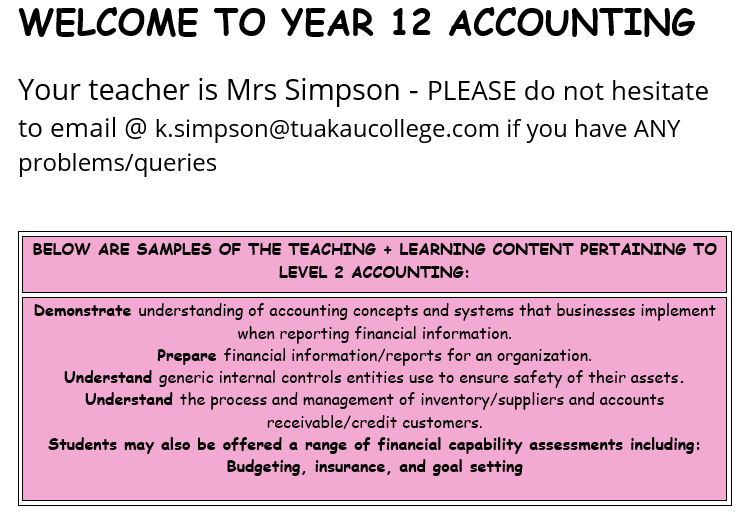
L2 Accounting
12ACCThis course includes the study of the financial understandings related to ensuring the use of appropriate communication tools and skills to communicate financial information. The context may be individuals, whaanau and local or regional small or medium entities, including community organisations that operate accounting sub-systems, while acting with integrity.

L2 Art Painting
12ARTThis course enables ākonga (students) to develop ideas and creative approaches to make artworks in Painting. Ākonga create their own artworks while learning about the work of New Zealand and International artists and the cultural and social contexts that these artworks reflect. Ākonga can work towards an individual standard or multiple standards including developing a body of work for the external folio standard.
The theme for 2023, ‘Sense of Place,’ allows students to explore landscape, architecture, nature and still-life and their attachment to these subjects. Students can collect objects that have value to their culture, such as person-made or natural (flora and fauna) items. They will collect, take photos, make arrangements or assemblages, drawing from inside and outside to develop a theme.
The first Internal aims to encourage students to embrace the use of subject matter to explore a range of media as well as exploring conventions assorted with different approaches. The second Internal will develop and extend students ideas about containment and the relationship of objects in different spaces.

L2 Biology
12BIOIn this course students will:
> Carry out a practical investigation into an ecological pattern on the rocky shore of New Zealand
> Explore the ecological distribution patters and explain possible causes for these patterns
> Explore the biological structure of a cell at the microscopic level
> Explore the diverse ways in which animals carry out the life process
> Explore genetic variation and how this leads to change
L2 Building Construction
12BCNBuilding Construction is most relevant to those considering undertaking trade training. In this course students will make a range of prescribed projects, supported by relevant theory. Assessment will address the standards listed below, but others can be added if these better meet the learning outcomes of the students.
L2 Chemistry
12CHEThis course is based on Science in the New Zealand curriculum at Level 7 - Material World. Students will:
> Investigate and measure the chemical and physical properties of a range of groups of substances
> Demonstrate an understanding of oxidation and reduction reactions used in everyday life
> Relate properties of matter to structure and bonding
> Investigate the properties and trends shown in the naming and reactions of organic compounds
L2 Design and Visual Communication
12DVCStudents will be set two design briefs, one based on spatial/architectural design and the other on product design. They will produce portfolios for both that will involve researching the design brief, exploring alternatives, and refining a chosen design through to a final solution according to the brief’s specifications.
The skills students are going to develop are freehand sketching, ideation, competency using the design process, and Computer Aided Design. Level 2 Design and Visual Communication requires written analysis, evaluation and justification throughout the portfolio.
L2 Digital Technology
12DTEYear 12 Digital Technology (NCEA Level 2)
This year is dominated by the "Your Community Online!" project—a major, two-term undertaking where you architect and implement an advanced digital solution for a real community. You will choose a specialisation, master sophisticated design and development techniques, and explore computer science concepts like Artificial Intelligence and Encryption.Core Skills & Key Assessments:- The "Big Project": You will design (AS91891), build, and document a large-scale website that is either Media-focused (AS91893) or Process/Data-focused (AS91897). You will also create a comprehensive portfolio summarising your journey (AS91899).
- CS Concepts (AS91898): You will prepare for an external exam on the concepts, applications, and ethical implications of Artificial Intelligence and Encryption.
L2 Drama
12DRAStudents build on their current Drama skills and apply them at a more advanced level:
- Students learn to apply Drama Techniques in a scripted environment with more complex characters.
- Devised Drama deals with more dramatic topics and ask students to examine life experiences beyond their own.
- Students participate in a class production in more advanced roles that require them to work in a more focused and meaningful way.
- Students view live productions and analyze them with a greater understanding of what it means to be a performer having experienced it themselves.
L2 Economics
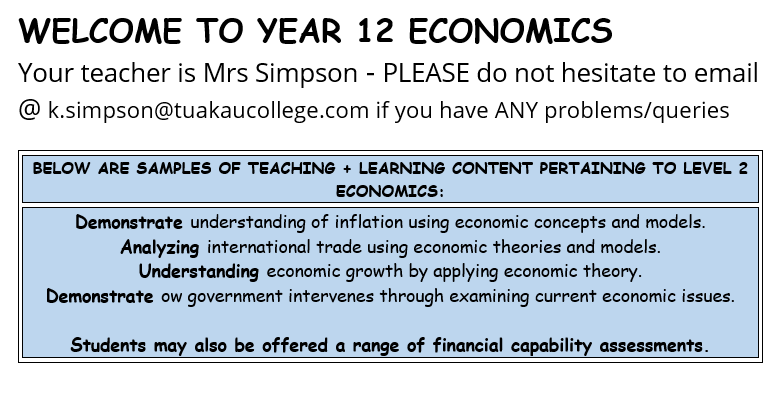
12ECOThis course is useful for anyone considering a career in Business, Marketing, Law or Management. Students will explore the issues of inflation, growth, unemployment and (if time permits) trade. Students will use economic models and concepts to show understanding of these issues, their causes, impacts and possible effects on groups in New Zealand's economy.

L2 English
12ENGThis is an internal and externally assessed Level 2 Achievement Standards English course, which provides opportunities for endorsement. There are options for modular study.
L2 Fabrics Technology
12FABThis practical-based programme has a sewing focus. The course has been designed to allow students to develop knowledge and skills of practical design and sewing. It involves research into current trends to inspire individual design. Students will learn how to design and create a garment to meet the 'Fashion Forward' brief.
All products created are taken home.
Requirements: Closed in shoes. Long hair tied back, all hair secured off the face.
L2 Future Foundations
12FFOYear 12 Future Foundations: Financial Foundations
Theme: "Empowering Independence"
Future Foundations at Year 12 equips students with the knowledge and tools to take control of their personal and financial wellbeing. With a strong focus on financial literacy, legal awareness, and goal-oriented planning, students will learn how to make informed decisions that support their independence and long-term success. The course also explores the importance of cultural identity, online safety, and accessing local support services—empowering students to navigate adulthood with confidence and resilience. Please note: the assessments completed are Unit Standards that are internally assessed.
Key Areas of Learning:
- Whakapapa and cultural identity
- Budgeting, saving, and financial goal-setting
- Tenancy rights and responsibilities
- Traffic law and safe driving awareness
- Online safety and digital literacy
- Support networks and community services
- Effective teamwork and communication
Focus: Financial literacy, decision-making, personal support strategies and linking personal goals with financial planning.
Goal: In Year 12, students engage in skills tied to their personal development, including budgeting, saving, and making informed financial decisions that support their goals.
L2 Gateway
12GTYGateway is a hands-on, work-focused programme designed to give students real-world experience in a vocational area of their interest. Students will explore career pathways, gain valuable industry insights, and develop employability skills through structured work placements. Ideal for students considering a trade or vocational career, Gateway offers the opportunity to connect classroom learning with practical workplace experience in fields such as Building and Construction, Hairdressing, Electrical, Mechanical, Engineering, Early Childhood Education, Hospitality, and many more.
Key Features:
- Includes a minimum of 20–40 hours of work experience
- Students must identify an area of vocational interest
- Opportunity to gain relevant industry-based unit standards
- Develops workplace readiness, communication, and teamwork skills
- Supports career planning and transitions beyond school
Ideal for: Motivated, reliable students who are ready to explore real-world pathways and take initiative in a professional setting, students who ready to move into vocational pathways.
Assessment: Internal | A tailored mix of industry-relevant unit standards depending on the student’s placement.
L2 Geography
12GEOThe students will study the following themes and topics in Geography course this year.
- A large natural environment – Taupo Volcanic Zone. The content focuses on the creation and eruption of Taupo volcanoes, changes to these landscapes and vegetation over centuries, stretching from Tongariro region to the By of Plenty.
- Geographic topic at a global scale – a range of issues can be chosen for these study (from the deforestation of Amazon Rainforests, Human trafficking, HIV/AIDS, Pacific Garbage Patch, to the formation of Mountains around the globe). Mountains around the globe topic will focus on an in-depth study of tectonics processes and the socio-economic importance of these mountains to the indigenous people and to the people today.
- Geographic Concepts and skills – study will be required to learn, understand and use a range of geographic skills (graphing, map interpretation, cartoon interpretation, photograph annotations, etc) to analyse data and write basic to in-depth reports.
Field trip (Compulsory):
Tongariro Crossing ( Scheduled for March / April)
L2 Health Education
12HEAThe Level 2 Health Education course offers a holistic view by exploring issues within the community, enhancing the Hauora of local members of society, exploring sexuality and researching and understanding issues surrounding adolescent health.
L2 History
12HISAn in-depth study of historical issues and peoples perceptions of these historical events. Some of the topics taught at Level 2 History include the Vietnam War, conspiracy theories and the assassination of J F Kennedy.
L2 Horticulture
12HORStudents in this course will develop a range of agricultural and horticultural science skills at NZQA Level 2 and 3, including researching a range of techniques to improve plant production, demonstrating knowledge of factors which influence plant growth, recognising materials and conditions associated with horticultural production and maintaining a documented work record of horticultural activities. This course further introduces students to some aspects of nursery production which include but are not limited to: plant identification by its phenotype and binomial nomenclature, plant propogation techniques and a range of growing media.
Some students will also further develop their understanding and skills related to farming activities. This is through an external course offered offsite by Primary ITO.
L2 Hospitality
12HOSThis practical based program will further students knowledge and skills of food production in the Hospitality Industry. The course framework is based on pre-tertiary unit standards provided by the Hospitality Training Organisation, Service IQ. Students will extend their knowledge in safe work practices, hygiene, food safety and knife skills in addition to preparing and presenting a range of food items to industry standards. Students will also complete a level Two barista Unit Standard and be involved whenever possible with the catering for functions within the school.
L2 Mathematics (MAI)
12MAIThis course is designed for students who wish to study a variety of mathematical topics at Level 2, including Statistics, Probability, Trigonometry, and Geometry. The programme allows for some flexibility, and minor adjustments may be made in consultation with the teacher to suit individual learning needs.
L2 Mathematics (MAT)
12MATThis course is designed for students intending to continue with Level 3 Mathematics, such as Calculus or Statistics. It focuses on developing strong algebraic and problem-solving skills, providing a solid foundation for further study in mathematically demanding subjects.
L2 Media Studies
12MEDStudents will be introduced to the world of media, how it works and how we can produce it for ourselves. We’ll examine superhero films and the impact that genre is having. We’ll look at representations of different groups including teenagers – you! – to see how adults understand who you are. We’ll learn how to write articles for the online environment. And you’ll get a chance to make a film yourselves!
L2 Music
12MUSStudents will choose (with their teacher) a programme of three standards tailored to their strengths from the three aspects of music - performance (solo and/or group performance), composition (creating your own music) and musicology (analysing music and/or investigating an aspect of the NZ music industry).
All students will receive instrumental/vocal lessons at school if they do not already have private lessons.
L2 Outdoor Education
12OUTThis course offers students the opportunity to participate in a variety of outdoor experiences - learning in, through and about the great outdoors. A mixture of unit and achievement standards are offered. Through outdoor experiences students will learn tramping and navigation skills, leadership skills, team building skills rock climbing skills, abseiling skills, weather interpretation skills and risk management skills.
Students will play an essential part in organising and implementing some of these outdoor experiences and will need to demonstrate responsibility and leadership in this environment. There are written components in this course and students will require a commitment to completing the written tasks to achieve the credits offered.
Camps and day trips are compulsory. Students will also have the opportunity to participate in the optional annual ski camp (additional cost).
L2 Physical Education
12PEDThe Level 2 Physical Education course is an academic course and offers students the opportunity to learn the following topics; principles and methods of training, theories of skill learning, participating in the Tough Guy Tough Gal challenge. Ākonga are expected to behave in a socially responsible manner throughout the year for the on-going assessment and explain the significance of a sporting event to themselves, others and society. They also have the opportunity to attend the optional annual snow trip. Ākonga participate in a range of practical components throughout the year and these a determined on a class-by-class basis but in the past have included contexts such as; basketball, turbo touch, netball, tennis, fitness and a range of modified games.
L2 Physics
12PHYStudents will be given an insight into the physical world. Physics will provide explanations for a wide range of physical phenomenon including light, sound, heat, electricity, magnetism, waves, forces and motion. These are united by the concept of energy, which is transformed from one form into another without loss.
Physics lies at the heart of the natural sciences; it explains how the world works and it is useful and exciting.
L2 Product Design
12PRDProduct Design combines the areas of creative design, science and engineering. Designers plan and develop outcomes for the use in homes, businesses and industries. The technology process includes design and construction of an outcome which addresses a given brief.
Students will be encouraged to produce an outcome through trialing, testing and evaluation. The outcome will reflect the nature of the issue being resolved ensuring that it satisfies the requirements of the brief.
This course will provide a pathway for students to Level 3 Product Design. The external standard in this course is optional.
L2 Spanish
12SPAIn Year 12, students begin an advanced course of study with particular focus on reading and writing skills. Students study topics that may include family life and their future, travel and tourism, the media and Hispanic history and cultures.
Learning a second language can help students resumes stand out in a competitive job market.
Students will be internally assessed on both speaking skills and writing skills as well as externally assessed on listening, reading and writing skills.
L2 Sports Leadership
12PSLThe Level 2 Sports Leadership is course which combines a range of Achievement and Unit Standards. Ākonga typically participate in a range of physical activities such as Adventure Based Learning, Netball, Turbo Touch and other modified team games. Ākonga plan, facilitate and evaluate a range of events and learning about common injuries and ways to minimise the impact of these. Ākonga will also explain the factors which influence their own, and others participation in physical activity. You must be keen on getting involved in practical activities and working with younger students.
L2 Te Ao Haka
12TAHĀkonga who engage with Te Ao Haka recognise that pride in their culture also comes with a responsibility to create a positive space for others to continue expressing themselves in developing their craft. Therefore, ākonga are able to understand their contributions to the art form. Te Ao Haka provides many students access to Te Reo Māori that they have not previously had and encourages and facilitates learning about reo-ā-waha as well as reo ā-tinana, allowing students to expand their skills as communicators.
Please note if you select this course there is an expectation that you commit to the schools Kapahaka group.
L2 Te Reo Māori
12TERTe tohu tauāki - Proficiency target statement - By the end of Level 7 of Te Aho Arataki Marau mō te Ako i Te Reo Māori, students can take part in general conversation with speakers of te reo Maori, understand most of what is said and contribute relevant comments. They can explain and discuss many of their own ideas and opinions and may use te reo Maori creatively.
Kaupapa Maori will used as learning contexts which will include kapa haka, raranga and other kaupapa such as Poukai, Ngaa Atua and Kiingitanga.
L2 Tourism
12TOUThis is a full year course which forms an integral part of the Vocational Pathways programme. It has core compulsory units to enable the student to achieve National Certificate in tourism and Travel at Level 2.
Possible additional Unit standards offered are: US24724, US24726 and US24727
Subjects for Year 12 Students
L2 Drama
12DRAStudents build on their current Drama skills and apply them at a more advanced level:
- Students learn to apply Drama Techniques in a scripted environment with more complex characters.
- Devised Drama deals with more dramatic topics and ask students to examine life experiences beyond their own.
- Students participate in a class production in more advanced roles that require them to work in a more focused and meaningful way.
- Students view live productions and analyze them with a greater understanding of what it means to be a performer having experienced it themselves.
L2 English
12ENGThis is an internal and externally assessed Level 2 Achievement Standards English course, which provides opportunities for endorsement. There are options for modular study.
L3 Accounting
13ACCThis course is an introduction to higher studies in Accounting, Management, Law an Finance. It covers the financial accounts of partnership and companies.
The course deals with preparing management information, job costing and accounting systems, controlling inventories, purchases and sales.

L3 Art Painting
13ARTIn Level 3 Painting, ākonga study, develop and systematically produce a body of work. They learn to critically engage, evaluate and investigate Painting procedures and practices. Researching the work of both traditional and contemporary artists informs the development of their own ideas. Ākonga can produce a body of work in Painting by completing the two internals culminating in the portfolio external standard.
Level 3 Painting is a course for students who wish to work on an individually chosen proposal or theme.

L3 Biology
13BIOIn this course students will:
> Demonstrate an understanding of how an animal maintains a stable internal environment
> Demonstrate understanding of human manipulations of genetic transfer and its biological implications
> Integrate biological knowledge to develop an informed response to a socio-scientific issue
> Demonstrate understanding of responses of plants and animals to their external environment
> Demonstrate understanding of trends in human evolution
L3 Calculus
13CALThis course demands advanced Algebra skills and emphasizes Calculus, Trigonometry, and Complex Numbers. It is designed for students planning University or Tertiary study in fields such as Mathematics, Engineering, Architecture, Sciences, Medicine, Dentistry, Optometry, and related disciplines. AS91579 will be taught if time permits.
L3 Chemistry
13CHEIn this course students will have the opportunity to:
> Demonstrate understanding of Oxidation/Reduction processes
> Demonstrate understanding of chemical processes in the world around us
> Demonstrate understanding of spectroscopic data in chemistry
> Demonstrate understanding of thermochemical principles and the properties of particles and substances
> Demonstrate understanding of the properties of organic compounds
L3 Design and Visual Communication
13DVCStudents will be two design brief, one based on spatial/architectural design and the other on product design. They will produce portfolios for both that will involve researching the design brief, exploring alternatives, and refining a chosen design through to a final solution according to the specifications of the brief.
One of the most exciting aspects of this course is that you will be given the opportunity to negotiate your own brief, adapting the situation and specifications to suit your own interests. The focus is on resolving the design brief so that it is ready for production and enter the market.
The skills students are going to develop are freehand sketching, ideation, competency using the design process, and Computer Aided Design. Level 3 Design and Visual Communication requires thorough written analysis, evaluation and justification throughout each portfolio.
L3 Digital Technology
13DTE- The "Digital Solutions" Project: Your major work will be developing a "complex digital outcome" for NCEA Level 3. You will choose your focus and be assessed on it through standards like AS91902 (Complex Computer Program) or AS91901 (Complex Digital Media Outcome).
- Reflective Analysis (AS91907): You will produce a portfolio critically evaluating your design and development process, justifying your decisions, and linking them to Maatauranga Maaori principles.
- Emerging Technology (AS91906): You will prepare for an external exam where you critically analyse the societal and ethical implications of a cutting-edge technology like Generative AI, Quantum Computing, or Blockchain.
L3 Drama
13DRALevel 3 Drama leads on from the skills taught in Level 2 Drama. The focus becomes on interpretation of scripts through performance. Students will publicly perform plays in front of an audience, and see a live play which they then discuss in a written examination.
L3 Economics
13ECOThis course is useful for anyone considering a career in Business, Banking, Marketing, Law or Management. Students will use economic models and concepts to show understanding micro-economics, the efficiency of market equilibrium and the macro-economic influences on the New Zealand economy.
If time permits they will be offered an optional standard relating to market structures.

L3 English
13ENGIn the Level 3 English course students will build on the skills of reading, writing and oral communication.
L3 Fabrics Technology
13FABThis practical-based programme has a sewing focus. The course has been designed to allow students to develop knowledge and skills of practical design and sewing. It involves research into current trends to inspire individual design. Students will learn how to design and create a garment to meet the 'Fashion Forward' brief.
All products created are taken home.
Requirements: Closed in shoes. Long hair tied back, all hair secured off the face.
L3 Future Foundations
13FFOYear 13 Future Foundations: Community and Contribution
Theme: "Impact and Involvement"
Future Foundations in Year 13 brings together students' personal, financial, and interpersonal skills, challenging them to apply their knowledge in meaningful ways that benefit both themselves and their communities. With a focus on leadership, teamwork, and real-world impact, students will engage in community-based projects, build financial resilience, and explore how informed decision-making can influence positive change. This course prepares students to leave school with a sense of purpose, confidence, and a commitment to contributing as responsible citizens. Please note: the assessments completed are Unit Standards that are internally assessed.
Key Areas of Learning:
- Long-term financial planning and risk management
- Credit and debt decision-making
- Evaluating major purchases
- Community engagement and service
- Leadership and facilitation in peer support
- Personal initiative and social responsibility
Focus: Community engagement, teamwork, leadership, and applying personal and financial skills for broader social impact.
Goal: Year 13 integrates students' personal and financial skills into real-world applications, emphasising community engagement, collaboration, and contributing meaningfully to society.
L3 Geography
13GEOThis course further develops the ideas and concepts, and skills in Geography. Geography at this curriculum level is designed to prepare you for University Entrance. As such you are expected to analyse, critically evaluate and carry out rigorous academic investigation of the topics.
The themes and topics taught during the course of the year are:
>Natural Processes (A study of Coastal Processes at Sunset Beach, Port Waikato)
> Tourism Concepts and Development (Rotorua and Dubai)
> Geographic Issues (A Contemporary NZ geographic issue)
> Global Issue (Students are to choose a topic for their research from the list provided by the subject teacher)
L3 Health Education
13HEAIn the Level 3 Health Education course ākonga will be exploring a range of issues for particular groups in New Zealand and International context. They will research current health practices and explore issues in relation to ethics.
L3 History
13HISAn advanced level of study of historical issues, events and viewpoints. Some topics taught include the Cold War and the New Zealand Wars.
L3 Horticulture
13HORStudents in this course will develop a range of Horticultural skills at NCEA Level 3. This includes growing and monitoring a variety of nursery crops, demonstrating knowledge of soil-less media and demonstrating knowledge of the production horticulture industry in New Zealand. Students will also be introduced to basic Landscaping.
For those who are interested in a career in Horticulture, opportunities to do work experience will be available.
L3 Hospitality
13HOSThis practical-based programme is a valuable subject for any student wishing to explore the area of food production or Hospitality as a future career. Those who do not pursue this as a career will have valuable qualifications recognised by employers; qualifications that could be used to gain part-time work to assist tertiary training applications. The course focuses on health and safety for hospitality businesses, food production for customers and events and students will also continue their barista training by completing the level Three barista Unit Standard.
L3 Media Studies
13MEDStudents will be introduced to the world of media, how it works and how we can produce it for ourselves. We’ll examine Dystopian films and how they depict our future. We’ll look at the way we watch movies and TV shows and how our viewing habits will change in the future. We’ll learn how to write scripts for short films and you’ll get a chance to make a film yourselves!
L3 Music
13MUSStudents will choose (with their teacher) a programme of three standards tailored to their strengths from the three aspects of music - performance (solo and/or group performance), composition (creating your own music) and musicology (analysing music and/or researching a music topic).
All students will receive instrumental/vocal lessons at school if they do not already have private lessons.
L3 Outdoor Education
13OUTThis course will give students the opportunity to participate in a variety of outdoor experiences - learning in, through and about the great outdoors. A mixture of unit and achievement standards are offered. Through outdoor experiences students will learn tramping and navigation skills, leadership skills, bush survival skills and risk management skills.
Students will play an essential part in organising and implementing these outdoor experiences and will need to demonstrate responsibility and leadership in this environment.
There are written components in this course and students will require a commitment to complete the written tasks to achieve the credits offered. Camps and day trips are compulsory.
L3 Physical Education
13PEDThe Level 3 Physical Education course is an academic course. Ākonga will learn about the following topics; events, trends and issues in sport, training programmes, biophysical principles and health promotion in physical activity. There is only one practical standard available in Physical Education and ākonga have an option of completing it by playing badminton and/or entering the Tough Guy and Gal event. There is also an optional Outdoor Education experience to complete Achievement Standard 91504 (in 2020 this was a trip to Snow Planet). Cost and details will be confirmed closer to the date.
L3 Physics
13PHYAt this level students will develop the following skills: investigating and explaining applications of physics to a real life context, develop understanding of nuclear physics, electrical systems, mechanical systems and wave systems.
L3 Product Design
13PRDProduct Design combines the areas of creative design, science and engineering. Designers plan and develop outcomes for the use in homes, businesses and industries. The technology process includes design and construction of an outcome which addresses a given brief.
Students will be encouraged to produce an outcome through trialing, testing and evaluation. The outcome will reflect the nature of the issue being resolved, ensuring that it satisfies the requirements of the brief.
The external standard in this course is optional.
L3 Spanish
13SPAStudents are expected to engage with and respond clearly and critically to a variety of extended texts, including authentic texts (those not created or modified specifically for language learners). They are expected to use the language more flexibly and with greater effectiveness at times in sustained interactions and extended texts.
They are expected to explore the views of others, develop and share personal perspectives, and justify, support, or challenge ideas and opinions in different situations and on matters that are beyond their immediate experience.
In all their output, it is expected that students will use their developing knowledge of linguistic and cultural forms to help them create meaning.
L3 Sports Leadership
13PSLThe Level 3 Sports Leadership course is made up of a range of some Achievement Standards and a large proportion of Unit Standards. Ākonga cover a range of topics including the role of a coach, event planning, teaching and coaching a sporting activity as well as officiating. Ākonga participate in a range of activities including Badminton, Tough Guy and Gal and other modified games. Students must be keen to work with younger students and be willing to take on leadership roles.
L3 Statistics
13STAThis course is designed for students intending to pursue University or tertiary study in areas involving Mathematics and Statistics. It focuses on developing strong skills in statistical analysis and probability. Students will be expected to apply high-level numeracy and demonstrate strong comprehension and written communication.
L3 Te Reo Māori
13TERTe tohu tauāki - Proficiency target statement - By the end of Level 8 of Te Aho Arataki Marau mō te Ako i te reo Māori, students can read a variety of authentic te reo Maori materials and write expressively for a range of purposes. Students use a range of strategies to help them learn te reo Maori effectively and they demonstrate a high level of fluency for a learner of te reo Maori as a second language. Kaupapa Maori contexts will be used as the vehicle to promote te reo.
L3 Tourism
13TOUThis is a Level 3 Unit Standards course that contributes towards the National Certificate in Tourism. This leads to further study in the tourism and travel industry or services pathway.