
Collingwood Area School
Tasman
Collingwood Area School Curriculum
54 subjects available for 2026/2027.
Subjects for Year 11 Students
NCEA Level 2 Accounting
2ACCNCEA Level 2 Accounting is available through NetNZ or Te Kura.
Accounting is fundamental for business and for everyday life. Students gain financial literacy and the tools to make real-life financial decisions in a changing and uncertain world. One of the vital skills students learn is how to prepare and communicate financial information to a wide range of people. Further study can lead to a career in accounting in many diverse businesses worldwide. With a business or commerce degree, you can keep your options wide open.
This course builds on the knowledge already gained in Level 1. It has a strong focus on accounting for sole traders and is useful for people interested in running their own business. Students gain further knowledge, skills and experience needed to manage a small business, including the basics of managing inventory and accounts receivable processes. Students process and interpret financial transactions and then, more importantly, report on this financial information. A practical segment using the accounting software MYOB is also included.
NCEA Level 2 Agriculture
2AGRThis course is a practical, production-focused course, involving learners in problem-solving in the Agriculture/Horticulture domain.
It is based on realistic and practical Agricultural and/or Horticultural contexts. Students learn to explore agricultural and horticultural issues and to communicate their ideas to others In agricultural and horticultural science. Learners will find themselves dealing with contexts, issues, and problem-solving drawn from a broad agenda that includes, for example:
- products (e.g. pork, poultry, avocados, honey, timber, milk, wool, apples, grapes)
- environments (e.g. waterways, erosion, landscape, soil, shelter, glasshouses, effluent, pollution; environmental modification and sustainable management practices)
- solutions for particular management issues (e.g. irrigation, cropping, harvesting and milking equipment, data, information and communication digital technologies, shelter and shade construction, and cultivation technologies).
Students that complete this course should be ready to gain employment or continue their studies through NCEA Agriculture Level 3 or at a tertiary provider.
Agriculture Level 2 is offered as an online course by NetNZ and Te Kura.
NCEA Level 2 Biology/Environmental Science
2BIOWhat is Biology?
Biology is at the centre of all life and students explore the living world, its ecology, plant and animal life processes, evolution, and relationships between biology and technology. Through this study, students gain an understanding of themselves, the world, and how organisms survive and live together. They also develop essential scientific knowledge, methods and techniques. From here, ākonga are able to analyse scientific information effectively and discuss the wide range of implications science has on our world, including medical and environmental issues. Biology is a broad interest subject and is important for careers and in a variety of areas, from health to forestry and zoology.
KEY AREAS OF LEARNING OFFERED
This course is a pathway leading to Level 3 and beyond, developing the essential knowledge and skills leading to careers in the biological, scientific, medical, ecological, sport science and environmental fields.
- Biology and broader biological issues in society.
- Broad range of scientific skills and knowledge.
CONTENT
- Aspects of Biology & Environmental Science
- Plant and Animal Biology
- Cells, Genetics and Evolution
- Aspects of Ecology & Sustainability, including Socioscientific issues in the biological sciences
NCEA Level 2 Business Studies
2BUSIn a rapidly changing world, it is important that people are able to make informed and rational decisions about business matters. Business Studies considers how individuals and groups organise, plan and act to produce goods and services to satisfy customers.
The knowledge and skills gained in Business Studies and exposure to enterprise culture can help shape creative, energetic and enterprising people who will contribute to New Zealand’s economic future. In Business Studies, students develop their understanding of business theory and practices in a range of relevant contexts.
In this course, students explore the five key themes (business formation, functions of business, people in business, business management and the business environment) within the context of a medium-to-large business of local, national or international significance. The business should also be connected to their life, for example: a listed company, a retail company with multiple outlets, a school, local government, a large corporation, or a bank.
Students look at internal and external features, critical business problems, and apply business knowledge to provide possible solutions and recommendations to address them. They also have the opportunity to conduct market research and identify motivation practices and apply their knowledge of motivation theory in a business.
NCEA Level 2 Chemistry
2CHEWhat is Chemistry?
People have always been fascinated by the world around them and chemistry is the study of the substances that make up the universe. From the time people worked out how to create fire, chemistry has been at the forefront of exciting discoveries such as the structure of DNA and the use of semiconductors in electronics.
Chemistry looks at the behaviour of substances, the changes they undergo to create new ones and the reactions between them. Yet it is more than what happens at a micro level, it is about what it is that makes us, our materials and everything around us. Students learn the essential skills and knowledge needed to analyse scientific information, conduct experiments and research.
Chemistry is essential for careers in a wide range of areas including medicine, pharmacy, engineering, environmental science, winemaking and food technology.
KEY AREAS OF LEARNING OFFERED
This course is a pathway leading to Level 3 and beyond, developing the essential knowledge and skills leading to careers in the scientific, pharmaceutical, medical, ecological, nutritional, sport science and environmental fields.
- Chemistry and broader chemical issues in society.
- Broad range of scientific skills and knowledge.
CONTENT
Aspects of Chemistry
- Bonding, Structure and Energy changes
- Oxidation/Reduction reactions
- Organic chemistry
- Chemical Reactivity
- Environmental water pollution and ions
- Socioscientific issues in the chemical sciences
NCEA Level 2 Classical Studies
2CLANCEA Level 2 Classical Studies is available through NetNZ.
The Classical world of Greece and Rome and the empires, the stories and the people that emerged have shaped the very world we live in today. Hannibal Barca the curse of Rome, the most amazing man Pericles who even has a Golden Age named after him. Octavian who oversaw the transformation of Rome from Republic to Empire, and the stories of Mark Antony and Cleopatra are just some of the amazing themes of the Classical period we will explore.
Topics covered include:
- Classical Greece from Solon to Pericles. Alexander the Great
- The Roman Empire from the death of Julius Caesar to Augustus becoming Rome’s first Emperor
NCEA Level 2 Criminal Minds
2CRINCEA Level 2 Criminal Minds is available through NetNZ.
A study of crime and the criminal mind. Explore the psychology behind crime. Figure out how to solve crimes using your deduction skills and put these to the test in a murder mystery.
The criminal justice system determines the guilt or otherwise of an accused, and imposes sanctions on a guilty person. But what lies behind the mind of an offender? What factors contribute to offending? In this course, you will investigate different crimes to learn about the key concepts in law. You will use theories from psychology to try to explain the behaviour of the criminal mind to an applied case.
This course mixes subject areas such as Law, Psychology, Science and English. A range of NCEA standards are applicable.
NCEA Level 2 Digital Technology
2DTGMedia
This course further develops design and development skills, focusing on problem-solving and creating rather than just being users of digital technologies. It develops the student's knowledge of multimedia so as they can communicate information effectively. Students will design and create a digital media/multimedia outcome that meets the purpose and end-user requirements. It has an emphasis on the need for Innovative creativity and aims to provide students with a pathway in digital technologies towards tertiary studies and innovative employment opportunities.
Students will complete a project for an end-user by designing and creating a media/multimedia digital outcome to further develop their digital skillset. An innovative approach and creative thinking along with problem solving and self-managing competencies are highly recommended. Students work through the design process life cycle of problem solving, documenting, effective testing, refining and evaluating.
Students are able to take both DTM and DTP should they wish to work on a bigger project by combining both areas.
This course will develop:
- skills in designing and developing a digital outcome
- advanced digital media/multimedia skills
- an understanding of what is good design
- project planning
- computational thinking
- evaluating
- an understanding of HCI (Human Computer Interaction)
Types of projects could be:
- creating a website using HTML/CSS/Javascript
- graphics and producing an interactive infographic
- an animation
- the graphics for a game
- an App
- a database using MySQL and PHP that is used in the website or capturing video and editing to produce a film.
Programming
This course develops an advanced understanding of concepts in Computer Science and techniques to plan and implement advanced programs which underpin further study in Computer Science. It has an emphasis on the need for computer awareness and understanding and aims to provide students with a pathway in digital technologies towards tertiary studies and innovative employment opportunities.
Students will complete a project for an end-user by designing and creating a program to further develop programming knowledge and skills. An innovative approach and creative thinking along with problem solving and self-managing competencies are highly recommended. Students work through the program development life cycle of problem solving, coding, documenting, effective testing, refining and evaluating.
It is an introduction to Computer Science and the use of digital data as the principle tool for data storage, manipulation and transmission
Students are able to take both DTM and DTP, should they wish to work on a bigger project by combining both areas.
The Working World: Spark, Orion Health, Tait Communications, CerebralFix, Vodafone, Fonterra, SLI Systems.
Assessment: Students will choose, in negotiation with their teacher, from the list of standards to be assessed against and are not expected to complete all of them.
Please Note: A removable USB drive may be required, depending on the project, and if working between home and school.
NCEA Level 2 Economics
2ECONCEA Level 2 Economics is available through NetNZ or Te Kura.
Economics is a social science about people and how they use resources. By studying economics, students become aware of the roles that individuals play in an economy, increase their understanding of economic events and improve their own decision making.
Students explore the interactions between producers, consumers and governments and the impact economic decisions can have on society. Economics encourages ākonga to think critically and independently about business, economic and social issues. This subject leads to careers in a range of fields including social policy and planning, business and financial management.
This course gives students the opportunity to explore major economic issues such as economic growth, unemployment, trade and inflation. Students develop the skills to define and measure these and analyse their causes and effects in the context of the New Zealand economy.
Students learn to use and evaluate economic models. The role of the government in the economy and the consequences of government policies are also explored. Students examine the interdependent nature of economies and compare and contrast the varying impacts of economic forces on different groups in society. This gives students a greater understanding of economic events and trends.
NCEA Level 2 English
2ENGLevel 2 English continues to focus on making meaning from texts by interpreting the works of authors and directors, as well as students creating their own texts. There is added depth and complexity, building on the foundational skills learned in Level 1. Learning areas include reading, writing, viewing and presenting. There is increased focus on sophisticated writing and a deepening complexity in the ideas and topics which are covered. Students are encouraged to draw connections between texts and the real world with increasing depth and nuance.
KEY AREAS OF LEARNING OFFERED
Visual and written language, analysis of films and written texts, speaking and presenting, research skills, writing skills.
CONTENT
Content falls into the areas of close viewing of visual and written texts, reading and writing, researching and presenting. There is a focus on creating our own work and studying the work of great artists, writers and directors. The contexts for learning will be determined by the class teacher, and will respond to the unique identities and interests of the class. Students should expect to study a range of texts that are connected thematically. Themes will be relevant, thought-provoking and have real-world applications.
NCEA Level 2 Gateway
2GATThe Gateway programme offers students the chance to gain work experience in the industry they hope to work in when they leave school, and study industry-related unit standards that count towards a nationally recognised industry qualification.
These Unit Standards are assessed by the Industry Training Organisation (ITO) and count towards NCEA. The student is expected to attain 20 credits (at various levels) as part of their commitment to Gateway.
Student suitability is determined by attendance and behaviour checks made at school. Students must be able to work independently and keep motivated, working on their own.
An interview between the business and student is set up and if the business decides to take the student on, an agreement is signed between the workplace, school and student. After that, the student begins their work placement and their performance is monitored by the Gateway Coordinator. If the placement is not working for either the employer or the school and student, then the agreement is cancelled.
The student attends the workplace one day per week for approximately three terms. Any tools or clothing needed by the student are able to be supplied by the school.
Collingwood Area School's Gateway scheme has been highly successful over the years with many students gaining apprenticeships and employment after their placements.
NCEA Level 2 Geography
2GEONCEA Level 2 Geography is available through NetNZ.
This course will develop the understanding of Geography as it relates to the NZ Curriculum.
The topics and standards offer ways for students to understand how the processes that shape natural and cultural environments change over time, vary in scale and from place to place and create spatial patterns. Also to understand how people’s perceptions of and interactions with natural and cultural environments differ and have changed over time.
Topics covered include:
- Urban Patterns
- New Zealand Geographic issues
- Aspects of a geographic topic at a global scale
- Geography concepts and understanding of a given environment
- Development Studies
NCEA Level 2 Health
2HLTNCEA Level 2 Health is available through NetNZ or Te Kura.
Through this course, students will analyse health issues that affect the wellbeing of individuals, others and society.
Students will learn to take collective action to enhance student well-being within our school or community. Gender and sexual identity issues that impact our society are explored and students are encouraged to develop strategies that promote social justice for all. Students will evaluate risk and protective factors associated with a resilient role model and evaluate how they manage change, build resilience and enhance their mental health.
Other adolescent health issues covered within this course may include but not limited to teenage drinking, social media, drug use, stress management, and managing relationship conflict.
This course provides students with the opportunity to extend and build on their knowledge of strategies to enhance health and wellbeing. Students will develop the skills of critical thinking, collaboration, research skills and health promotion.
A minimum of 14 achievement standards normally made up of 10 internal and 4 external credits are offered to allow students to gain endorsement in this subject.
NCEA Level 2 History
2HISNCEA Level 2 History is available through NetNZ or Te Kura.
To understand the past is to understand the present. History gives students an insight into current world problems and New Zealand’s identity and place in world events. It explores people and events and how they have influenced the world. History is not just about presenting the facts, but observing and questioning values and attitudes. Students improve their communication and writing skills, which enables them to express clear, convincing and well-thought-out arguments. From ancient civilisations to contemporary pop culture, from wars to peace treaties, history is both a fascinating and intellectually stimulating subject.
The aim of this course is to provide students with the skills to become successful and competent historians. We will study a variety of recent historical events to provide interesting and engaging contexts to develop these skills.
Students will have some say in choosing topics to cover, especially for the 2.1 and 2.2 Achievement Standards.
NCEA Level 2 Hospitality and Cookery
2HOSHospitality Cookery Level 2 is the first step in a career as a cook or chef. It also provides students with an opportunity to gain a qualification that is recognised by employers in the food industry. The course is not endorsed, but all credits gained will count towards NCEA Level 2.
Students will be asked to prepare and present food for others throughout the year.
KEY AREAS OF LEARNING OFFERED
Students will develop skills and knowledge in food preparation, food presentation, safe food handling, knife work and food service in a simulated commercial kitchen environment.
CONTENT
Topics taught are likely to include:
- Practice Food Safety Methods in a Food Business
- Handle and Maintaining Knives
- Prepare and Present Salads
- Prepare and Present a range of Fruit and Vegetable Cuts
- Grill food in a commercial kitchen
- Bake food in a commercial Kitchen
- Roast food in a commercial Kitchen
- Fry Food in a commercial Kitchen
- Prepare and present a range of hot and cold sandwiches.
NCEA Level 2 Legal Studies
2LEGNCEA Level 2 Legal Studies is available through NetNZ or Te Kura.
What is Legal Studies?
Legal Studies covers a broad range of topics and aims to provide an understanding of the role of law in society and the basic processes and principles of the New Zealand legal system. Legal Studies explores and evaluates the ability of the legal system to provide just outcomes for all individuals and groups, giving students a better understanding of their legal rights and responsibilities. Students will develop an appreciation of how the legal system impacts their lives and how they can influence and change it. This subject can lead to a range of possible careers including the legal profession, business, government service or agencies.
What this course involves
This Legal Studies course enables ākonga to develop an understanding of the role of law and its relationship to everyday life in New Zealand. Students will explore concepts of law such as crime, negligence and contract. They study litigation and dispute resolution processes used in New Zealand, how laws are reformed and different voting systems such as MMP and FPP.
Other major areas of law covered include concepts of democracy and government such as rule of law, separation of powers and liberal democracy, and different concepts of justice, such as restorative justice and marae justice.
NCEA Level 2 Mathematics with Calculus
2MATThis course will build on previous Mathematics learning and extend your thinking into new areas such as calculus. This course is a pathway to Level 3 and beyond, developing essential knowledge and skills for careers in the scientific, technological, engineering, architectural, astronomical, and geological fields.
KEY AREAS OF LEARNING OFFERED
All the Mathematics necessary for Level 3 Calculus. Its main focus is Algebra and Calculus.
CONTENT
Aspects of Mathematics, including:
- Graphical Methods
- Calculus
- Systems of Equations
- Linear Programming
- Critical Path Analysis
NCEA Level 2 Media Studies
2MEDMedia Studies examines how media in many forms (film, television, the internet, print, radio, etc.) create and deliver meaning. It involves both practical skills (such as film-making, radio broadcasting, and journalism skills) and theoretical skills (analysis, interpretation, and forming arguments). This is a great subject in preparing you for the world of post-truth and misinformation that we currently live in. This subject also helps provide a pathway into a huge range of careers that involve the media in some form (e.g., journalism, game design, public relations, marketing, film and television careers, radio and broadcasting, etc).
KEY AREAS OF LEARNING OFFERED
This will depend a little on the students who take the subject. There could be a focus on a particular media form such as journalism, game design, radio, film making, etc; or there could also be a mix. The subject does require the completion of a 10 credit project where you design and make a media project. This is a significant chunk of the credits on offer and is not to be entered into lightly. Other standards offer opportunities to look at audiences, representation, film/television analysis and genres.
CONTENT
The topic and texts will be decided by the class teacher, and will respond to the specific identities and interests of the students in the class.
NCEA Level 2 Outdoor Education
2OEDReady to push your limits? This course is for students who want to build on their outdoor skills and take their performance to the next level. We'll challenge you to think critically, lead a team, and conquer new challenges, both physically and mentally. This isn't just about adventure, it's about developing the resilience and confidence to reach your full potential.
WHAT YOU'LL LEARN
- Mastering Skills: We'll get into the details of physical performance, helping you refine your abilities and understand how skills are developed.
- Leadership in Action: You'll have an opportunity to step into a leadership role, learning to guide and motivate others. This is a chance to develop your interpersonal skills and discover what it takes to lead effectively in the outdoors.
- New Challenges: Your learning will take place in a variety of contexts and activities.
Some examples of things we have covered in past years are:
- Water-based activities (Sea Kayaking, rafting, white water kayaking, SUP, Scuba diving & snorkelling)
- Mountain Biking
- Snow sports
- Adventure Tourism (skydiving)
- Rock Climbing & Abseiling
- Caving
WHAT TO EXPECT
The course has a mix of practical trips and in-school learning. We focus on enhancing your critical thinking and self-management skills. You can choose to be assessed through Unit Standards or Achievement Standards. It's important to note that Achievement Standards are the only option for a subject endorsement. There are no exams, and your assessment will be a mix of practical and written work. You will help construct the course to include your interests.
ARE YOU INTERESTED?
If you have any questions or are considering studying Outdoor Education, I would strongly encourage you to come and see Mr Taylor.
NCEA Level 2 Painting
2PAINTThe aim of the course is to provide the student with a thorough grounding in painting practices. The course is a preparation for further study at Level 3 (Year 13) and at the tertiary level.
Students are taught to understand the ways paintings are made and to develop knowledge of the current processes, procedures, materials and techniques. This involves how to carry out research, generate ideas and develop these ideas in a systematic way through to the finished painting. Drawing will be used as the basis for all artworks. A workbook is kept throughout the year to record this process of development.
Students are encouraged to use contemporary and traditional artist models to develop their own work. At the beginning of the year, students are guided as to their approaches in painting, both in subject matter and media. For the remainder of the year, students choose their own theme to develop their ideas for their folio, looking at a range of appropriate artist models in both traditional and contemporary practice.
NCEA Level 2 Photography
2PHOThis course prepares students for a wide range of careers in Photography and Creative Industries. Students are introduced to photographic practice within a visual art context. They are taught to understand the ways in which photographs are made and the variety of contexts in which they are viewed. Students will learn how to use the manual camera functions of a digital single-lens reflex camera, and how to apply these with creative control.
Students will learn digital photographic processes including the use of Adobe Photoshop software and digital file management. The course will cover still life, studio and documentary photography. Students will study established artist models and use this knowledge to inform their own work. They will then generate and develop ideas to produce a body of work in the form of a folio submission at the end of the year.
NCEA Level 2 Physical Education
2PHEReady to go beyond the game? This course challenges you to look at physical activity not just as something you do, but as a force that shapes society, culture, and your own identity. You'll apply critical thinking to analyse how movement impacts young people and learn the strategies that can elevate performance in any context.
WHAT YOU'LL EXPLORE
- The Big Picture: Examine the relevance of physical activity in our world. You'll use your critical thinking skills to analyse social trends, community programs, and the challenges and opportunities young people face in sports and outdoor recreation.
- Performance and Strategy: Dive into the details of what it takes to perform at a high level. You'll explore a variety of strategies, from advanced training techniques to mental resilience, and learn how to apply them to your own physical pursuits.
- Key Learning Areas: The course is structured around physical safety, physical activity, sports studies, and outdoor education. You'll gain a well-rounded perspective, learning how to manage risks, understand the dynamics of different sports, and apply your knowledge in a range of environments.
WHAT TO EXPECT
This course focuses on practical, health-related, and movement contexts. You'll tackle a new module each term, with assessments designed to suit your learning style. There are no exams, and you'll be assessed through a combination of practical and written work.
Students will help construct the course for the year, based on their interests.
ARE YOU INTERESTED?
If you have any questions or are considering studying Physical Education, I would strongly encourage you to come and see Mr Taylor.
NCEA Level 2 Physics
2PHYWhy study physics?
Physics lies at the heart of the natural sciences
Almost any scientific problem can be approached using the ideas and methods of physics.
Physics explains how the world works
Physics helps us understand why things in the natural world happen the way they do. It enables us to explain, for example, how buildings move in an earthquake, why a car takes as long as it does to come to a stop when the brakes are applied, why the sky is blue and grass green, and why the supports of a bridge have to be of certain dimensions.
Physicists – and students studying physics – are able to use their understanding to predict how an object will behave under particular conditions, improve the functioning of everyday objects, and envisage totally new developments.
Physics is useful and exciting
The knowledge and processes used by physics have produced new and exciting technologies that are in everyday use. Almost any example of modern technology has its origins in mechanics, optics, electronics, thermodynamics, nuclear physics, or some other branch of physics. Physicists are challenged to discover how nature works; along the way, they get to know the excitement of explaining, seeing, or doing something that no one has understood or done before.
Learning in physics opens up career opportunities
Learning in physics will come in useful no matter what you go on to do. Employers value the kinds of skills that studying physics develops: the ability to grasp things quickly, focused solution finding, plus problem-solving, analytical, mathematical, and IT skills.
People with a background in physics are found in all these areas and more: telecommunications, space, medicine, finance, law, music, television, environment, architecture, civil engineering, sports, gaming, energy, and education.
KEY AREAS OF LEARNING OFFERED
This course is a pathway leading to Level 3 and beyond, developing essential knowledge and skills leading to careers in the scientific, technological, engineering, architectural, astronomical and geological fields.
- Physics and broader physical issues in society.
- Broad range of scientific skills and knowledge.
CONTENT
Aspects of Physics:
- Electromagnetism systems.
- Mechanics.
- Atomic and Nuclear physics.
- Practical Physics Investigations
NCEA Level 2 Psychology
2PSYNCEA Level 2 Psychology is available through NetNZ.
This course is designed to introduce students to Psychology and the study of human behaviour. It explores the approaches adopted in Psychology including the Cognitive, Biological, Humanistic, Behavioural and Psychodynamic approaches. Students will also examine key psychological debates like Nature versus Nurture and how debates have changed over time. Finally, the complex ethical minefield of psychological practice is researched in this course by studying ethics and by designing, and carrying out, a psychological experiment.
KEY AREAS OF LEARNING OFFERED
- Understand key approaches in Psychology and how these play a part within key psychological debates.
- Explore a range of issues in Psychology and evaluate their psychological impact.
- Explore and evaluate key psychological research
- Appreciate the complexity of research and methodology
COURSE CONTENT
- Examine different psychological approaches used to explain a behaviour.
- Examine how a psychological debate has changed over time.
- Examine ethical issues in psychology.
- Examine how theory is used in fields of psychological practice
NCEA Level 2 Technology (Engineering)
2ETECHIn Year 12, students taking Materials Tech will be doing a practical strand following the Unit Standards programme. Each student will develop skills when undertaking set projects, then, with their new skills, find an issue that they can design a solution for and build a prototype. They will then construct and evaluate their solutions to their design problems.
KEY AREAS OF LEARNING OFFERED
- Competently use workshop tools and know the processes.
- Competently make a range of Engineering projects.
- Use appropriate PPE (Personal Protective Equipment) and safety rules in a workshop.
- Understand the materials they are using in the workshop.
- Use hand and power tools. Assemble projects using welders and trade specific fasteners.
- Understand and interpret plans and extract the appropriate information.
- Welding techniques;
- MIG or arc
- Fitting and turning (Lathe work)
- Construction techniques
- Forging and metal tempering techniques
- Toolmaking
CONTENT
Students will learn the following fundamental skill and concepts through the design and construction of an individual project.
- Gain experience in decision-making through practical problem-solving.
- Develop design skills that will allow the translation of knowledge into practical realities.
- Develop self-discipline and a range of practical skills which permit the safe and satisfying use of tools and materials.
- Practise skills of reading, measurement, calculation, reasoning and experimentation in a workshop situation.
NCEA Level 2 Technology (Wood Based)
2TECHThe Level 2 Hard Materials Technology (Wood-Based) is a course designed for students who excel in the workshop and are passionate about creating high-quality practical projects. Students should select this course if they want to work predominantly with wood as a material for their project. Students are not excluded from using some metal or making a multimedia project.
CONTENT
Students will learn the following fundamental skill and concepts through the design and construction of an individual project.
- Gain experience in decision-making through practical problem-solving.
- Develop design skills that will allow the translation of knowledge and ideas into practical realities.
- Develop self-discipline and a range of practical skills which permit the safe and satisfying use of tools and materials.
- Practise skills of reading, measurement, calculation, reasoning and experimentation in a workshop situation.
- Make an honest appraisal of the quality of solutions in relation to original intentions.
- Work in depth with materials and recognise and explore their qualities.
Other NCEA Level 2 NetNZ Courses
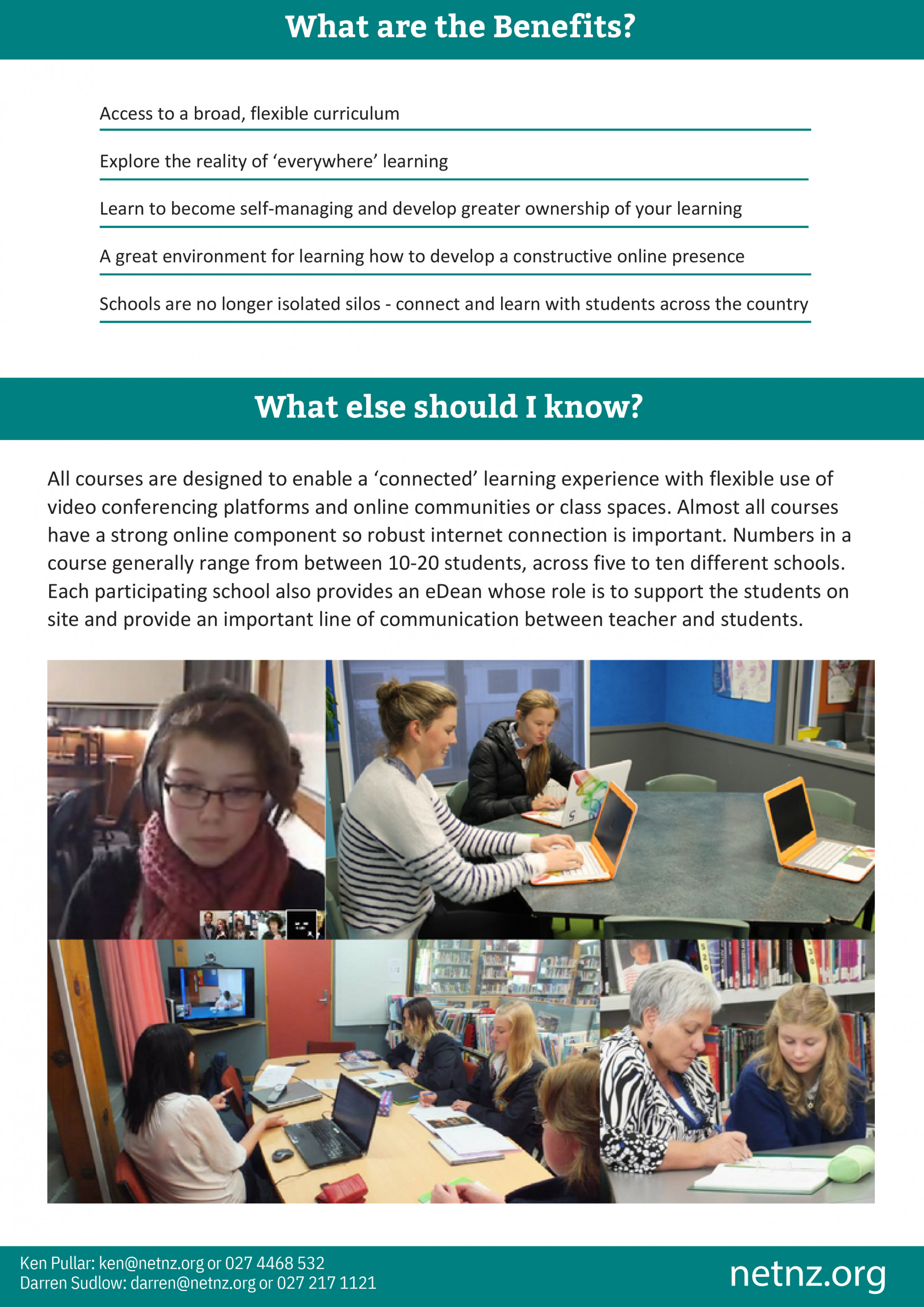
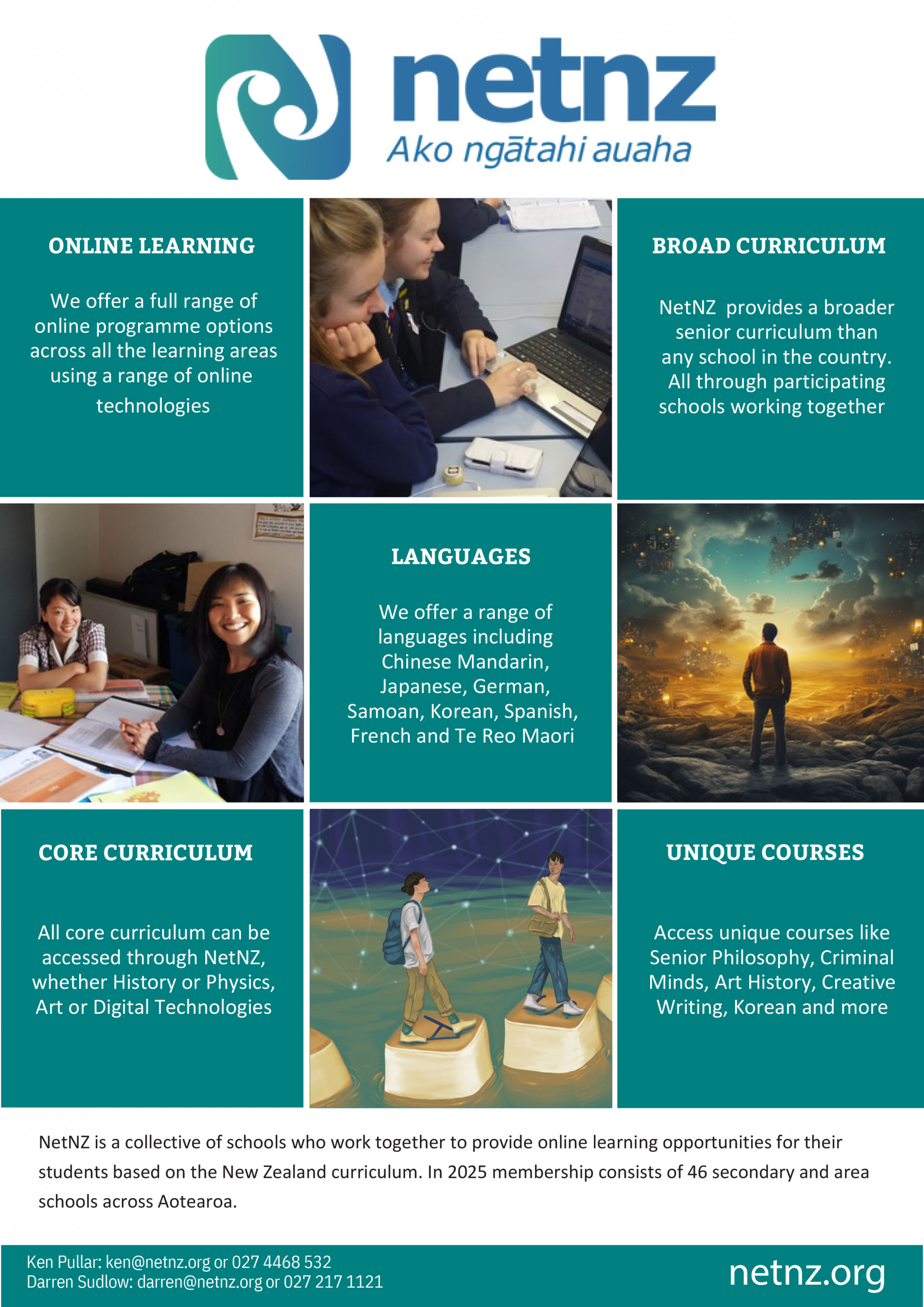
2NETThere may be a NetNZ course not listed in the NCEA Level 2 Learning Area that you are interested in studying. With NetNZ's wide range of programmes available, it's impossible for us to cover everything here. However, that doesn't stop you from choosing the course/s you want to study.
For a full list of the courses available through NetNZ, go here: https://app.journey.nz
Choose this subject as one of your options to add a NetNZ course that is not listed. You can also talk to Ms Saunders or your Dean about your options and how they can fit into your timetable.
Other NCEA Level 2 courses available through NetNZ include:
- Media Studies | Understand how/why TV and Films exist the way they do & how you can become a content creator
- Philosophy | Explore fundamental questions about the world and our place in it.
- Sociology | An Introduction to how we function in society
- Art History | For students with an interest in the visual arts, classics and general history
Also available are courses that combine various subject areas, such as:
- The Art of Us | Explore how images, signs and symbols have been used and manipulated over time in visual media.
- Education for Sustainability | Learn to think and act in ways that will safeguard the future wellbeing of people and our planet.
- The ‘Creative Forest’ Project | Develop and implement a prototype project in areas of interest.
Top of the South Trades Academy
TRADESA Course for Every Passion
The Top of the South Trades Academy offers a diverse range of vocational pathways. Whether you are interested in technology, creative arts, or the great outdoors, there is likely a course that fits your goals:
- Manufacturing & Technology: Dive into the world of Automotive Engineering, Mechanical Engineering, or the high-demand field of Electrical trades.
- Creative Industries: Explore your artistic side with Arts & Design, Hairdressing, or Creative Design for Hair & Makeup.
- Service & Sports: Get active with Sport & Exercise or learn the ropes of the vibrant Hospitality and Beauty industries.
- Primary Industries & Outdoors: Connect with the environment through Aquaculture & Marine Conservation, Adventure Tourism Leadership, or Future Farming (Papa Taiao Earthcare).
- Community & Protection: For those interested in public service, the Uniformed Services programme provides a rigorous introduction to careers in the police, defence, or emergency services.
Why Join?
The Trades Academy is about more than just learning a trade; it’s about building a bridge to your future. By attending every Friday, students can:
- Earn NCEA Credits: All courses count toward NCEA Level 2 or 3, making sure your time away from school still contributes to your graduation.
- Trial a Career: It’s a "risk-free" way to see if a career path is right for you before committing to full-time tertiary study or an apprenticeship.
- Gain Confidence: Learning in a tertiary environment with industry-standard equipment helps build independence and professional social skills.


Subjects for Year 12 Students
NCEA Level 3 Accounting
3ACCNCEA Level 3 Accounting is available through NetNZ or Te Kura.
Accounting is fundamental for business and for everyday life. Students gain financial literacy and the tools to make real-life financial decisions in a changing and uncertain world. One of the vital skills students learn is how to prepare and communicate financial information to a wide range of people. Further study can lead to a career in accounting in many diverse businesses worldwide. With a business or commerce degree, you can keep your options wide open.
Students develop knowledge from previous levels within the context of companies and partnerships. Students gain knowledge, skills and experience in using management for effective decision-making. Students report, analyse and interpret information for partnerships, manufacturing businesses and companies. Accounting NCEA Level 3 and Scholarship prepares students for tertiary education. New Zealand Scholarship exams are designed to extend very high-achieving Level 3 students. Those who wish to enter the New Zealand Scholarship exam in this subject must discuss this option with their Te Kura subject kaiako.
NCEA Level 3 Agriculture
3AGRThis course is a practical, production-focused course, involving learners in problem-solving in the Agriculture/Horticulture domain.
It is based on realistic and practical Agricultural and/or Horticultural contexts. Students learn to explore agricultural and horticultural issues and to communicate their ideas to others In agricultural and horticultural science. Learners will find themselves dealing with contexts, issues, and problem-solving drawn from a broad agenda.
Students who complete this course should be ready to gain employment or continue their studies through a tertiary provider.
This is a University Entrance (UE) approved Achievement Standards course that covers the production and marketing of two primary industry products and the environmental impact of Agriculture and/or Horticulture.
Agriculture Level 3 is offered as an online course by NetNZ and Te Kura.
NCEA Level 3 Biology
3BIOWhat is Biology?
Biology is at the centre of all life and students explore the living world, its ecology, plant and animal life processes, evolution, and relationships between biology and technology. Through this study, students gain an understanding of themselves, the world, and how organisms survive and live together. They also develop essential scientific knowledge, methods and techniques. From here, ākonga are able to analyse scientific information effectively and discuss the wide range of implications science has on our world, including medical and environmental issues. Biology is a broad interest subject and is important for careers and in a variety of areas, from health to forestry and zoology.
KEY AREAS OF LEARNING OFFERED
This course is a pathway leading to tertiary study, developing the essential knowledge and skills leading to careers in the biological, scientific, medical, ecological, sport science and environmental fields.
- Biology and broader biological issues.
- Broad range of scientific skills and knowledge.
CONTENT
Aspects of Biology
- Homeostasis
- Plant and animal responses to environmental change
- Practical Investigation into organisms' responses
- Human Evolution
- Socioscientific issues in the biological sciences
NCEA Level 3 Chemistry
3CHEWhat is Chemistry?
People have always been fascinated by the world around them and chemistry is the study of the substances that make up the universe. From the time people worked out how to create fire, chemistry has been at the forefront of exciting discoveries such as the structure of DNA and the use of semiconductors in electronics.
Chemistry looks at the behaviour of substances, the changes they undergo to create new ones and the reactions between them. Yet it is more than what happens at a micro level, it is about what it is that makes us, our materials and everything around us. Students learn the essential skills and knowledge needed to analyse scientific information, conduct experiments and research.
Chemistry is essential for careers in a wide range of areas including medicine, pharmacy, engineering, environmental science, winemaking and food technology.
KEY AREAS OF LEARNING OFFERED
This course is a pathway leading to tertiary study, developing essential knowledge and skills leading to careers in the scientific, pharmaceutical, medical, technological, nutritional, sport science and environmental fields.
- Chemistry and broader chemical issues in society.
- Broad range of scientific skills and knowledge.
CONTENT
Aspects of Chemistry
- Equilibrium in aqueous systems
- Oxidation/Reduction reactions
- Organic chemistry
- Thermochemical principles
- Spectroscopic data
- Socioscientific issues in the chemical sciences
NCEA Level 3 Classical Studies
3CLANCEA Level 3 Classical Studies is available through NetNZ.
Level 3 CLASSICAL STUDIES is the study of the culture and civilization of ancient Greece and Rome. We pay particular attention to the religion, art, architecture, law, sociology, politics, philosophy and history of these two cultures. As such Classics is an interdisciplinary study and whether you are interested in art, literature, history, drama, philosophy, or politics, you will find something of interest to you in Classics.
Throughout the year we will study:
- Augustus and the establishment of the Roman Empire
- Roman Art and Architecture
- Greek Science
- The comedies of Aristophanes
NCEA Level 3 Criminal Minds
3CRINCEA Level 2 Criminal Minds is available through NetNZ.
A study of crime and the criminal mind. Explore the psychology behind crime. Figure out how to solve crimes using your deduction skills and put these to the test in a murder mystery.
The criminal justice system determines the guilt or otherwise of an accused, and imposes sanctions on a guilty person. But what lies behind the mind of an offender? What factors contribute to offending? In this course, you will investigate different crimes to learn about the key concepts in law. You will use theories from psychology to try to explain the behaviour of the criminal mind to an applied case.
This course mixes subject areas such as Law, Psychology, Science and English. A range of NCEA standards are applicable.
NCEA Level 3 Digital Technology
3DTGDigital Technologies is the fastest growing industry and students that have a genuine interest and do well in this area are highly sort after. This course further develops design and development skills and knowledge of multimedia to communicate information effectively.
Students will build a portfolio of work by completing a project which creates a digital outcome for an end-user/stakeholder. This project based course develops a student's understanding of complex tools, techniques and concepts within a Digital Technologies framework. The students will base their work around an end-user/stakeholder's requirements by developing a proposal and designing, creating and completing a digital outcome that is fit for purpose. Projects can be, but not limited to a media focus or part of a programming/gaming focus.
This is an approved subject for University Entrance, and Scholarship Technology is offered at this level. This course caters for novice to advanced students, and student-centred learning is a focal point of this course.
Types of projects could be: creating a multimedia website using HTML/CSS/Javascript - capturing video and editing to produce a film - creating the graphics for a game - creating an animation - creating an App - creating a database using MySQL and PHP, Game design.
Independent work habits and Self-Management competencies are essential for the successful completion of this course.
Please Note:
A removable USB drive may be required depending on project and if working between home and school.
NCEA Level 3 Economics
3ECONCEA Level 3 Economics is available through NetNZ or Te Kura.
Economics is a social science about people and how they use resources. By studying economics, students become aware of the roles that individuals play in an economy, increase their understanding of economic events and improve their own decision making.
Students explore the interactions between producers, consumers and governments and the impact economic decisions can have on society. Economics encourages ākonga to think critically and independently about business, economic and social issues. This subject leads to careers in a range of fields including social policy and planning, business and financial management.
Students develop and improve economic understanding of a range of social and economic issues. There are three main areas of study. The first is based around resource allocation and the market and will look closely at the concepts of scarcity and opportunity cost, demand and supply, market analysis, and monopolies and other market structures.
The second area explores situations of market failure and looks at the role of government in the economy in correcting market failure. The third area looks at influences on the New Zealand economy as a whole, both internal and external, including the aims of government and the effects of government policies.
New Zealand Scholarship exams are designed to extend very high-achieving Level 3 students. Those who wish to enter the New Zealand Scholarship exam in this subject must discuss this option with their Te Kura subject kaiako.
NCEA Level 3 English
3ENGLevel 3 English really steps up the meaning we create and take from texts as students interpret the works of authors and directors with nuance and depth. Really exciting and novel ideas are introduced as part of the level 3 English curriculum. Students continue to create their own piece of work. Learning areas remain focused on reading, writing, viewing and presenting. Students begin to learn how to write academically in preparation for university. There is a sustained and complex exploration of human nature through literature.
KEY AREAS OF LEARNING OFFERED
Visual and written language, analysis of films and written texts, speaking and presenting, research skills, writing skills.
CONTENT
Content falls into the areas of close viewing visual and written texts, reading and writing, researching and presenting. There is a focus on creating our own work and studying the work of great artists, writers and directors. Contexts for learning (themes and topics) are determined in discussion with the students taking into account both student interests and the literary merit of the texts. Content at level 3 is complex and stimulating. There is an exploration of the human condition. Themes often raise questions around what it is to be human as we start to touch on psychological and philosophical questions about humanity.
NCEA Level 3 Gateway
3GATThe Gateway programme offers students the chance to gain work experience in the industry they hope to work in when they leave school, and study industry-related unit standards that count towards a nationally recognised industry qualification.
These Unit Standards are assessed by the Industry Training Organisation (ITO) and count towards NCEA. The student is expected to attain 20 credits (at various levels) as part of their commitment to Gateway.
Student suitability is determined by attendance and behaviour checks made at school. Students must be able to work independently and keep motivated, working on their own.
An interview between the business and student is set up and if the business decides to take the student on, an agreement is signed between the workplace, school and student. After that, the student begins their work placement and their performance is monitored by the Gateway Coordinator. If the placement is not working for either the employer or the school and student, then the agreement is cancelled.
The student attends the workplace one day per week for approximately three terms. Any tools or clothing needed by the student are able to be supplied by the school.
Collingwood Area School's Gateway scheme has been highly successful over the years with many students gaining apprenticeships and employment after their placements.
NCEA Level 3 Geography
3GEONCEA Level 1 Geography is available through NetNZ.
Externals include Human and Physical Geography components and a skills paper. There are four internally assessed pieces of work as well. Most material is on a Google Site, and all work is completed using Google Docs. A selection of standards from those listed below is negotiated with students at the start of the year.
Throughout the year, there will be an opportunity to sit four internal assessment standards and three external achievement standards, all by negotiation between student and teacher. The course potentially offers 26 credits but will certainly offer at least 14.
Level 3 Geography covers both the natural and cultural world:
- a contemporary geographic issue which relates to the impacts of sea level rise in Bangladesh (Internal Assessment)
- the global pattern of the distribution of financial wealth, including location patterns, factors behind it and the social and economic effect it has had (Internal Assessment)
- gather geographic data (with a focus on spatial variations) to analyse contributing factors (Internal Assessment)
- apply geographic skills and concepts in a setting they are unfamiliar with (External Assessment)
NCEA Level 3 Hard Materials Technology
3TECHLevel 3 Hard Materials Technology is a course designed for students who excel in the workshop and are passionate about creating high quality practical projects. This course allows students to find their own problem that they can design a solution for, and then build a prototype. The course is highly enjoyable as the projects that are created are entirely student-centred.
CONTENT
All assessment is based around the design, problem solving and construction of an individual student’s project. Students will submit a portfolio of work for marking. Some of the projects that have been completed in the past include:
- BBQs
- Bespoke chairs and stools
- Coffee Tables
- Knives and Meat Cleavers
- Butchers Blocks
- Lathe projects
- Welding and Milling projects
NCEA Level 3 Health
3HLTNCEA Level 3 Health is available through NetNZ or Te Kura.
Students consolidate their understanding of the holistic model of Hauora (Well-being) and investigate current New Zealand health issues impacting individuals, others and societal well-being. Students investigate different health practices used to treat or manage a particular health condition of their choice by researching the philosophies behind Western Scientific Medicine, Complementary and Alternative Medicine and Traditional Medicine.
Students come to understand the different viewpoints forming current ethical issues impacting our society such as the euthanasia, vaccinations and cannabis referendum. They will develop a greater understanding of the determinants affecting our health such as social, political, economic, and cultural environmental implications. Students come to show comprehensive knowledge of the four underlying concepts of health well-being (Hauora), socio-ecological perspective, attitudes and values and health promotion.
Through theoretical learning, students will develop competency in critical thinking by investigating and analysing relevant research around Health Issues affecting individuals and societal well-being. Students will develop skills of relating to others through their analysis of health issues on the impacts on self, others and society. Through working with health practitioners in our local community students will learn to manage their own learning through organising interviews, workshops and presentations on current health practices.
Knowledge, skills and experiences gained in Health Education are beneficial for many types of occupations. Students may want to take this course to learn more about their own health, or they may be looking for a career in Health.
NCEA Level 3 History
3HISNCEA Level 3 History is available through NetNZ or Te Kura.
To understand the past is to understand the present. History gives students an insight into current world problems and New Zealand’s identity and place in world events. It explores people and events and how they have influenced the world. History is not just about presenting the facts, but observing and questioning values and attitudes. Students improve their communication and writing skills, which enables them to express clear, convincing and well-thought-out arguments. From ancient civilisations to contemporary pop culture, from wars to peace treaties, history is both a fascinating and intellectually stimulating subject.
The aim of this course is to provide students with the skills to become successful and competent historians. We will study a variety of recent historical events to provide interesting and engaging contexts to develop these skills.
Students will have some say in choosing topics to cover, especially for the 3.1 and 3.2 Achievement Standards.
NCEA Level 3 Hospitality and Cookery
3HOSHospitality Cookery Level 3 a step up from Level 2. In this course, the food we produce will be made and served to others. We will work together as a team, sharing roles and responsibilities as you would in a commercial kitchen. Students will have an opportunity to practice and perfect the skills required in the preparation and cooking of more complex dishes.
Students will also serve food to others and clean up these serving areas. A high standard of personal hygiene will be required.
The course is not endorsed, but all credits gained will count towards NCEA Level 3.
KEY AREAS OF LEARNING OFFERED
Students will develop skills and knowledge in food preparation, food presentation, safe food handling, knife work and food service in a simulated commercial kitchen environment.
CONTENT
Topics taught are likely to include:
- Complex Sandwiches
- Egg Dishes
- Pasta Dishes
- Cakes, Sponges, and Scones
- Pickles, Chutneys and Preserves
NCEA Level 3 Legal Studies
3LEGNCEA Level 3 Legal Studies is available through NetNZ or Te Kura.
What is Legal Studies?
Legal Studies covers a broad range of topics and aims to provide an understanding of the role of law in society and the basic processes and principles of the New Zealand legal system. Legal Studies explores and evaluates the ability of the legal system to provide just outcomes for all individuals and groups, giving ākonga a better understanding of their legal rights and responsibilities. Students will develop an appreciation of how the legal system impacts on their lives and how they can influence and change it. This subject can lead to a range of possible careers including the legal profession, business, government service or agencies.
What this course involves
At this level, students will be able to evaluate concepts, principles, and systems and processes of the New Zealand and other legal systems. They will explore the application of a concept of law such as crime or natural justice to real situations. Students study formal means of challenging state power, such as the Ombudsman used in New Zealand and evaluate a law making process associated with a major issue such as film production in New Zealand.
Other major areas of law covered include concepts of democracy and government and different concepts of justice. Students have the opportunity to evaluate particular legislation, legal cases and legal issues of interest to them, as part of the assessment requirements of the course.
NCEA Level 3 Mathematics with Calculus
3CALCIn Level 3 Calculus you will build on the Algebra, Calculus and Graphs studied in Level 2. This course is for students who were successful in Level 2 Calculus and who wish to study Engineering, Architecture, Commerce or Mathematics at university, or students with a keen interest in Mathematics.
KEY AREAS OF LEARNING OFFERED
Aspects of Calculus and Algebra, including the introduction of a new concept, Complex Numbers will be introduced.
CONTENT
Aspects of Mathematics, including:
- Simultaneous Equations
- Differentiation
- Integration
- Complex Numbers
NCEA Level 3 Mathematics with Statistics
3STATThis course is for students who were successful in Year 12 and who wish to continue Statistics and Probability at Level 3 with a view to tertiary study or entering trades. Students who were successful in 12 Calculus will be able to succeed in this course without the statistical background from Level Two.
KEY AREAS OF LEARNING OFFERED
A wide range of Mathematical and Statistical Concepts.
CONTENT
Aspects of Mathematics and Statistics, including:
- Inferences
- Time Series Data
- Bivariate Data
- Probability Distributions
NCEA Level 3 Media Studies
3MEDMedia Studies examines how media in many forms (film, television, the internet, print, radio, etc.) create and deliver meaning. It involves both practical skills (such as film-making, radio broadcasting, and journalism skills) and theoretical skills (analysis, interpretation, and forming arguments). This is a great subject in preparing you for the world of post-truth and misinformation that we currently live in. This subject also helps provide a pathway into a huge range of careers that involve the media in some form (e.g., journalism, game design, public relations, marketing, film and television careers, radio and broadcasting, etc).
KEY AREAS OF LEARNING OFFERED
Again, as with Level 2, this will depend a little on the students who take the subject. There could be a focus on a particular media form such as journalism, game design, radio, film making, etc; or there could also be a mix. The subject does require the completion of a 10 credit project where you design and make a media project. This is a significant chunk of the credits on offer and is not to be entered into lightly. Other standards offer opportunities to look at audiences, representation, film/television analysis and genres.
CONTENT
The topic and texts will be decided by the class teacher, and will respond to the specific identities and interests of the students in the class.
NCEA Level 3 Outdoor Education
3OEDReady to become a master of the outdoors? This course is for students who want to take on a leadership role, safely lead their own adventures, and explore future pathways in the outdoors. You'll learn to manage risks and connect with our environment, all while gaining valuable skills for life and future study.
WHAT YOU'LL LEARN
- Tools for a Lifetime of Adventure: Learn the essential skills to safely engage in outdoor recreation, whether for a career or personal enjoyment. We'll focus on leading and managing risk in diverse outdoor settings.
- A Pathway to future study: This course is structured to provide a strong foundation for tertiary study. By choosing Achievement Standards, you can gain a subject endorsement and meet University Entrance requirements. This opens doors to careers in adventure tourism, environmental science, and beyond.
- Hands-on Experience: Your learning will be based on your interests and include a variety of contexts and activities.
WHAT TO EXPECT
There are no exams. Your assessments will be a mix of practical and written work. You can choose to be assessed through Unit Standards or Achievement Standards. Students will co-construct the course outline based on their personal interests.
ARE YOU INTERESTED
If you have any questions or are considering studying Outdoor Education, I would strongly encourage you to come and see Mr Taylor.
NCEA Level 3 Painting
3PAINTThe Level 3 Painting course will extend your art-making skills and the way in which you see and respond to the world. Students are encouraged to honour and express their own culture as they develop their work, and to explore the cultural perspectives and experiences of others.
This course is ideal for senior students currently studying art who are interested in further developing their creativity, painting and thinking skills. The course focuses on drawing, painting, and related areas of contemporary art practice.
Students will explore and extend their skills in a variety of painting media, including watercolour, mixed media, gouache, open acrylics, oil paints, spray paints, paint pens, dyes, high-flow acrylics. Digital painting and other approaches to contemporary art making, aligned with established practice can also be a focus.
There are many exciting ideas, processes, materials and techniques that open up to be explored at this level of specialisation. Students who already have strong skills in a particular painting media will have the opportunity to extend those skills into other media if they want to. Level 3 Painting will support all students to take risks, extend and learn new skills, sharing knowledge together.
There is no set theme of study in Year 13 Painting, each student will personally select an idea to explore and outwork in sequences of drawing and paintings. You will refine techniques and ideas over the course of the year. You will learn how to research your idea, deepen and expand your thinking and personal expression as you are guided through each phase of learning. Students will extend themselves as artists by developing a strong art journal practice. Your learning and achievement is advanced by learning about visual ideas and artists' work from the past and present, and also by engaging in teacher and peer critique. Students will learn to support others in the class to develop and extend their ideas.
This course enables students to evolve their individual approach to art-making in a way that supports and empowers personal creative expression. You will make drawing and painting sequences that generate, analyse, clarify and regenerate ideas. You will study artists' works in order to extend ideas and produce new work using conventions appropriate to painting. The course structure is designed to promote independent work habits and develop knowledge and skills appropriate to your own personal painting style, theme and interests.
Visual Art equips students with transferable skills that can be used in a wide range of tertiary courses and careers, whilst studying a subject that inspires and excites. This course will develop skills such as communication, critical and creative thinking, problem-solving, the ability to research and analyse, adaptability, dexterity, patience, attention to detail, independence, and innovation.
NCEA Level 3 Photography
3PHOThis course builds on the technical and conceptual skills developed in Level 2 Photography.
Students are expected to create outstanding images to an industry standard and develop the aesthetic, technical, and conceptual skills needed to create a professional practice. Students will be guided and supported throughout the course to be able to accomplish this.
They will further appreciate the technical and conceptual complexity that characterises photography while enhancing their ability to discuss their work and the work of others.
Students will work towards a portfolio/digital portfolio of original photographic/moving image work. They will gain a further understanding of methods and ideas that form contemporary photography practice and develop critical and creative thinking skills.
NCEA Level 3 Physical Education
3PHEThis course is for students who are passionate about physical activity and considering a career in a health or sports-related field. You’ll move past simply playing the game to explore how the latest science and societal trends influence performance and long-term well-being. By analyzing complex issues, you'll develop practical strategies for safe participation and healthy living, setting a strong foundation for future study. This is an approved University Entrance subject.
WHAT YOU'LL LEARN
- Elevate Your Understanding: Get into the core concepts of physical safety, quality performance, well-being, and leadership. You'll tackle real-world challenges, applying your knowledge to create effective solutions.
- A Pathway to future study: The course focuses on building key academic skills for higher education, including research, report writing, and presentations. This provides a valuable head start for students interested in fields like sport science, kinesiology, physiotherapy, or health promotion.
- Real-World Relevance: This course is about more than just theory. You'll examine how societal factors like technology, culture, and community influence physical activity. You'll gain skills that are valuable in any future career, from coaching to health promotion and beyond.
WHAT TO EXPECT
The course is delivered through Achievement Standards and includes a significant theory component. This means you'll be challenged with both practical application and in-depth academic work. There are no exams. Your assessment will be a mix of practical tasks and written assignments that require strong research skills and analytical thinking.
Students will help construct the course for the year, based on their interests.
ARE YOU INTERESTED?
If you have any questions or are considering studying Physical Education, I would strongly encourage you to come and see Mr Taylor.
NCEA Level 3 Physics
3PHYWhy study physics?
Physics lies at the heart of the natural sciences
Almost any scientific problem can be approached using the ideas and methods of physics.
Physics explains how the world works
Physics helps us understand why things in the natural world happen the way they do. It enables us to explain, for example, how buildings move in an earthquake, why a car takes as long as it does to come to a stop when the brakes are applied, why the sky is blue and grass green, and why the supports of a bridge have to be of certain dimensions.
Physicists – and students studying physics – are able to use their understanding to predict how an object will behave under particular conditions, improve the functioning of everyday objects, and envisage totally new developments.
Physics is useful and exciting
The knowledge and processes used by physics have produced new and exciting technologies that are in everyday use. Almost any example of modern technology has its origins in mechanics, optics, electronics, thermodynamics, nuclear physics, or some other branch of physics. Physicists are challenged to discover how nature works; along the way, they get to know the excitement of explaining, seeing, or doing something that no one has understood or done before.
Learning in physics opens up career opportunities
Learning in physics will come in useful no matter what you go on to do. Employers value the kinds of skills that studying physics develops: the ability to grasp things quickly, focused solution finding, plus problem-solving, analytical, mathematical, and IT skills.
People with a background in physics are found in all these areas and more: telecommunications, space, medicine, finance, law, music, television, environment, architecture, civil engineering, sports, gaming, energy, and education.
KEY AREAS OF LEARNING OFFERED
This course is a pathway leading to tertiary study, developing essential knowledge and skills leading to careers in the scientific, technological, engineering, architectural, astronomical and geological fields.
- Physics and broader physical issues in society.
- Broad range of scientific skills and knowledge.
CONTENT
Aspects of Physics:
- Electrical systems.
- Mechanics.
- Wave systems.
- Modern and Nuclear Physics.
- Socioscientific issues in the physical sciences.
NCEA Level 3 Psychology
3PSYNCEA Level 2 Psychology is available through NetNZ.
This course covers significant psychological research, what made these studies important, and what impact they have on society today. By comparing different approaches within the field of psychology, students will investigate what makes us behave the way we do. Students will explore how it is applied in the fields of mental health, social, and forensic psychology. We will cover the fields of biological and sociocultural psychology to try to find out how our genetic heritage and social environment interact. Students will investigate several issues present in modern psychology, such as gender and cultural bias, and the use of children and animals in psychological research. Specific focus areas for each topic and assessment contexts will be negotiated between participating students and the teacher to allow for student interest.
KEY AREAS OF LEARNING OFFERED
- Analyse the significance of key research studies and their impact on society
- Analyse the interaction between psychological approaches
- Analyse how theories are applied in fields of psychological practice
- Analyse a significant issue in psychological practice
CONTENT
- Analyse The Significance Of A Key Piece Of Research And Its Impact On Society
- Analyse The Interaction Between Psychological Approaches
- Analyse A Significant Issue In Psychological Practice
- Conduct independent psychological research with consultation
- Analyse how theories are applied within a field of psychological practice
Other NCEA Level 3 NetNZ Courses
3NETThere may be a NetNZ course not listed in the NCEA Level 3 Learning Area that you are interested in studying. With NetNZ's wide range of programmes available, it's impossible for us to cover everything here. However, that doesn't stop you from choosing the course/s you want to study.
For a full list of the courses available through NetNZ, go here: https://app.journey.nz
Choose this subject as one of your options to add a NetNZ course that is not listed. You can also talk to Ms Saunders or your Dean about your options and how they can fit into your timetable.
Other NCEA Level 3 courses available through NetNZ include:
- Media Studies | Understand how/why TV and Films exist the way they do & how you can become a content creator
- Psychology | Why we do what we do
- Art History | Working as a team of researcher curators exploring big ideas in Art History
- Computer Science & Programming | Explore advanced programming techniques and computer science concepts
Also available are courses that combine various subject areas, such as:
- Gaming, Film and Literature | Explore how video games have been influenced by literature and film.
- Criminal Minds | A study of crime and the criminal mastermind.
- Education for Sustainability | Learn to think and act in ways that will safeguard the future wellbeing of people and our planet.
Top of the South Trades Academy
TRADESA Course for Every Passion
The Top of the South Trades Academy offers a diverse range of vocational pathways. Whether you are interested in technology, creative arts, or the great outdoors, there is likely a course that fits your goals:
- Manufacturing & Technology: Dive into the world of Automotive Engineering, Mechanical Engineering, or the high-demand field of Electrical trades.
- Creative Industries: Explore your artistic side with Arts & Design, Hairdressing, or Creative Design for Hair & Makeup.
- Service & Sports: Get active with Sport & Exercise or learn the ropes of the vibrant Hospitality and Beauty industries.
- Primary Industries & Outdoors: Connect with the environment through Aquaculture & Marine Conservation, Adventure Tourism Leadership, or Future Farming (Papa Taiao Earthcare).
- Community & Protection: For those interested in public service, the Uniformed Services programme provides a rigorous introduction to careers in the police, defence, or emergency services.
Why Join?
The Trades Academy is about more than just learning a trade; it’s about building a bridge to your future. By attending every Friday, students can:
- Earn NCEA Credits: All courses count toward NCEA Level 2 or 3, making sure your time away from school still contributes to your graduation.
- Trial a Career: It’s a "risk-free" way to see if a career path is right for you before committing to full-time tertiary study or an apprenticeship.
- Gain Confidence: Learning in a tertiary environment with industry-standard equipment helps build independence and professional social skills.