
Westlake Girls’ High School
Auckland
Westlake Girls’ High School Curriculum
218 subjects available for 2026/2027.
Subjects for Year 8 Students
Year 9 Dance
9DANCYear 9 Dance provides an opportunity for an introduction to dance. Students will be actively involved in performance.
This course aims to widen students’ understanding of what Dance is, use different genre terminology and have a positive experience through the medium of Dance.
Course cost $5.
Students will be studying either High School Musical or the film Hairspray and will learn a dance for this Musical Theatre performance.
Choreography is based on the shapes and pathways of Māori Kowhaiwhai patterns. If time allows, students will also attempt Lyrical, Zumba Dance Fitness and Street dance. No previous dance experience is needed!
Year 9 Drama
9DRAMThis course provides students with an introduction to Drama and Theatre Studies. Topics covered include Improvisation, Devising and Physical Theatre, using music, myth and images as stimulus.
The course aims to build confidence in students, and enable them to consider how meaning can be created and ideas can be expressed in a variety of ways.
There is an emphasis on practical group work and strong attendance is required to ensure individual and group success.
Year 9 Food Technology
9FDTCYear 9 students will use the technological design process to create a food product. Basic skills in personal hygiene, food safety, preparation and presentation of food are covered through a range of practical and theory activities.
There is an emphasis on collaboration and regular attendance is required to ensure individual and group success.
Year 9 Japanese
9JAPAThis is an introductory course (for about two terms, 20 weeks ) to the Japanese language and culture. Students learn to greet others, introduce themselves in Japanese, give their name and age, say where they live, and express likes and dislikes. This course develops the four language skills – listening, speaking, reading and writing. In Term 1 students are introduced to the hiragana writing system.
Year 9 Literacy Support
9LITSThis course is in addition to 9ENGL and will take the place of an option.
This course aims to offer extra literacy support for identified students.
Students in this course will explore the basics of language, work to develop key literacy skills, and be offered extra support in unpacking the criteria for tasks offered in English courses.
If you have a student who has an Education report please contact the WGHS Senco- Julie Mulcahy to ensure support across all classes. [email protected]
Year 9 Spanish
9SPANIn this course, students learn how to communicate basic information about themselves in Spanish. They will also learn how to talk confidently, ask and answer questions about aspects of their lives such as describing themselves, their family and pets, their nationality, the language(s) they speak, giving their address, etcetera, as well as other information. There is a strong emphasis on pronunciation at this year level. The skills in listening, reading and writing are also developed through the learning process. Also integrated in this course are particular features of Hispanic culture.
Year 9 STEAM Pathway
9STEA
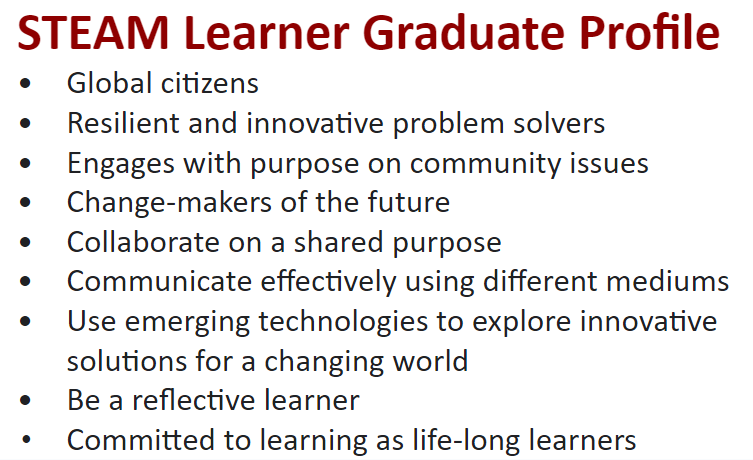
The STEAM programme is a 2 year programme that offers students an integrated approach to learning. This Science, Technology, Engineering, Arts and Mathematics curriculum provides a pathway to deep learning that strengthens links between subjects. Through project-based learning, opportunities are provided for students to become life-long learners, leaders and change-makers of the future. The STEAM programme aims at developing global competencies such as critical thinking, collaboration, communication, character, creativity and citizenship.

Science and Mathematics will be enriched with projects linking the two disciplines whilst English and Social Studies will strengthen written, oral and digital literacy, global appreciation and critical thinking.
Unique technology option subjects only available to Year 9 STEAM students include Robotics and Papertronics. These courses integrate robotics, coding, circuitry and design with projects that link into several learning areas. Students will be encouraged to be innovative and creative as they attempt to solve real-world problems. Year 9 STEAM students complete both these options over the course of the school year.
Students wishing to apply for the STEAM programme need to submit an application form. Click here to apply
Spaces in the programme are limited and selection will be based the students application.
Year 9 Te Reo Māori
9TREOThe Year 9 course introduces students to some elementary Te Reo Māori and Tikanga Māori (Māori language, customs, and values), with specific emphasis placed on developing the students’ ability to speak, listen, read, and write Māori.
The course has the following content:
• Mihimihi–Greeting
• Taku Whānau–My family
• Taku Rūma Ako–My classroom
• Taku Kura–My school
• Taku Tinana–My body
• Te Matariki
Year 9 Te Reo Māori Full Year
9TREMThe Year 9 Full Year Course introduces students to some elementary Te Reo Māori and Tikanga Māori (Māori language, customs, and values), with specific emphasis placed on extending the students’ ability to speak, listen, read, and write Māori.
The course has the following content:
• Mihimihi–Greeting
• Taku whānau–My family
• Taku rūma ako, taku kura–My classroom, my school
• Taku tinana-My body
• Te ao taiohi-The teenage world
Year 9 Textile Technology
9TXTCYear 9 students use the design process to produce a tote bag that meets all the requirements of a given brief. Students are taught basic construction skills and explore methods of applied design.
Subjects for Year 9 Students
Year 10 Chinese
10CHINThis course is a full year course covering New Zealand Curriculum Levels 3 and 4. It builds on the content covered in Year 9 and will start with revision of the Year 9 programme. We will continue to practice and build confidence in using pinyin and Chinese characters, as well as developing the four skills in Chinese, listening, reading, speaking and writing.
Students with no prior knowledge can select this subject under discretion of the Teacher in Charge or Head of Languages.
The topics covered this year are:
- About China, the culture and its people
- Self and Family
- Daily Routines
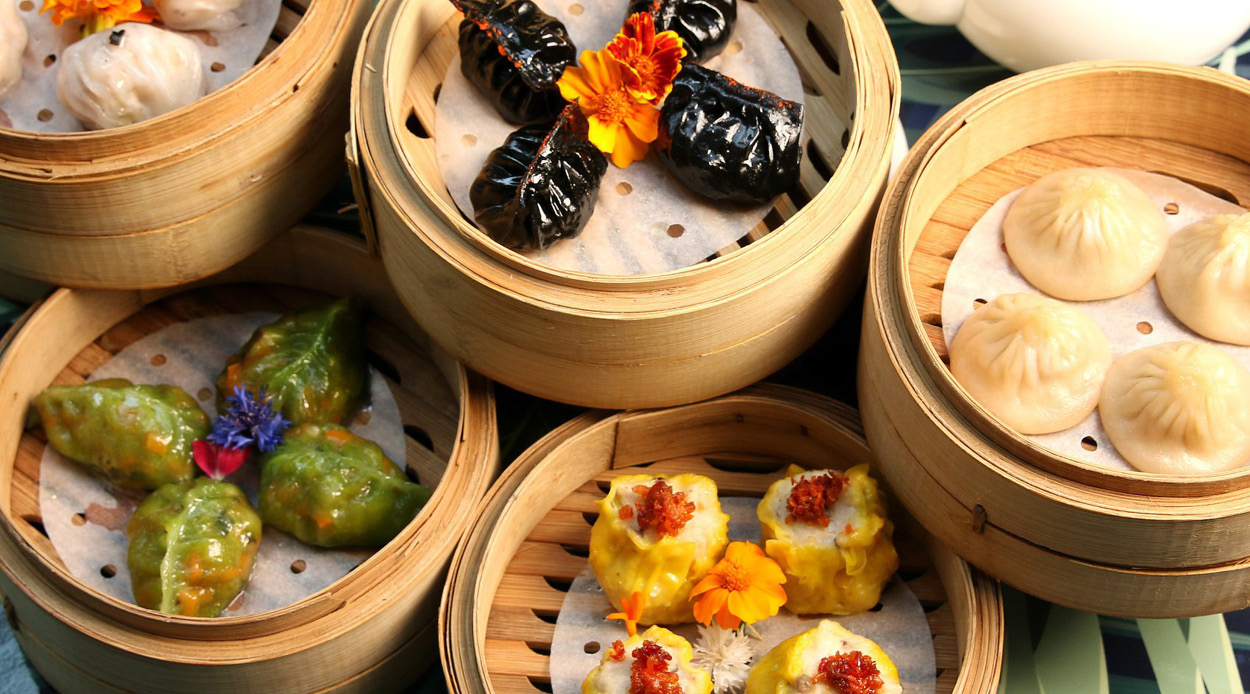
- Dinning in a Chinese Restaurant
- School Life
- Going Around
- Weather and Hobbies
Learning Outcomes
- Conduct a simple conversation in Chinese on personal information.
- Give a short speech about myself in Chinese.
- Ordering food in a Chinese restaurant
- planning a trip to China, providing information on itinerary, packing, transport, accommodation, etc.

Year 10 CYGNET Sports Programme
10CYGT10 CYGNET is a full year course which provides a pathway for more able students to develop in their sport and as an athlete while following the New Zealand Curriculum. The CYGNET Sports programme is about learning the skills required to perform in their chosen sport, is focused on learning principles and skills as an athlete to improve.
Sports offered include: Hockey, Football, Netball, Basketball and Rowing. Numbers across codes may be altered at the discretion of the HOF of PE/Health/Sport and Director of Sport.
One Code session per week will allow talented students to be extended in their sport and training is received from specialist coaches.
Sports Science lessons will be both practical and theory sessions
Topics may include
- Principles of training and learning how to create a training program
- Fitness conditioning and testing.
- Nutrition and eating for performance.
- Goal setting and self reflection.
- Hauora and looking after self as a person.
- Injury prevention and management.
- Sports psychology and mental toughness. Building resilience and overcoming challenges.
- Sport specific technical skills sessions and analysing skills to improve.
- Learning how to take on feedback to improve.
- Exercise physiology principles
- Sports specific leadership coaching - learning how to lead others.
- Drugs in sport. Training for an event.
- Other school and Millennium trips.
- Fun competitive games.
Any new students wishing to join Year 10 Cygnet in 2027 should email April to request an invitation to the Term 4 trial. The cost to participate in this programme is $250.
Year 10 Dance
10DANCWelcome to the exciting world of Dance! Work will build on the introduction to Dance that students experienced in the Year 9 Dance course. Students will develop practical and theoretical knowledge in Dance. They will explore the Dance elements and choreographic devices through choreography tasks based around the ideas and images of Waka/Journey, Spoken Word and Myths and Legends. We have a variety of tutors who share their skills and knowledge during the Dance Studio Series. A variety of genres will also be explored both in practical and theoretical lessons; including K-Pop, Siva Samoa, Ballroom Dance, Contemporary, Flamenco, Zumba Dance Fitness, Musical Theatre, African dance, Country Linedance, Lindy Hop and Hip Hop. Each of these topics will allow students to learn particular dance styles and then use them to generate their own ideas and choreography. Students will watch, discuss and analyse dance films, documentaries, productions, and performances. They will also develop ideas about the societal contexts of different genres. The course will run for a full year and genres may change depending on the teacher of the course.
Course cost $30
If times allows, students will attempt Samoan Sāsā, Chinese Fan Dance, Scottish Country Dance and Māori Poi. Students also have the opportunity to perform or help backstage with the annual WGHS Dance Showcase.
Year 10 Design and Visual Communication (Graphics)
10DVCTDesign and Visual Communication (DVC) is a design subject with a strong element of drawing. It allows students to develop skills that help them to communicate ideas in response to a design brief. It focuses on understanding and applying drawing techniques and design practice to communicate design ideas. Students will start to enhance their ability to conceptualise, develop, and communicate design ideas and potential outcomes, and their skill to interpret graphical information.
Students will learn the fundamental principles of aesthetics and function, and human factors, which underpin their ability to conceptualise and explore their design ideas.
Design and Visual Communication (DVC) covers two main areas of three-dimensional design:
- Spatial Design – Architecture and Environmental
- Product Design
During the year students will experience drawing, spatial design and/or product design.
This course is University approved and is a starting point for career pathways, including: Three-dimensional design, advertising, apparel design, architecture, computer-aided design (CAD), environmental design, exhibition design, footwear design, furniture design, industrial design, interior design, landscape design, product design, game design, toy design, transportation design…
The course leads on to Level 1, 2 and 3 DVC, including Scholarship, in future years of study.
Year 10 Digital Technology
10DGTCThis course provides opportunities to learn skills across a range of software and is an excellent foundation for future courses. Students will explore digital media, image editing, web design, coding, game development, and animation. They will apply a design process using research, planning, and problem solving to develop digital solutions that are suitable for the intended purpose.
For students who intend to study Digital Technology at Year 11, it is recommended that they have studied Digital Technology in Year 10.
Year 10 Drama
10DRAMThe year’s work will centre on performance and will provide a foundation for NCEA Drama in Years 11 to 13. Students will develop skills around acting techniques, theatrical forms and genres as well as applying the elements and conventions of drama through creating their own devised work. They may use text, music, images, props and costumes as ways of creating impactful theatre and will develop their ability to reflect on their own progress as well as feedback constructively on the work of others.
Viewing live theatre is essential so there will be a class trip to view a performance. We do our best to keep costs to a minimum, using public transport where possible. These opportunities expose our students to best practice, innovative ideas and showcase the possible pathways in the performing arts. They also provide insight into differing social, historical and cultural perspectives to help build empathy for and awareness of how other people experience the world.
There is an emphasis on group work and strong attendance is required to ensure individual and group success.
Year 10 English
10ENGLDue to the English curriculum document for 2026 currently being in draft form only, courses are subject to change. The demands of the draft curriculum will be such that all students will be expected to read an increased number of texts at every year level to meet requirements. Students are to expect to be doing reading every night for at least 30 minutes and will be expected to meet the demands of the curriculum document.
In Year 10 English, students cover a range of thematic units, which include: the study of novels, drama, short stories, poetry, Shakespeare, media, film, visual and oral language.
Students will be provided with the opportunity to complete their NCEA Literacy co-requisite qualification. This consists of two standards- one accesses writing and the other reading. These standards are an essential component of the revised NCEA qualification. In 2024 students will also be able to gain their Literacy credits through tagged achievement standards. Standards that contribute towards a student's literacy cannot be used to accumulate level credits.
To prepare students for the literacy co-requisite qualification and prepare them for NCEA students will continue to build on their portfolio writing, language blocks, and reading challenges started in Year 9. Students are taken to the Library once every three weeks for a reading period to further embed good reading practice. If you would like a reading recommendation list then please contact your student's English teacher.
Year 10 Food Technology
10FDTCThis course explores technological modelling through a range of practical and knowledge based activities. This program prepares students for NCEA Level 1 at Year 11 by introducing some of the subject specific terminology and concepts.
Content covered includes safety, the design process and technological modelling through a range of theory and practical experiences.
Students must have a genuine interest in new product development and collaboration with their peers.
A curriculum cost is charged to cover a portion of the cost of food used in practical lessons.
This course is not suitable for students with severe food allergies.
Year 10 Hard Materials Technology
10HDTCThis course has been developed to enable students to gain knowledge, skills and confidence in the workshop environment using a variety of materials including wood, plastic, and metal. The students will be taught how to apply a wide variety of processes and materials fabrication to make a range of projects.
Throughout the year students will use and develop design skills to solve and meet the requirements of a design brief.
This course will form a sound basis on which to prepare Year 11 Hard Materials Technology.
A curriculum cost is charged.
Year 10 Japanese
10JAPAThe Year 10 Japanese course builds on content covered in Year 9. This year students will learn to read and write katakana. They will continue to build confidence in using hiragana. Students will also build their knowledge of vocabulary and sentence patterns to complete Levels 3 and 4 of the National Japanese Curriculum.
Students will be developing all four language skills; reading, writing, listening and speaking. They will also be learning about Japanese culture in relation to the topics covered during the year. The topics are:
•Family
•Describing People
•Houses
•Daily Routine
•School
•Food and Drink
•My Town
•Shopping
By the end of this course students will have been introduced to most of the topics in NCEA Level One. Students who have a good grasp of hiragana should enjoy this course.
Year 10 Literacy Support
10LITSStudents explore literacy skills that are being used across the curriculum. Inquiry Learning is used to engage students in their learning and support them in the practice of these skills. Students will look at visual, oral, and written strands of the curriculum.
This course is to support students who struggle with literacy and provide them with foundation skills that will enable them to work more effectively across the curriculum.
Students who take this course will have the opportunity to work on an NCEA Level 1 English standard to provide them with extra support for Level 1 English.
Year 10 Mathematics & Statistics
10MATSAll students at Year 10 level must take Mathematics.
Mathematics and Statistics takes students on a journey of increasingly sophisticated thinking about number, patterns, space, and data. Through purposeful exploration and practice, students build the knowledge and fluency they need to solve problems, reason logically, and make sense of the world around them. The mathematical and statistical processes of investigating, representing and connecting situations, and generalising, explaining, and justifying findings are fundamental to all mathematical and statistical teaching and underpin the way students gain understanding of the knowledge and practices being taught.
In Year 10 the knowledge and practices are organised into six strands: Number, Algebra, Measurement, Geometry, Statistics, and Probability. Teaching focuses on students’ use of proportional reasoning to transform numerical quantities, measurements, and shapes, including right-angled triangles. They begin to generalise their understanding and application of tables, equations, and graphs, including to explore patterns and the connections between different representations. They extend their understanding of area, perimeter, and volume for a variety of 2D shapes, including circles, and 3D shapes, including prisms. They use data visualisations to investigate, represent, and explain patterns, trends, and variation, and they apply their knowledge to situations involving chance.
There will be enrichment classes and students will be invited into these classes on the basis of their Year 9 performance.
Year 10 students will sit the 10 credit assessment US 32406 Use mathematics and statistics to meet the numeracy demands of a range of situations in Term 3.
A graphics calculator will be essential for students taking senior Maths courses, but a scientific calculator will be sufficient for Year 9 and 10.
Year 10 Music
10MUSMThis course is designed to create a foundation level of music knowledge that will prepare students to study Level 1 Music at Year 11.
A wide range of music styles and genres are explored through practical work, in both individual and group contexts. Students enrolled in 10MUSM must be currently learning an instrument and be actively engaged in improving their technical skills and confidence to perform. Music lessons are available through the school Itinerant Music Programme.
Students are expected to participate in the schools extra-curricular programme in either choral or instrumental ensembles.
Year 10 comprises of:
- Solo and Group performances on their chosen instrument.
- Musical Knowledge (Music theory and aural)
- Portfolios of Composition (group and individual tasks)
- Music Technology (using Sibelius and Soundtrap software)
- Investigating a wide range of musical styles and contexts.

Year 10 Physical Education & Health
10PHEDPhysical Education
The general aims of the Physical Education programme are to develop the knowledge, skills and attitudes needed to maintain and enhance personal health and physical development.
• To develop motor skills through movement and develop positive attitudes towards physical activity.
• To participate in creating healthy communities and environments by taking responsible action.
• To encourage student’s ability to develop skills and attitudes that enhances interactions and relationships with other people.
Note: House T-Shirt/Black shorts or leggings and sports shoes are compulsory.
Health
The general aims of the Health Education programme are to develop the knowledge of students in relation to personal growth and development, demonstrate a range of interpersonal skills, and understand personal growth and development. Topics include, but are not limited to;
- Self Esteem/ Body Image
- Mental Health
- Sexuality Education
- Building positive relationships
- Drug Education
Year 10 Science
10SCIEYear 10 Science enables students to develop knowledge and a coherent understanding of the living, material, physical and technological components of their world. It supports students to develop investigation, collaboration, communication and research skills. The course also helps to grow students’ interest in and understanding of the knowledge and processes of science which form the basis of many of their future careers.
Topic areas covered include aspects of Biology, Chemistry, Physics and Earth Science which can all be selected as subjects at Level 2.
Year 10 Social Sciences
10SOSCThe Junior Social Sciences programme is planned so that students gain knowledge and understanding about events, places and people of significance to New Zealand and beyond, in the past and the present. Social Studies helps students to understand their world and provides the skills that will enable them to participate in a changing society as informed and confident citizens.
Exact content for 2027 is to be confirmed once the new curriculum is publish in August 2026.
Year 10 Spanish
10SPANAt Year 10, students will learn to describe more aspects of their own lives and background in spoken and written Spanish. Practice in the comprehension of texts through listening and reading will further develop language and analytical thinking skills. The course is designed to build confidence in communication.
The content and vocabulary learnt will provide a valuable knowledge base for NCEA Level 1 Spanish. Key areas covered are Personal Information, Family and Home, Interests, Hobbies and Sport, Food and School life.
With each topic, various aspects of the diverse cultures of Spain and Latin America are interwoven so that the student gains an appreciation and greater understanding of the Spanish-speaking world.
Year 10 STEAM Innovation Lab (Y10 Technology Option)
10STLB
Innovation Lab is a unique technology option subject only available to Year 10 STEAM students
If you would like to apply to join the STEAM programme in Y10, you can do so using this link.
Course Overview
Innovation Lab brings creative arts, design, and engineering together in one hands-on course. Over the year you'll work through a series of real projects, picking up serious technical skills along the way and using them to build things that actually work.
In this course you will:
- Learn fabrication skills including 3D modelling and 3D printing
- Design interactive digital experiences for a real end user using Augmented and Virtual Reality
- Build and understand electrical circuits using Arduino microprocessors
- Learn animation techniques in Adobe After Effects and Premiere to communicate ideas visually
- Design and build mechanical machines powered by Newton's laws of motion
- Work collaboratively on group projects, and manage your own progress on individual ones
- Design and prototype a solution to a real issue in our community, in our Community Innovation Projects unit
How the course works
Each unit starts with the basics: what the technology is, how it works, and what it's used for in the real world. Once you've got that grounding, you'll be handed a project brief and set loose to work through it using the DESIGN process, with your teacher guiding you along the way.
You'll track your own progress through a digital portfolio website, updating it regularly as your projects develop. Some units are done in groups, others individually, but either way, a good chunk of this course involves disciplined managing of your own time, in and out of class, with the final deadline in mind.
The class is co-taught by Mr Jono Howan and Ms Tessie Liddell. For some units, the class splits into two groups, each spending extended time with one teacher before swapping over. Other units are taught to the whole class together.
Every unit is a taster of a different discipline, some will click straight away, others will stretch you. Give each one your best shot. That's where the real learning happens!
Year 10 STEAM Pathway
10STEAYear 9 STEAM students continue into Year 10 STEAM at the discretion of the HoD/STEAM programme coordinator. Limited spaces open to all current Year 9 students. You must submit an application form if you have not completed Year 9 STEAM.
The STEAM enrichment programme offers continuity through an integrated approach to learning for Year 9 STEAM students. Students not currently in the programme can try out this innovate pedagogical approach. Mainstream students can apply by clicking here to join STEAM in Year 10

Science and Mathematics will be enriched with interdisciplinary projects, while English and Social Studies will focus on enhancing literacy skills, global awareness, and critical thinking. As part of the STEAM programme, students work collaboratively in weekly Community Projects lessons to develop an innovative technological solution to a real issue they have identified in their community. The community projects benefit from a mentoring program and support from experts in the community who can shape the development of student ideas.
A unique technology option subject only available to Year 10 STEAM is Innovation Lab. This course brings together creative arts, design, digital media, computing, and engineering in an integrated project-based learning environment. In this course, learners will learn construction/fabrication skills and techniques. They will also explore a variety of innovative technologies which include: 3D Modelling and 3D Printing, Mobile Phone App Design, Laser Cutting, Virtual and Augmented Reality.
Year 9 STEAM students continue into Year 10 STEAM at the discretion of the Head of STEAM. Year 9 students who have not completed the Year 9 STEAM programme must submit an application form. Selection for a limited number of places will be based on a places available.
Year 10 Te Ao Haka
10HAKAYear 10 Te Ao Haka
"Whaia ngā mahi a Tānerore me Hine-te-Rēhia" - Follow the mahi of Tānerore and Hine-te-Rēhia.
This course is designed to build a strong foundation in Te Ao Haka, preparing students for further study in Level 1 Te Ao Haka in Year 11.
A wide range of Māori performing arts are explored through practical, hands-on learning in both individual and group contexts. Students will engage in haka, waiata, poi, and movement, developing confidence, coordination, and an understanding of the cultural meanings behind each performance. The course supports students to strengthen their identity, teamwork, and communication skills while learning in a fun, energetic, and supportive environment.
Students are expected to participate actively in all practical performance work, work collaboratively with others, and show respect for tikanga and te reo Māori in all aspects of learning. Commitment to rehearsals, class performances, and cultural activities is essential for success and growth in this course.
Year 10 Te Ao Haka comprises of:
- Solo and group performance in haka, waiata, poi, and movement
- Developing foundational knowledge of tikanga, te reo Māori, and performance context
- Creating and learning performance pieces both collaboratively and individually
- Exploring the purpose, meaning, and stories behind Te Ao Haka performances
- Building confidence in leadership, teamwork, and stage presence
- Participating in a range of cultural and performance-based experiences
This course provides the skills, confidence, and cultural understanding needed to succeed in Level 1 Te Ao Haka and to continue growing as a performer and learner in Māori performing arts.
Participation in Te Whare Haka o Te Rerenga Wāna is highly encouraged.


Year 10 Te Reo Māori
10TREO“Nāu mai, hoki mai!” The Year 10 course will continue to observe Māori values, customs and protocols. The course starts with revision of the Year 9 program, then moves on to the following content:- •Te Tinana, Ngā Kākahu – Body and Clothing •Ngā Kai, Te Hokokai – Food and Shopping •Tōku Whare, Tōku Kāinga – House, Home, and Chores – Māori Myths and Legends •Ngā Hākinakina, Ngā Ranuranu – Sport and Leisure •Te Haere Ki Te Tāone , Ngā Waka – Travel and Transport •Te Wā /Tāima – Time, Weather, Seasons. We will continue to practice and develop the four essential language skills; listening, speaking, reading comprehension and writing, with the support of the Te Matapuna and Te Rangatahi series. A willingness to learn vocabulary regularly is the key to success in this course.
There will be an opportunity for students to be placed in a Te Reo Māori Enrichment course in Y11 by the approval of the HOD Māori.
Year 10 Te Reo Māori Enrichment
10TREMThe Year 10 enrichment course will encourage higher levels of language and cultural understanding using day to day contexts covering such topics as;
Te Tinana, Ngā Kākahu – Body and Clothing •Ngā Kai, Te Hokokai – Food and Shopping •Tōku Whare, Tōku Kāinga – House, Home, and Chores – Māori Myths and Legends •Ngā Hākinakina, Ngā Ranuranu – Sport and Leisure •Te Haere Ki Te Tāone , Ngā Waka – Travel and Transport •Te Wā /Tāima – Time, Weather, Seasons.
We will use content material found at a Year 11 level to practice and develop the four essential language skills; listening, speaking, reading comprehension and writing, with the support of the Te Matapuna, Te Ako Panuku and Te Rangatahi series.
There will be an opportunity for students to be placed in a Year 11 Te Reo Māori course with an enriched programme provided.
Year 10 Textile Technology
10TXTCStudents are encouraged to gain a wide range of practical and design skills, and construct at least three garments. They will use and develop design skills to solve and meet requirements of a given brief.
This course will form a sound basis on which to prepare for Textile Technology in Year 11.
Year 10 Visual Arts
10ARTVA full year option course that gives students experience and encouragement in all specialised art fields from Year 10 to 13.
An engaging practical focus allows students to explore and extend their skills to gain confidence in a variety of art-making disciplines including Drawing, Design, Painting, Printmaking & Sculpture.
(Photography is also included as a documenting and resource making tool but is offered as a separate discipline from Year 11 onward).
Students learn to analyse and apply the visual style and techniques of selected New Zealand and International Artists as inspiration for their own creative decision making process.
This course is suggested as valuable preparation for Year 11 Visual Arts and Year 11 Art Design and Photography.
Subjects for Year 10 Students
Year 11 Art Design and Photography
11ARTDAs Design and Photography are specialist Visual Arts subjects, this course is a foundation course for both areas. This is a practical course enabling students to develop their skill sets in design concepts and photography.
Students will develop skills and understanding, in both photography and design, of how to manipulate imagery, apply typography, and move from taking to making a photograph. Students draw with a range of media, a camera, and digital applications such as Photoshop and InDesign.
This course is highly recommended for students wanting to study Art Design or Photography at Level 2.
All new NCEA Level 1 Standards are listed below.
Year 11 Chinese
11CHINThis year-long course covers Level 6 of the New Zealand Curriculum with One Achievement Standard offered and 5 credits possible at NCEA Level 1. Through the course, students will be provided with multiple encounters with texts drawn from written, oral, and visual sources and multiple opportunities to develop their skills as creators of written, oral, and visual texts that meet the language expectations of Curriculum Level 6. It also places a focus on the development of students’ intercultural competencies and their awareness of the connection between language, culture, and identity and their understanding of strategies to aid language learning.
This course builds on the foundational knowledge gained in Years 9 and 10 and offers students the chance to become competent in dealing with a range of everyday situations in Chinese. Students who have not taken Year 10 Chinese and have prior knowledge may be allowed to take the course with the approval from TIC Chinese/HoD Languages.
The standards offered in this course may be altered at the discretion of the Head of Department.


Year 11 Commerce
11COMMCommerce is the use and exploration of accounting, economic, and business concepts and models to make sense of society and solve problems. In this subject, ākonga will build the knowledge, skills, and values they need to navigate and participate in the economic world. They will learn how participants in the economy make decisions and analyse how these decisions impact sustainability.
Through a mix of accounting, economics, and business, students will learn to think critically, solve problems, and understand different perspectives—including Māori and Pacific approaches to business. Whether you want to start your own business, become a savvy consumer, or simply understand the financial world better, this course is for you.
The standards offered in this course may be altered at the discretion of the Teacher in Charge.
Year 11 Dance
11DANCStudents will develop their skills in performance and choreography as well as theoretical aspects of Dance. Genres studied could include Samoan Sasa, Charleston, Tap, K-Pop, Bollywood, Reggaeton and Musical Theatre.
Choreography tasks at Year 11 are based on Conflict in Relationships and on Māori Whakatauki and the process will include exploring the dance elements and choreographic devices. The external achievement standard will focus on the history and development of Gumboot Dance and the cultural context of South Africa.
Course cost $30
New NCEA Level 1 Standards may not yet be loaded. It is expected you will do one internal and one external per course with a total of 10 Credits.
The standards offered and genres taught in this course may be altered at the discretion of the Head of Department.
Year 11 Design and Visual Communication (Graphics)
11DVCTStudents will develop their design, research and drawing skills to create their own spatial (architecture) and product design outcomes. Students will learn about the design process, and use a variety of drawing and modelling techniques to produce new, innovative and creative solutions to design problems
Design and Visual Communication provides a variety of design, drawing and digital experiences to assist in developing creative thinking and promoting a broader awareness and understanding of design.
This course involves extending core design knowledge, detailed drawing skills and the use of digital tools. Students will explore and refine design ideas in response to a brief informed by designer models, using creative strategies and visual techniques to aid design thinking. The use of visual communication and digital presentation skills is integral for effective design.
Topics Covered:
- Fundamental skills in visual communication.
- Spatial Design: Students will use inspiration from influential designers to assist in the design of a Lakeside Retreat.
- Product Design: Students will develop a stylish water bottle for a particular context.
- Design presentation: Students create final rendered architectural drawings and use advanced modelling techniques to achieve polished outcomes.
Design and Visual Communication is an approved subject for University Entrance.
Year 11 Digital Technology
11DGTCThis course provides opportunities to learn skills across a range of software and create innovative digital solutions. Students will learn about the digital design and development processes used to create, test and evaluate digital outcomes. They will use feedback to improve the outcomes they develop and understand how digital technologies impact on the people who use them, including the related ethical issues.
Digital Technology is an approved subject for University Entrance.
The standards offered in this course may be altered at the discretion of the Head of Department.
Year 11 Drama
11DRAMThe year’s work will centre on drama creation, scripted performance and will provide a foundation for NCEA Drama in Years 12 to 13. Students will develop skills around acting techniques, Theatre Aotearoa as well as applying the elements and conventions of drama through their own devised work. They may use text, music, images, props and costumes as ways of creating impactful theatre and will develop their ability to reflect on their own progress as well as feedback constructively on the work of others.
Viewing live theatre is essential so there will be class trips to view performances. We do our best to keep costs to a minimum, using public transport where possible. These opportunities expose our students to best practice, innovative ideas and showcase the possible pathways in the performing arts. They also provide insight into differing social, historical and cultural perspectives to help build empathy for and awareness of how other people experience the world.
There is an emphasis on group work and strong attendance is required to ensure individual and group success.
Year 11 English
11ENGLThis course is designed for the majority of students and provides a strong foundation for Level 2 NCEA English.
Through the thematic units of the Language of Protest, Crime and Punishment, and Pick 'n' Mix, students explore how language is used to communicate ideas, influence audiences, and shape perspectives. Students will engage with a range of text types, including fiction, non-fiction, podcasts, documentaries, articles, and visual texts, making connections between texts that explore similar themes and issues.
Throughout the course, students develop their reading, speaking, and analytical skills. They learn to identify and analyse language features, explore how meaning is created, and respond critically to a variety of texts. A particular focus is placed on developing unfamiliar text skills, enabling students to confidently interpret and analyse texts they have not previously encountered. Students also strengthen their essay-writing skills, learning how to construct clear, well-supported arguments and communicate their ideas effectively.
This course provides a strong foundation for further study in English and other subjects that require critical thinking, reading comprehension, and effective written communication.
Year 11 English
11ENGEStudents interested in this course should express their interest to their English teacher and indicate this on the course selection form on their English classroom page. Students should seek feedback from their Year 10 English teacher about whether this course is suitable for them prior to selecting it. Entry to the course is subject to teacher recommendation and timetable availability.
This course is designed for students who enjoy reading, writing, discussing ideas, and engaging critically with a range of texts. Through thematic units, students explore how language shapes meaning, influences audiences, and reflects the values of different societies and time periods.
The year begins with a study of the Language of Protest, examining how language can challenge injustice and inspire change. Students then investigate the theme of Crime and Punishment through a range of media, exploring differing perspectives on crime, justice, and responsibility. The final unit, Pick N' Mix, introduces students to a diverse range of genres and text types, encouraging them to make connections across texts and ideas.
Throughout the course, students develop their ability to analyse and evaluate oral, written, and visual texts. They learn how context shapes language choices and influences the way ideas are communicated and understood. Students also develop skills in both formal and creative writing, learning to communicate ideas with clarity, purpose, and originality while refining their control of language, structure, and style.
This course provides a strong foundation for further study in English and other subjects that require effective communication, critical thinking, and analytical skills.
Year 11 ESTEAM (Open to ALL current Year 10 students)
11ESTM
- This course is open to:
- Current Y10 STEAM students: The selection process considers project grades, Community Project performance, and participation in the Innovation Expo
- Any Non-STEAM Y10 student (with Head of Department approval): Students must have a teacher recommendation
- Students in this class will be entered into a Level 2 standard
- This subject has no external exams, all assessments are internal
- The course is taught in 1 option line
Why Choose ESTEAM?
In an ever-changing world, innovation is transforming every aspect of life - from careers and economies to cultures and personal experiences. To thrive in this future, students need more than knowledge; they require adaptive skills, critical thinking, and the ability to collaborate and solve complex problems. ESTEAM prepares learners to meet these challenges by fostering the attitudes and values essential for shaping a sustainable and meaningful future.
What Does ESTEAM Offer?
ESTEAM, which stands for Entrepreneurship, Science, Technology, Engineering, Arts, and Maths, empowers students with an innovative mindset and essential 21st-century skills. These include financial literacy, design and systems thinking, and strategies for managing and motivating teams. Students will tackle real-world issues in their local communities, aligning their projects with the UN Sustainable Development Goals. Through workshops and guidance from industry professionals, ESTEAM offers a practical, hands-on learning experience that connects education to the professional world.
How Will ESTEAM Prepare You?
ESTEAM students will build valuable connections with local businesses while working on their collaborative research projects. They will use technology to design skills to create innovative solutions to challenges within their communities. By blending creative problem-solving, financial literacy, and an entrepreneurial mindset, ESTEAM ensures that all learning is practical, real-world-focused, and introduces students to diverse career pathways they may not have previously considered.
How the course works:
- In this course, Year 11 students will complete a Level 2 standard and will complete work from a range of different subjects e.g. Business Studies, Agriculture and Horticulture Science, etc...
- Assessments fit around students' project work. Students will work on long term projects that will cover multiple standards
- Projects will have a focus on collaboration between students
- Students have agency over their projects, allowing for originality and innovation to be demonstrated
The exact standards offered in this course may be altered from the current selection, and entry to the course is at the discretion of the TIC of STEAM.
Year 11 Food Technology
11FDTCYear 11 Food Technology focuses on the design process and understanding how ingredients and materials function to meet specific needs. Students will apply design thinking to identify consumer needs, generate ideas, and create outcomes that are fit for purpose. They explore food properties and ingredient performance to develop and evaluate practical solutions.
This course blends creativity with technical understanding and supports the development of problem-solving and critical-thinking skills. A supplementary cost is charged to cover ingredients used in practical lessons.
Technology is an approved University Entrance subject, offering valuable pathways into food science, product development, and design-related careers.
This course is not suitable for students with severe food allergies.
The standards offered in this course may be altered at the discretion of the Head of Department.
Year 11 French
11FREN
This course builds on the foundational knowledge gained in Years 9 and 10 and offers students the chance to become competent in dealing with a wide range of everyday situations in French. Students will be encouraged to manage their work for the internal standard and will be offered some flexibility in their choice of tasks.
The standards offered in this course may be altered at the discretion of the Teacher in Charge.
Year 11 Geography
11GEOGCourse Description
Geography is an excellent subject for students looking for variety in their study. Students studying Geography strengthen their abilities to research, communicate in writing, use spatial reasoning skills and inter-personal skills. Year 11 Geography examines people, the natural environment, and interactions between the two.
The course will likely include studying::
- Natural hazards such as tropical cyclones and earthquakes.
- Distribution of populations around the world and within countries, and megacities.
- Our local marine environment: Auckland and the Hauraki Gulf.
- Weather and climate patterns.
- -Different types of environments such as river, coastal, glacial and tectonic environments.
- ArcGIS softward as a digital mapping platform.
- A variety of countries from around the world, such as: New Zealand, China, Japan, Nigeria, Australia, Egypt, France, and others!
- Field trips are an important part of the Geography curriculum. There will be a one-day trip during the year to support learning.
- The standards and topics offered in this course may be altered at the discretion of the Teacher in Charge.
A field trip a part of this course and will incur a fee.
The programme is intended to provide foundational knowledge and skills that students can carry through into Level 2 and 3 Geography as well as into the workplace.
Year 11 Hard Materials Technology
11HDTCStudents develop a design brief and complete a small furniture design project throughout the year, working with a variety of hard materials that could include wood, metal and plastic. A materials supplementary cost is charged. Technology is an approved subject for University Entrance.
Students need to start this course at the beginning of the year.
*Students must choose either Fabric Technology or Hard Materials Technology. They cannot study both.
NOTE: Depending on individual student’s choice of project and materials, it may be necessary to make an additional charge towards the end of the course to cover individual costs.
The standards offered in this course may be altered at the discretion of the Head of Department.
Year 11 Health
11HLTHYear 11 Health builds on the knowledge and skills developed in the Junior Health programme. The course provides students with the opportunity to explore a range of health-related contexts that are relevant to their everyday lives. Key areas of learning include Change and Wellbeing, Taking Action to Enhance Mental Health, Relationships and Sexuality, and Food and Nutrition.
A central focus of the course is understanding the factors that influence wellbeing and exploring practical ways to enhance personal health. Students investigate protective factors that support positive health outcomes and develop strategies that can be applied to improve their own wellbeing. Through these learning contexts, students gain an understanding of how personal, interpersonal and societal influences impact the health of individuals.
The course is enriched by contributions from a range of external providers who share specialist knowledge and experiences across a variety of health-related topics, providing students with authentic and relevant learning opportunities.
Year 11 History
11HISTHistory equips students with the ability to think critically, evaluate information, and understand how people and societies change over time. These skills are essential in a world shaped by global events, rapid change, and complex challenges. A background in History is highly regarded in fields such as Law, Journalism, Politics, and any profession that values analytical thinking and informed decision‑making.
The topics studied for Year 11 History are:
- Local History - settlement in Auckland.
- The impact of WWI and WWII on New Zealand
- Medicine and Health Through Time c1350-c2000
- The Transformation of Surgery in Britain c1845-c1900
- The Atlantic Slave Trade
- Black Civil Rights Movement
For students who wish to study History at Level 2 or Level 3, it is highly recommended that Year 11 History is taken.
The standards and topics offered in this course may be altered at the discretion of the Teacher in Charge.
Year 11 Japanese
11JAPAThis course builds on the foundational knowledge gained in Years 9 and 10 and offers students the chance to become competent in dealing with a range of everyday situations in Japanese.
Standards offered
External assessment: Demonstarate understanding of written Japanese related to everyday contexts. 5 credits
The standards offered in this course may be altered at the discretion of the Head of Department.
Year 11 Maths and Statistics Progression
11MATPALL STUDENTS ARE AUTOMATICALLY PUT INTO 11MATP AND WILL HAVE A CONVERSATION WITH THEIR MATHS TEACHER ABOUT THE PREFERRED COURSE WHICH THEY WILL BE MOVED INTO LATER IN THE TERM
The Year 11 Mathematics course covers Level 6 of Mathematics and Statistics in the New Zealand Curriculum document. As Year 11 students, you will be studying towards NCEA Level 1. The aim of this course is to provide a firm basis for any mathematical work undertaken in Year 12 and higher levels and also to encourage the development of mathematical processes.
Students in this course will be building knowledge about number, algebra, measurement, geometry, statistics, and probability, and drawing on the practices of mathematics and statistics.
They will explore how the mathematics and statistics they are learning, are used as tools in local and global contexts. They apply increasingly specialised techniques across the stands of mathematics and statistics to visualise and investigate complex situations, including measuring physical objects or motion, elements of chance, and multivariate data. They investigate patterns and variation in mathematical functions and statistical data. They use logic and reasoning to provide comprehensive explanations, develop mathematical proofs, and evaluate statistical claims.
As students build knowledge through their use of the mathematical and statistical processes, they develop a deep understanding of the following.
Patterns and variation | Ngā ia auau me ngā rerekētanga. The world is full of patterns and is defined by a multitude of relationships in which change and variation occur. Mathematics and statistics provide structures that are useful for noticing, exploring, and describing different types of patterns and relationships, enabling us to generate insights or make conjectures.
Logic and reasoning | Te whakaaro arorau me te whakaaroaro. By engaging with mathematical concepts, we develop logical reasoning and criticalthinking skills that enable us to evaluate information, question assumptions, and present arguments with clarity. Statistical reasoning from observation and theory allows us to differentiate what is probable from what is possible and to draw reliable conclusions about what is reasonable.
Visualisation and application | Te whakakite me te whakatinana. The visualisation of mathematical and statistical ideas profoundly influences how we perceive, understand, and interact with abstract concepts. Application in mathematics and statistics involves creating structures and processes that help us understand complex situations, enabling better decision making and communication of ideas.
This course is designed for students who gain success in US Numeracy in Year 10 and who plan to follow a Calculus or Statistics pathway in years 12 and 13. Students who are less confident with algebraic processes should take 11 MATS.
Those students who successfully complete this course will the have opportunity to take Level 2 mathematics course 12MATP.
This course is a prerequisite for Year 12 Mathematics and Statistics NCEA Level 2.
A graphics calculator is recommended for this course and will be essential for students moving on to year 12 Maths courses.
The standards offered in this course may be altered at the discretion of the Head of Faculty.
Year 11 Music
11MUSMThis foundation course provides a platform for students to begin to experiment, develop and express their own artistic identity through music. It aligns with the new NCEA curriculum and students will gain credits in performance. Level 1 Music offers a broad curriculum that explores music from both classical and contemporary genres.
The big ideas from the new curriculum are woven together in a programme of learning that encompasses the music concepts of composition, music technology, music theory, score analysis, and aural skills. These areas of learning are assessed through school-based SAA assessments throughout the year. The skills, experience and confidence gained through practical participation will enable students to achieve Level 2 standards in these creative domains in Year 12.
Students who are working above the national standard of Level 1 NCEA in solo performance, may be offered the opportunity to be assessed at Level 2 standard in Year 11, at the discretion of the HoD.
To succeed in this course, students must be learning an instrument (voice is included) through either the itinerant music programme, or with a private teacher.
Students are also expected to contribute to the extra-curricular music programme of the school in either a choir or instrumental ensemble.


Year 11 Physical Education
11PHEDYear 11 Physical Education is a dynamic course that explores the important role movement plays in our lives and how it shapes our wellbeing. This course is ideal for students who are curious about how the body works, what influences the way we move, and how we can improve our movement experiences. You will learn through a mix of practical and theory-based lessons, exploring different ways of understanding the moving body. This includes biophysical concepts such as anatomy, biomechanics, and physiology, alongside health models and sociocultural influences like fitness culture. A highlight of the course is a three-day surfing camp at the start of Term 2, where you will apply your learning in a real-world context and challenge yourself in a new environment.
Year 11 Science
11SCIEThis course offers a broad range of subjects designed to give a taste of all aspects of Science. Students will build on their understanding of fundamental ideas of Biology, Chemistry, Earth & Space Science, and Physics. Key experimental and research skills associated with scientific endeavour are developed in the practical components of this course.
This course is suitable for all students in Year 11.
The 11SCIE course provides a foundation for further Science study in the senior school. Students in this course are able to continue with all the individual Sciences in Year 12.
The standards offered in this course may be altered at the discretion of the Head of Department.
Year 11 Social Studies
11SOST•The focus at Level 1 is to develop a sense of global citizenship through the examination of current social issues and cultural change in the 21st Century. Through this subject students will develop their general knowledge, writing and critical thinking skills.
•There are no prerequisites for entry into this course although entry is subject to TIC discretion.
Possible topics are:
- Black Lives Matter, Police Brutality, Racism, and Protest (External Examination- 5 Credits)
- Beauty Standards- inquire into an issue associated with our current perceptions of beauty, including plastic surgery, different perceptions of beauty, child beauty pageants, size zero models, fur in fashion, body image and Instagram models, skin tanning and whitening and so on.
- Prisoners of conscience – the struggle for human rights and social justice
- The cost of living crisis- doing a social action to help support the humanitarian system
- Current events and issues as they arise.
The standards and topics offered in this course may be altered at the discretion of the Head of Teacher in Charge.
Classes available for this course may be limited.
Year 11 Spanish
11SPANWhat is Year 11 Spanish at Westlake Girls?
Spanish is the third most widely spoken language and is used by over 500 million people in Spain and both North and South America. In the Year 11 Spanish ākonga (students) will continue learning the rich history and a variety of cultures and societies that have spanned the globe, including their music, art, food and their everyday life.
What this course involves
This course develops the four main language skills: listening, speaking, reading and writing. Ākonga hear and learn the Spanish language as it is spoken in both Spain and Latin America.
Throughout the course, the style remains (as Y10) conversational and learning is set to a backdrop of realistic and everyday situations, this includes the interactions with a penpal from our sister kura (school) in Spain. From introducing oneself to describing family and friends, this course provides ākonga with the ability to socially converse in Spanish using past, present and future tenses in that conversation.
Other topics covered include: 24 hours in Sevilla, holidays and travel, celebrations, school life and sports and leisure activities.
This course also focus on improving the ākonga’s English literacy and numeracy.
Year 11 Sports Performance and Leadership
11SPLSYear 11 Sport Performance and Leadership is designed for students who are passionate about sport and want to develop both their performance and leadership capabilities. This course combines sport science, sociology of sport, psychology, and practical leadership, with a strong emphasis on learning through movement. Students wantig to do this course will need to be involved in at least one sport for 2027.
Students will explore key concepts such as the muscular system and exercise physiology while participating in different physical activities and group fitness experiences through Les Mills. They will also examine psychological and sociocultural influences in sport and learn how to apply this knowledge to understand and enhance performance. A strong focus is placed on reflecting on personal performance and using strategies to improve.
Course highlights include a three-day surfing camp, where students develop both their practical skills and leadership through leading group activities, as well as the opportunity to engage in a sport science lab experience at AUT Millennium, gaining insight into high-performance environments.
This course is ideal for students who are motivated to grow as athletes and leaders while gaining a deeper understanding of the science of sport.
Year 11 Te Ao Haka
11HAKA"Whaia ngā mahi a Tānerore me Hine-te-Rēhia" - Follow the mahi of Tānerore and Hine-te-Rēhia.
This course provides students with the opportunity to explore, experience, and celebrate Māori performing arts through Te Ao Haka. Aligned with the new NCEA Level 1 curriculum, students will gain credits through practical performance, cultural inquiry, and the exploration of the unique features that make Te Ao Haka a living and evolving art form. The course encourages students to develop confidence, leadership, creativity, and a strong sense of identity while working within a supportive and collaborative environment.
The big ideas of the Te Ao Haka curriculum are woven throughout a programme of learning that encompasses haka, waiata, movement, performance practice, tikanga, whakapapa, and the cultural knowledge that underpins Māori performing arts. Students learn to understand, perform, create, and respond to a range of traditional and contemporary forms of Te Ao Haka while developing skills in communication, teamwork, critical thinking, and self-expression. These areas of learning are assessed through school-based assessments completed throughout the year.
Through active participation, students develop resilience, discipline, leadership, and strong interpersonal skills. Te Ao Haka provides opportunities to strengthen both reo ā-waha (spoken language) and reo ā-tinana (physical expression), while fostering whanaungatanga and a deeper understanding of Māori culture and identity. The knowledge, skills, and confidence gained through this course provide a strong foundation for further study in Te Ao Haka at Level 2 and beyond.
To succeed in this course, students should be willing to participate fully in practical performance activities, work collaboratively with others, and engage respectfully with tikanga Māori. Regular attendance, commitment to rehearsals, and involvement in performances and cultural events will support student achievement and enhance the learning experience.
Participation in Te Whare Haka o Te Rerenga Wāna.

Year 11 Te Reo Māori
11TREOYear 11 will allow the students to apply a range of communicative skills in a variety of contexts that will enable them to express their thoughts in te reo Māori with accuracy, fluency, cultural integrity and gain an understanding of language revitalisation. They will develop self-managing skills and strategies that will enable them to know when to lead or follow, and when and how to act independently or collectively for the benefit of te ao Māori. They will be able to apply creative and critical thinking, as well as metacognitive processes to make sense of information, experiences and ideas which will inspire them to be lifelong learners of te reo Māori, in tandem with learning tikanga Māori. They will be able to strengthen their own identity, therefore, providing a strong foundation for them to create and nurture relationships with others and the environment.
The ideas, values and attitudes developed from a Māori worldview expressed through te reo Māori will enable students of Te Reo Māori to be culturally confident and competent to participate in and contribute to Māori language and culture revitalization within their communities.
The course content will be based on contexts such as a formal acknowledgement (mihi) and response, a conversation, to give & follow instructions, or a variety of scenarios dependent on the teaching program and the interests and needs of the students.
The essential language skills will be based on speaking and writing against NCEA guidelines.
*The standards offered in this course may be altered at the discretion of the Head of Department.
Course Content:
Kōrero (Speaking)
Whakawhanaungatanga: (Connections)
Skills required: Students will interact in spoken reo Māori to share and respond to connections with others.
Kaupapa- Ko ahau tēnei.
Activity topics that could be used to find connections with your classmates are;
Each other's birth dates, birth places, family, where you live
Each other’s likes and dislikes (for example, books, activities, or food)
Why are you studying Te Reo Māori?
Things you do in your free time.
Events that you have attended at some time in the past (for example, music, cultural, or sporting events).
Outcome: The student will be able to use a range of language to communicate information, ideas, and opinions related to the context of the activity topics mentioned or of choice.
Assessment: Task One- Summative 4-min recorded Paired Kōrero
Kōrero Tuakiri (Identity)
Skills Required: Students can interact in spoken reo Māori to share and to respond about events or experiences that you had with your families and friends.
Kaupapa- Tōku whānau me ōku hoa – My family and friends.
You could cover:
Details about your family and friends.
What you have in common with your family or your friends.
Activities you enjoy doing together, and why.
Something you recently did together or are going to do together in the future.
Outcome: Interact with your partner(s) about events or experiences that you have had with your families and friends.
Kaupapa- Ngā Runaruna – Hobbies
You could cover:
What is your hobby?
When and how did you start to do it?
Who else participates in the hobby with you?
Why you enjoy it?
A special memory you have related to your hobby.
What new things you want to learn or experience in relation to your hobby.
Outcome: You and your partner(s) are talking about a hobby/activity that you enjoy.
Kaupapa- Tōku tino wāhi – My favourite place
You could cover:
Where the place is?
Why you like being there, how often you go, and who you go with
What you do there and why, and what you are going to do there in the future?
Any changes you want to make to that place, if any?
Any special references there are to this place (for example, songs, proverbs, or sayings)?
Outcome: Interact with your partner(s) to learn about places that are special to each other. This may include online spaces or places.
Assessment: Task Two-Summative 4-min recorded Paired Kōrero
Choose one of the three interactions to record.
Tuhinga (Writing)
Tuhinga (Written) Portfolio Te Mahi Kawa/Ōpaki
Skills required: To submit a piece of work to communicate information, ideas, and opinions using written Māori to discuss a formal or informal occasion, a family setting, a school event, a Kapa Haka competition, experiences from events present or past, or the like.
Significant learnings from this portfolio are;
Understand their contribution to the revitalisation of the language for the good of the collective
Connect with those outside the classroom to explore and learn from the community and from examples of Māori success
Practise and enjoy experimenting with a wide range of spoken, written, and visual communication in te reo Māori
Explore the key values of Māori culture and Māori principles embedded in the language
Explore how language and culture affect, and work together in, communication.
Outcome: A student must demonstrate the ability to present information, ideas and opinions in written text connected to the chosen topic or events and experiences in the past as well as the present despite any errors present. The text can be in the form of a written report, a letter, a short story, or the like.
Assessment: Task One-Summative
Year 11 Textile Technology
11TXTCStudents will use the design process to address a brief to produce a textile item/s which is authentic and fit for purpose. Students will apply sustainable practices in the development of their design for a specified person, whanau, or community.
Technology is an approved subject for University Entrance.
Students need to start this course at the beginning of the year.
*Students must choose either Textile Technology or Hard Materials Technology. They cannot study both.
The standards offered in this course may be altered at the discretion of the Head of Department.
Year 11 Visual Arts
11ARTVThis is a foundation course for all L2 and L3 senior specialist Art programmes; Painting, Printmaking and Sculpture. This course is broad-based, covering Drawing, Painting, Printmaking and Sculpture. Photography is introduced to create resource images and to support compositional understanding . Students independently respond to a provided theme over the course of the year, developing technical skills that enable them to explore, develop and resolve ideas visually. Terms 1 and 2, students will complete a 7 - paintings portfolio. Terms 3 and 4, students will complete 1.2 interal assessment in Printmaking and Sculpture.
Subjects for Year 11 Students
Level 2 Accounting
12ACCOThe standards offered in this course may be altered at the discretion of the Head of Department.
By completing this course successfully students will gain knowledge, skills, and experience to:
•Manage the financial affairs of individuals, whanau, and local or regional small or medium entities, including community organisations, that operate accounting sub-systems, while acting with integrity.
•Make use of appropriate communication tools and skills to process, report and interpret financial information for individuals, whanau, and local or regional small or medium entities, including community organisations that operate accounting sub-systems.
Level 2 Art Design
12ARTDAt Level 2, students work on an individualised design portfolio throughout the year. Building on the foundations of design and photography from Level 1, students further develop skills and understanding of design by blending creativity, strategic problem-solving, and technical skills to develop visual and physical solutions . Students will work with design briefs to create outcomes such as logos, posters, tickets, flyers, billboards, and / or websites. This course introduces conceptual and technical skills required for Level 3 Design.
An achieved or better in either Level 1 Design and Photography course is recommended or HOD approval.
Level 2 Art Design & Photography
12ARDIThis course is designed for students who are new to design and photography, or do not have a sufficient foundation of skills to enroll in a L2 Design or Photography course inclusive of an external portfolio. Students who are interested in developing art design and photography skills are encouraged to enroll.
The credits earned in this course are internal assessed credits only. This course is UE approved. Two internal assessment credits (4 each) are eared in design and Two internal assessment credits (4 each) are earned in photography.
The completion of this course provides a pathway into Level 3 Design and/or L3 Photography.
Level 2 Art History
12ARTHIn this course, students will learn to "read" and interpret the meanings of world famous artworks.
Guided class discussions cover the exciting historical events that inspired artists' to revolutionise visual style and techniques. Students also utilise research articles and videos to support understanding and develop critical analysis skills toward successful written assessment responses.
The two areas of study over the year begin with the dramatic shifts in 19th Century French art movements (Neoclassicism, Romanticism, Realism, Impressionism and Post-Impressionism), then move closer to home investigating the visual evidence of exploration, settlement and colonisation in Art in Aotearoa. A day trip enhances students personal connection to the artwork analysis process.
An achieved or better in Level 1 English or literacy based subject is recommended.
Level 2 Art Painting
12ARPAAt Level 2, students work on an individualised painting portfolio. Building on the foundations of drawing and painting in Level 1, students develop a broad-base of drawing and painting techniques and skills. These include drawing for painting, exploration of dry and wet materials, and the ability to explore, develop, and resolve an idea visually. The focus is on studying and applying the processes and skills of drawing and painting. Students create a portfolio, generating and developing their own visual ideas and themes through the study of contemporary artists models.
An achieved or better in the Y11 Art Visual painting portfolio is recommended, or by approval from HOD. Students who have only completed Y11 Design and Photography need to speak with Ms Heslop (HOD) or Ms Oddy (TIC) before enrolling as foundational skills in drawing and painting are required.
Level 2 Art Photography
12ARTPAt Level 2, students follow an individualised program that builds on Level 1 Design and Photography. They explore themes such as architecture, still life, or portraiture by researching photographers and developing ideas. Students learn to use a camera and editing techniques to create a cohesive body of work, while also analysing established artists to inform their own creativity. Students work to complete a two - board portfolio throughout the year. This course offers more independent working options to prepare for Level 3 requirements.
An achieved or better in Y11 Visual Arts or Year 11 Design and Photography course is recommended, or by approval from HOD.
Level 2 Art Printmaking
12ARPRAt Level 2, students build on the foundations of Printmaking from Level 1 Visual Arts, exploring a range of printmaking processes to create images. Students use photography and/or collect existing imagery for visual inspiration and explore a variety of practical methods including intaglio (drypoint), relief, monoprint and stencilling.
Digital resources help students to select and analyse the visual styles and techniques of New Zealand and international artists to inspire and extend their own creative decision making.
Throughout the year, students create print series based on their own ideas and theme which combine to produce a final 2 board portfolio.
For entry: An achieved or better in Level 1 Art Visual or Level 1 Design and Photography is recommended, or by approval from HOD.
Level 2 Art Sculpture
12ARTSThis foundation course introduces students to the key elements of sculpture. Working within the overarching theme of Transformation, students will develop their own sculptural ideas through a range of materials, techniques, and artist model influences. As the year progresses, their work will evolve from individual sculptural forms to more complex installations. By the end of the course, students will complete a two - board portfolio that showcases their personal responses to the theme through a series of original sculptural works.
An achieved or better in Level 1 Art Visual or Level 1 Design and Photography is recommended, or by approval from HOD.
Level 2 Art Visual
12ARVIThis course is designed for students who are new to Visual Art or do not have a sufficient foundation of skills to enroll in a L2 Printmaking, L2 Painting or L2 Sculpture course inclusive of an external portfolio. This course is for students who are interested in developing visual art skills in these three disciplines in preparation for other creative courses.
The credits earned in this course are internal assessed credits only. Note that a total of 16 credits are available in this course making it UE approved.
The completion of this course provides a pathway into Level 3 Art Painting (if all internals earn Merit or highter), Level 3 Art Printmaking and/or L3 Art Sculpture.
Level 2 Biology
12BIOLThis course will allow the student to develop their knowledge, skills, and attitudes in contexts that enable them to link the biology curriculum with their experiences of the world around them. Learning experiences will increase student knowledge of the flora, fauna, and the environment of Aotearoa's biosphere. Students will also gain an understanding of life processes, ecology, gene expression, and evolution.
There will be a field trip to the Rocky Shore as part of this course.
The standards offered in this course may be altered at the discretion of the Head of Department.
Level 2 Business Studies
12BUSSStudying business enables students to appreciate the issues that challenge businesses and stakeholders. In a rapidly changing world, it is important that citizens are able to make informed and rational decisions about business matters. Business contributes to the development of a culture of enterprise in New Zealand and supports our efforts to improve economic and community wellbeing. By completing this course successfully students will gain knowledge, skills, and experience to:
•Explore how and why large businesses in New Zealand make operational decisions in response to internal and external factors.
•Work in a business group to plan, take to market, review, and then refine a business activity incorporating a community well-being focus, basing recommendations for the future on market supplementary
costs back.
- Proposed Field Trip (TBC)
The standards offered in this course may be altered at the discretion of the Teacher in Charge.
Level 2 Chemistry
12CHEMIn their study of Chemistry, students will use their developing scientific knowledge, skills and attitudes to understand important concepts in Chemistry. They will carry out a range of practical investigations to reinforce these concepts and patterns and relate these to the world they live in.
The standards offered in this course may be altered at the discretion of the Head of Department.
Level 2 Child Development
12CHDVThis is a school partnership course run by Plunket. The course is a STAR funded programme. By the end of the course students will be able to demonstrate a comprehensive knowledge of the practical care and education of infants and young children. Each student taking this course is required to find a pre-schooler to observe in a home or child care setting.
This is a Unit Standard based course. Achieved is the highest grade which can be gained. No examinations are sat.
This course is not a University Entrance approved subject.
The standards offered in this course may be altered at the discretion of the Head of Department.
Level 2 Chinese
12CHINThis course covers Levels 7 of the New Zealand Curriculum with 4 Achievement Standards offered and 19 credits possible at NCEA Level 2. This course is a prerequisite to further study at Level 3.
Objectives: To support and encourage students to learn another language, develop their ability to understand and communicate information and ideas, to widen their cultural understanding, to open up career opportunities and provide enjoyment.
The Achievement Objectives for Levels 7 in selected linguistic and socio-cultural contexts students will:
- communicate information, ideas, and opinions through increasingly complex and varied texts
- explore the views of others, developing and sharing personal perspectives
- engage in sustained interaction and produce extended text
PREREQUISITES: at least 5 credits at Level 1 Chinese; Students with prior knowledge, without taking Year 11 Chinese can seek the exception of TIC Chinese/HoD Languages
The standards offered in this course may be altered at the discretion of the Head of Department.
Level 2 Classical Studies
12CLSTReady for an exploration into the Ancient World of Rome and Greece?
Through the lens of history, literature, and art and architecture, you will develop your ability to critically analyse information and argue, a skill essential in a world where we are exposed to an overload of information.
Classics is multidisciplinary, meaning it’s a combination of History, English and Art History, but focused around the ancient worlds of Greece and Rome, civilisations that reshaped Europe and the world beyond.
We begin by examining 5 centuries of Greek and Roman history, looking at people and events that shifted societies, before moving to the origins of drama, studying such tragedies as Oedipus Rex and Antigone, finishing with an examination of the art of the ancient world.
Key skills developed - source analysis, close reading, essay writing.
The standards and topics offered in this course may be altered at the discretion of the teacher in charge.
Level 2 Dance
12DANCStudents will develop their skills in performance, choreography and theoretical dance. Genres and styles studied include Reggaeton, Cumbiaton, Arabiaton, Salsaton, Samoan Siva, Musical Theatre / Cabaret and Contemporary dance. Students are given the option of choreographing a solo OR a group dance to gain 4 internal credits in Level 2 choreography. Choreography is based around the idea of issues facing today's youth (and or Mana Wahine) and can be presented as either a solo or a group piece. Students will explore the Dance elements and choreographic devices. Students are expected to perform at the annual WGHS Dance Showcase.
Course cost: $40
The standards offered in this course and genres taught may be altered at the discretion of the Head of Department.
Level 2 Design and Visual Communication (Graphics)
12DVCTThis course builds on foundational design knowledge and techniques established in Year 11. During the year, students will undertake two design projects requiring the use of specialist spatial and product design knowledge, independent project management, detailed visual communication techniques and fabrication skills.
Students will be encouraged to be creative in their design exploration, challenge and refine their own design practice and present their solutions digitally with flair.
The course leads to fields as such Product Design, Spatial and Architecture Design. Students will be encouraged to be creative in their design exploration, challenge and refine their design practice and present their solutions digitally with flair.
Spatial and Product design: Modern materials and manufacturing processes offer new possibilities for new ideas and re-thinking existing products for our evolving and expanding cities.
The standards offered in this course may be altered at the discretion of the Head of Department.
Level 2 Digital Technology
12DGTCThis course provides opportunities to create innovative digital solutions for an identified purpose. Students will explore digital media, image editing, and coding. This learning will be consolidated in a portfolio of technological practice including research, end user consultation, evaluation, and refinement of design ideas. Computer science concepts will be investigated and applied to the development of students’ own projects across a range of contexts.
Students will be able to negotiate the focus and digital outcome for their projects depending on their interests. This may include but is not limited to:
- Animation
- Application development
- Game development
- Graphic design
- Video production
- Web development
The standards offered in this course may be altered at the discretion of the Head of Department.
Level 2 Drama
12DRAMLevel 2 Drama allows students to develop their understanding and applications of drama techniques, elements, technologies and conventions through a variety of practical assessments. Students will be exploring text and sub-text, interpreting dramatic meaning through the use of acting techniques, and investigating drama from a particular time period or genre.
As part of the Drama student’s external Drama Achievement standard, they are required to view professional live theatre. In this course, students will view at least one live show a year. This is usually during school time and will cost approximately $20-$30.
There is an emphasis on group work and strong attendance is required to ensure individual and group success.
The standards offered in this course may be altered at the discretion of the Head of Department.
Level 2 Earth and Space Science
12ESSCThis course is aimed at those students who wish to continue in Science at Level Two within an Earth and Space Science field. These students would want a general Science background and Science knowledge without needing the in-depth knowledge of Chemistry, Physics and Biology.
There is a field trip to Takapuna beach for AS 2.3. There is no cost for this trip.
The standards offered in this course may be altered at the discretion of the Head of Department.
Level 2 Economics
12ECONYear 12 Economics shifts the lens from individual markets to the economy as a whole, asking the big questions about why economies grow, what causes unemployment, why prices rise, and how governments respond when things go wrong. You will examine the forces that drive New Zealand's economic performance, from the decisions made by the Reserve Bank on interest rates to the spending choices made by government in the Budget, and develop the tools to evaluate whether those decisions are working. Inflation, unemployment, and economic growth are not just statistics, they are the forces that determine whether people can afford their rent, find a job when they graduate, and maintain their standard of living over time. You will learn how these forces interact, why fixing one problem sometimes makes another worse, and how policymakers navigate those trade-offs under real-world pressure. If you want to understand why the Reserve Bank raises interest rates when inflation is high, what happens to jobs when an economy slows, and why governments sometimes spend more than they collect in tax, Year 12 Economics gives you the analytical framework to think clearly about the decisions that shape the economy you are about to enter.
Note: For students considering a Bachelor of Commerce or Business at university, most New Zealand universities require you to take a range of subjects across the faculty in your first year, meaning economics sits alongside accounting, management, marketing, and finance as part of a broad commercial foundation. Studying economics at both Year 12 and Year 13 puts you in a strong position to be prepared for your first year at university (even if you don't plan to major in Economics). Y12 & 13 economics provides you with analytical and critical thinking skills that transfer directly into university-level study across the commerce faculty.
The standards offered in this course may be altered at the discretion of the Head of Department.
Level 2 English Academic
12ENGAThis course is designed for English Language Learners and students who may need additional support with their language skills. This course takes the place of an English Literature course.
At the senior level a number of academic pathways have been designed to assist students ultimately to gain English competency and Literacy. Students will be supported in maximizing their language learning as well as their analytical skills.
This course provides students with the opportunity to complete their Literacy co-requisite qualification (if they have not achieved Level 1 Literacy) as well as engaging with a variety of NCEA standards.
Level 2 English Literature
12ENGLEvery book you read, film you watch, and argument you hear is trying to convince you of something. In Level 2 English, we focus on becoming critical analysts. This course is about figuring out how the texts and media around us actually work.
You will learn to look beneath the surface of literature to see how creators manipulate human emotion and reflect society's biggest issues. You will develop the skills to pull a text apart, debate its core ideas, and construct powerful, evidence-based arguments. If you want to understand human psychology, get comfortable debating big concepts, and learn how to write a sharp, convincing analysis, this is where you build those tools.
Level 2 English Visual
12ENGV12 English Visual is for students who want to explore visual aspects of the curriculum - including use of screen-casting and digital editing tools. You will learn to look beneath the surface of what you see on screen, decoding how directors use visual and verbal features to trick our brains and deliver powerful messages. Alongside film study, you will build essential research skills by investigating real-world issues, and master the art of close reading by examining a variety of short written texts.
Level 2 Food Technology
12FDTCYear 12 Food Technology builds on students' understanding of the design process gained in Year 11, with a strong focus on applying design thinking to identify consumer needs, develop innovative ideas, and create outcomes that are fit for purpose. Students produce a comprehensive portfolio of evidence that includes market, technical, and consumer research, with an emphasis on advanced food processing techniques to address an adolescent nutrition issue.
Progress is monitored through regular checkpoints, and the external assessment is a written report based on the portfolio. Consistent attendance and an interest in Food Technology is essential to ensure individual success.
A supplementary cost applies to cover ingredients used in practical lessons.
This course is not suitable for students with severe food allergies.
The standards offered in this course may be altered at the discretion of the Head of Department.
Level 2 French
12FRENPLACES ARE LIMITED FOR 2027 AS THIS COURSE IS RUN VIA TE KURA AND REQUIRES SELF-DIRECTED STUDY.
This course aims to develop the students’ ability to communicate confidently in less familiar situations, by extending their language base to cope with topics beyond their immediate personal life. The topics revolve around modern teenage life such as media, popular culture, healthy living, family and relationships.
The standards offered in this course may be altered at the discretion of the Teacher in Charge.
Level 2 Geography
12GEOGCourse Description
Geography is an excellent subject for students looking for variety in their study. Students studying Geography strengthen their abilities to research, communicate in writing, use spatial reasoning skills and inter-personal skills. Level 2 Geography examines people, the natural environment, and interacts between the two.
Topics we could study include:
• The natural landscape of the Tongariro National Park: research into how do elements of the natural interact to form the environment as we see it today.
• Disparities of development between Afghanistan and USA: explore the reasons for inequalities throughout the world and strategies to raise development levels and reduce poverty.
• Health geographies: study the spatial pattern of the disease of malaria, it's causes, and how this disease significance to different groups of people.
• Spatial analysis of crime in Chicago, USA: Learn to use ArcGIS software to map the pattern of crime incidence across the city of Chicago and determine some possible factors causing this pattern. Analyse this spatial data to problem-solve through research of different courses of action to reduce crime in prone areas.
Field trips are an important part of the Geography curriculum. There will be one overnight field trip to Tongariro National Park in term 1 to support learning for the '2.5 Research' internal assessment (worth 5 credits). There will be a cost associated with this important trip.
Geography at University is considered as both a Science and a Humanities’ subject and is cross-creditable depending on your chosen emphasis. A number of students who study Geography at University will go onto careers in planning, spatial analysis and the use of Geographic Information Systems (GIS) or environmental science. Other students combine Geography with Law or Commerce while medical students that require a Humanities’ subject can choose Geography.
The standards and topics offered in this course may be altered at the discretion of the Teacher in Charge.
Level 2 Hard Materials Technology
12HDTCStudents develop a design for a more complex furniture project which they then manufacture throughout the course of the year. They can work with a variety of hard materials that could include wood, metal and plastic to make the product. Students will also complete a study about sustainability in design. A materials supplementary cost is charged. Technology is an approved subject for University Entrance.
NOTE: Depending on individual student’s choice of project and materials, it may be necessary to make an additional charge towards the end of the course to cover individual costs.
The standards offered in this course may be altered at the discretion of the Head of Department.
Level 2 Health
12HLTHLevel 2 Health offers students the opportunity to explore meaningful, real-world issues while building on foundational health concepts. The course examines contemporary influences on wellbeing, including the impact of gender and sexuality in today’s society, with critical exploration of spaces such as the manosphere. Students also investigate the risk and protective factors associated with resilient role models, developing an understanding of how these factors support individuals to adapt and bounce back from adversity.
A key focus of the course is developing the skills to analyse adolescent health issues and interpersonal challenges. Students learn to examine the underlying influences and consequences of these issues and apply strategies that promote wellbeing. Through this process, they build the knowledge and critical thinking skills needed to respond to complex health challenges and make informed decisions that enhance their own wellbeing and that of others.
The standards offered in this course may be altered at the discretion of the Head of Department.
Level 2 History
12HISTHistory equips students with the ability to think critically, evaluate information, and understand how people and societies change over time. These skills are essential in a world shaped by global events, rapid change, and complex challenges. A background in History is highly regarded in fields such as Law, Journalism, Politics, and any profession that values analytical thinking and informed decision‑making.
The topics studied in Level 2 History include:
- 'Herstory' makers - Significant women in New Zealand's history.
- The Mao Independence Movement in Samoa
- Adolf Hitler and Nazi Germany
The standards and topics offered in this course may be altered at the discretion of the Teacher in Charge.
Level 2 Hospitality
12HOSPEntry into this course is at the discretion of the TiC Hospitality.
The standards offered in this course may be altered at the discretion of the Head of Department.
This course is designed for students with a genuine interest in food and the hospitality industry. A supplementary cost applies to cover the ingredients used in practical cookery sessions.
The course provides students with the opportunity to complete industry-based unit standards through ServiceIQ and Eatucation, preparing them for potential future roles in hospitality. Students must achieve Unit Standard 167 (Food Safety) in order to be eligible to gain credits for any of the cookery unit standards.
Students are expected to handle a wide range of ingredients throughout the course. Therefore, this program is not suitable for students with severe food allergies.
*Students must choose either Hospitality or Food Technology they cannot do both.*
Hospitality is not a University approved subject.
Level 2 Japanese
12JAPAThis course builds on the knowledge gained in previous years and offers students the chance to become competent dealing with a range of everyday situations in Japanese.
The standards offered in this course may be altered at the discretion of the Head of Department.
Level 2 Mathematics & Statistics
12MATSThe Year 12 Mathematics course covers Level 7 of the Mathematics and Statistics in the New Zealand Curriculum document. As a Year 12 student you will be studying towards NCEA Level 2. The aim of this course is to provide a firm basis for any mathematical work undertaken in Year 13 and tertiary levels and also to encourage the development of mathematical processes.
Students will complete Achievement Standards in Trigonometry, Graphs, Probability and Statistics. Students will develop their ability to think logically, apply skills, work with basic Algebra in a variety of contexts, including Graphing, and expand their knowledge of Trigonometry.
In addition, this course supports students’ understanding of Statistics and builds on your knowledge using the statistical inquiry cycle. Students will also be introduced to the Probability concepts that will help them to prepare for Level 3 Statistics course. Students will be taught all the skills necessary to achieve each standard, as well as how to put these skills into context and extend their thinking to be able to achieve at Merit and Excellence levels.
This is a course which leads to Level 3 Statistics course (13STAT). This course is designed for students who want a pathway into 13STAT but find Algebra challenging. Students cannot progress to 13CALC from this course and should take 12MATP if they think they might want to study Calculus in Year 13.
A graphics calculator is essential for this course.
The standards offered in this course may be altered at the discretion of the Head of Department.
Level 2 Mathematics Enrichment
12MATEThe Year 12 Mathematics with Calculus Enrichment course covers Level 7 of the Mathematics and Statistics in the New Zealand Curriculum document, and some Level 8 content. As a Year 12 student you will be studying towards NCEA Level 2. The aim of this course is to provide a firm basis for any mathematical work undertaken in Year 13 and tertiary levels and also to encourage the development of mathematical processes.
This course is a follow-on course from Level 1 Mathematics Enrichment (11MATE) and is designed to challenge our most able Year 12 mathematicians, covering the core Level 2 Achievement Standards in Trigonometry, Graphing, Algebra and Calculus and Level 3 Achievement Standard in Conic Sections.
Students develop their ability to think logically, apply skills, work with algebra in a variety of contexts, including Graphing, and expand their knowledge of Trigonometry. They will also be introduced to Differentiation and Integration through the Calculus paper. Students will be taught all the skills necessary to achieve each standard, as well as how to put these skills into context and extend their thinking to be able to achieve at Excellence levels and obtain a strong foundation to aim for Scholarship level next year.
Students who successfully complete this course will be invited to Level 3 Calculus Enrichment (13CALE) and/or Level 3 Statistics (13STAT) courses.
This course is very demanding and requires a high competency level in Algebra.
A graphics calculator is essential for this course.
The standards offered in this course may be altered at the discretion of the Head of Department.
Level 2 Mathematics General
12MATGYear 12 Mathematics General supports your understanding of Mathematics and enables learners to continue their Mathematics journey at NCEA Level 2. However, this course does not provide a pathway to a Level 3 Mathematics or Statistics course.
You will develop your understanding of Mathematical processes in Geometry, Graphing and Trigonometry. You will be introduced to Network methods and will further develop your skills with formulae and equations. This course will challenge learners' mathematical reasoning but is designed for learners who find the literacy demands of Statistical report writing a barrier to demonstrating their ideas. Learners will have the opportunity to gain success at all levels but the focus will be on building core concepts and repeating key ideas. This course is assessed entirely through internal assessments.
Students will also be supported to gain their Numeracy qualification if required through additional attempts at US 32406.
A scientific calculator is essential for this course.
The standards offered in this course may be altered at the discretion of the Head of Department.
Level 2 Mathematics Progression
12MATPThe Year 12 Mathematics Progression course covers Level 7 of the Mathematics and Statistics in the New Zealand Curriculum document. As a Year 12 student you will be studying towards NCEA Level 2. The aim of this course is to provide a firm basis for any mathematical work undertaken in Year 13 and tertiary levels and also to encourage the development of mathematical processes.
Students will complete Achievement Standards in Trigonometry, Graphs, Algebra, Calculus and Statistics. Students will develop their ability to think logically, apply skills, work with Algebra in a variety of contexts, including Graphing, and expand their knowledge of Trigonometry. They will also be introduced to Differentiation and Integration through the Calculus paper. In addition, students will be introduced to writing a statistical report that will help them to prepare for Level 3 Statistics course. Students will be taught all the skills necessary to achieve each standard, as well as how to put these skills into context and extend their thinking to be able to achieve at Merit and Excellence levels.
Therefore, this course allows student to progress to both Level 3 Calculus course (13CALC) and Level 3 Statistics course (13STAT). This is an appropriate course for those students who plan to progress in a Mathematics related discipline such as Science, Economics or Engineering.
This course is demanding and requires a high competency level in Algebra.
A graphics calculator is essential for this course.
The standards offered in this course may be altered at the discretion of the Head of Department.
Level 2 Media Studies
12MEDSLevel 2 Media Studies is a varied and interesting course that introduces students to the world of media. The course is a mixture of practical and theory-based topics.
Students learn about how women are represented in the media, from music videos, to gaming, to advertising, to action films, and more: the unit gives them the opportunity to explore their areas of interest and thoughtfully consider if the way women are portrayed on screen is reflective of how most women look and behave in real life.
Students undertake a genre study, looking at the way a film or television genre has changed over time, and the causes behind those changes.
They also delve into the relationship between an audience and a media product, writing about how one influences the other (e.g. we have studied the show 'Stranger Things' on Netflix, and we'll be looking at something fresh in 2027!).
Lastly, students work in groups of three to design and plan a narrative music video, and then film and edit their narrative music video using cameras and Adobe Premiere Pro.
Being a reliable, confident collaborator is the key to success in this course, as is the ability to express your written ideas clearly, and actively committing to exploring the ever-changing media world in which we live.
Students who take this course should have a keen interest in the world of film and media, and they should have good attendance at school, due to the large groupwork component of the subject.
The standards offered in this course may be altered at the discretion of the Head of Faculty.

Level 2 Music
12MUSMThis course builds on the learning of the new NCEA Level 1 curriculum.
Students will continue to develop and progress their musicianship through the main strands of the national curriculum: performing music, creating original music through notated compositions, and demonstrating understanding of music concepts and music contexts. Students will be nationally assessed through a combination of internal and external assessment opportunities throughout the year.
A requirement of this course is that students are continuing to learn their instrument through either the school Itinerant Music Programme, or with a private teacher. It is expected that students are actively contributing to the extra-curricular music programme of the school.
Students who have not taken Music as a subject previously or who are newly enrolled, will require acceptance into the course from the HoD, in the form of an audition.

Level 2 Music Contemporary
12MUSCThis specialised music course focuses on contemporary song-writing and production techniques.
Students will continue to develop and progress their musicianship through the main strands of the curriculum: performing music, creating original music through industry standard recording software, and demonstrating understanding of music concepts and contexts. Students will be nationally assessed on standards of performance, composition and sound technology with a combination of internal and external assessment opportunities throughout the year.
A requirement of this course is that students are continuing to learn an instrument through either the school itinerant music programme, or with a private teacher, and are actively contributing to the extra-curricular music programme of the school.

Level 2 Outdoor Education
12OUTEThis exciting and energetic course focuses on introducing students to Risk Management, Social Responsibility/Leadership skills, and Performance through a range of outdoor activities. These concepts are applied through the contexts such as bouldering, Mountain Biking, and Tramping. Students will have multiple trips throughout the year and also attend a week-long camp at the new Hillary Outdoors Pursuit in the Coromandel. The course consists of both theory and practical lessons.
Students must be aware that some camps and trips will be during school time. Students will be selected based on their ability to cope with this and their participation in 11PHED. Please note this course contains high risk activities and students will be vetted for safety purposes. Course endorsement is achievable. The cost of the course in 2026 was approximately $1500. This will increase as we confirm trips for 2027.
There is a limited number of students in this course, so handing in the application form is vital. Here is the link to the parent letter and form https://docs.google.com/document/d/15Z5IpykHgM1Vaph-OkbdoSS3NeWWwKl4K9F1qshz0yk/edit?tab=t.0
The standards offered in this course may be altered at the discretion of the Head of Department.
Level 2 Personal Financial Management
12FMGTPersonal Financial Management explores the themes of: managing money and income, setting financial goals, and managing financial risk, at Level 7 of the Financial Capabilities Framework. Successful students will be able to: compare different ways of making payments, describe the consequences of good and bad debt decisions, explain interest payments and investment options, and make informed decisions about personal income and wealth.
This course uses Unit Standards for assessment. Students can gain grades of Achieved, Achieved with Merit and Achieved with Excellence that can contribute to their Level 2 NCEA Certificate endorsement. It is currently not possible to gain a subject endorsement in Personal Financial Management as it is fully internally assessed.
The standards offered in this course may be altered at the discretion of the Head of Department.
Level 2 Physical Education
12PHEDYear 12 Physical Education offers a balance of practical and theoretical learning. Students will apply biophysical principles to analyse movement, explore how skills are learned, and design, implement, and evaluate a training programme to enhance performance. Practical contexts may include activities such as Korfball and Ki-o-Rahi, providing authentic opportunities to apply learning in physical and competitive environments. A strong focus of the course is social responsibility. Students are expected to contribute positively to group situations, support the learning of others, and reflect critically on their actions and interactions within practical settings. A highlight of the course is the camp at the beginning of the year, which is a favourite for students, teachers, and parents alike.
Please note that the standards offered in this course may be adjusted at the discretion of the Head of Department.
Level 2 Physics
12PHYSPhysics involves an integration of knowledge, skills and attitudes to develop scientific understanding. Concepts and applications of Forces, Motion, Energy, Electromagnetism, Waves and Atomic Physics will be studied. Practical work provides a key opportunity to extend understanding. Problem-solving is an essential part of scientific investigation.
The Level 2 Physics course is highly recommended for students intending to select Level 3 Physics.
The standards offered in this course may be altered at the discretion of the Head of Department.
Level 2 Psychology
12PSYCPsychology is all about why people think, feel and behave the way that they do. Do you ever wonder how memory works, why we dream, or what causes stress, anxiety, and motivation? Then Psychology might be the subject for you!
In Psychology, you’ll learn:
- How the brain works and how it affects our behaviour
- The power of thoughts, emotions, and habits
- Why people behave differently in groups
- How to improve mental health and wellbeing
- The science behind learning, memory, attention, and more!
You’ll get to explore real experiments, debate big questions, and apply what you learn to real-life situations—friendships, social media, sports, school, and your future career.
Skills you’ll build: critical thinking, empathy, research, analysis, and communication.
Where it leads: psychology, law, medicine, marketing, teaching, counselling, criminology and more!
The standards and topics offered in this course may be altered at the discretion of the Head of Department.
Level 2 Social Studies
12SOSTSenior Social Studies focuses on how societies work and ways people can participate in their communities as informed, critical, active, and responsible citizens. The focus at Level 2 is to understand how people meet their responsibilities and exercise their rights in local, national, and global contexts; and understand how conflicts can arise from different cultural beliefs and ideas can be addressed in different ways.
Topics include:
- Gun Debate in the USA
- NZ Cannabis Debate
- The Use of the Death Penalty (Criminology and Psychology)
- The Global Refugee Crisis and social action
- Current Cultural Conflicts- e.g. North vs South Korea and Roe vs. Wade (US Supreme Court overturns landmark decision), gender inequality.
Students may enter Level 2 Social Studies without having done the Level 1 course the previous year. A comprehensive introduction to key Level 2 skills will be undertaken early in Term 1.
Students that take this subject will have opportunities to further develop their general knowledge, essay writing, research, and critical thinking skills.
The standards and topics offered in this course may be altered at the discretion of the Head of Department.
Level 2 Spanish
12SPANThis course aims to develop the student’s ability to understand and communicate with confidence in Spanish in a wide range of genuine situations, both familiar and beyond immediate personal life. Social, historical and cultural contexts relating to the Spanish-speaking world are studied through film, reading and analytical research.
The standards offered in this course may be altered at the discretion of the Head of Department.
Level 2 Statistics General
12STSGStatistics General supports your understanding of Mathematics and Statistics and builds on your knowledge using the statistical inquiry cycle. You will research, plan, conduct, collect the data, employ the correct analyses, and effectively present the results of a statistical investigation, probability simulation and a survey.
You will also analyse different types of data from a range of situations, including multivariate, probability and surveys.
This course allows you to understand, interpret and evaluate statistics from real life much more deeply.
You will cover basic functions and graphs in preparation for the Level 3 course 13 STSG.
After successfully completing this course you will be able to continue your statistics journey into a university approved pathway, to year 13 Statistics General, 13STSG. Where new topics will be studied and the topics covered this year will be delved into more deeply.
Those students who plan to progress in a Mathematics related discipline such as Science, Economics or Engineering should take 12MATP.
A graphics calculator is essential for this course.
The standards offered in this course may be altered at the discretion of the Head of Department.
Level 2 Te Reo Māori
12TREOThe Year 12 course will cover more complex social situations and acknowledge Māori customs in our community. Students will be expected to explain and discuss many of their own ideas and opinions and may use language creatively. The following content is subject to change dependant on NCEA specifications. • Ko tētahi raru o te Hapori – Social Issues • Te Kawa o te marae – Customs found on the marae • Te Manaakitanga – Caring for visitors and the environment. The three essential language skills; speaking, reading comprehension and writing will be assessed against NCEA guidelines. *The standards offered in this course may be altered at the discretion of the Head of Department.
Level 2 Textile Technology
12TXTCThe standards offered in this course may be altered at the discretion of the Head of Department.
This course extends technology skills gained in Year 11. Students develop a brief to address a given issue and use this brief to complete an Eco-fashion project. Students will also complete a written report about sustainability in design.
This course is not suitable for beginners. Students need to start this course at the beginning of the year.
*Students must choose either Food Technology, Textile Technology or Hard Materials Technology*
Level 2 Tourism and Work Skills
12TMWSA course combining skills needed for preparing for life beyond school, exploring different work roles and impacts of tourism, one of NZ's fastest growing industries. You will have the opportunity to gain unit standards which will develop your skills for employment, and allow you to explore possible career opportunities. Some students may be invited to take part in the Gateway programme, which involves a work placement and industry related unit standards. Standards may be altered at HOD's discretion.
Subjects for Year 12 Students
Level 3 Accounting
13ACCOBy completing this course successfully students will gain knowledge, skills, and experience to:
a) Promote knowledge and understanding of accounting as a financial language for partnerships and companies which may be service, trading or manufacturing business;
b) Apply financial knowledge and skills to practical situations.
The standards offered in this course may be altered at the discretion of the Teacher in charge.
Level 3 Art Design
13ARTDDesign is a specialist Visual Arts subject which aims for students to develop an understanding of advanced processes and procedures used in design. Through a range of tasks students will demonstrate an understanding of image manipulation, materials, and techniques used in both hand generated and digital design. Students will define their own issue-based brief and resolve ideas through drawing, digital rendering and finished designs. The independent nature of this course is similar to tertiary education. Students produce a three - board portfolio throughout the year.
An achieved or better in Level 2 Design External Assessment Standard is required. An achieved or better in Level 1 Design and Photography External Assessment Standard could be granted entry with HOD approval.
Level 3 Art Design & Photography
13ARDIThis course is designed for students who are new to Design and Photography, or do not have a sufficient foundation of skills to enroll in a L3 Design or Photography course inclusive of an external portfolio. Students who are interested in developing art and design skills in these two disciplines in preparation for other creative courses are encouraged to enroll.
The credits earned in this course are internal assessed credits only. This course offers four internal credits for a total of 16 credits. It is a UE approved course.
Level 3 Art History
13ARTHIn this course, students will learn to "read" artworks and relate their making to historical, social and cultural contexts in order to gain a deeper understanding of the artist's intentions and meanings.
Guided class discussions cover the exciting historical events that inspired artists' to revolutionise visual style and techniques. Students also utilise research articles and videos to support understanding and develop critical analysis skills toward successful written assessment responses.
Students will study works from two topic areas; Modern and Post-Modern Art, with a focus on America and New Zealand from c1940 – c1990 and Contemporary Diversity after 2000. Key art movements covered include Abstract Expressionism, Pop Art, Feminism and Contemporary Conceptual Art.
A day trip will enhance student understanding of the important connections to location and the impact of scale in art.
An achieved or better in any L2 Art History assessment or achieved or better in L2 English or a literacy based subject is recommended.
Level 3 Art Painting
13ARPAPainting is a specialist Visual Arts subject which aims for students to develop an understanding of advanced drawing and painting processes and practices. Students will apply their knowledge of media exploration, developing and resolving visual ideas around a centralised theme, and research contemporary art practice to extend and develop their approach to painting. The independent nature of this course is in preparation for tertiary education.
An achieved or better in Level 2 Painting External Assessment Standard is required. An achieved or better in any other Level 2 Art Visual External Assessment Standard could gain entry with HOD permission.
Level 3 Art Photography
13ARTPAt Level 3, students work on an individualised program. Building from Level 2 photography, students further develop skills and understanding of photography through research of established and contemporary practice, the creation and manipulation of imagery using digital tools, and idea development developing a chosen theme in photography. The independent nature of this course is in preparation for tertiary education. Students complete a three-board portfolio throughout the year.
An achieved or better in Level 2 Visual Arts course is recommended, or by approval from HOD.
Level 3 Art Printmaking
13ARPRStudents will demonstrate the ability to explore, develop, and resolve ideas using print processes and compositional conventions. Students create a three - board portfolio throughout the school year.
For entry: An achieved or better in any Level 2 Visual Arts course is recommended, or by approval from HOD.
At Level 3, students learn or build upon the foundations of Level 2 Printmaking, exploring a range of processes to create images.
Students use photography and/or collect existing imagery for visual inspiration and explore a variety of practical methods including intaglio (drypoint), relief, monoprint and stencilling.
Digital resources help students to select and analyse the visual styles and techniques of New Zealand and international artists to inspire and extend their own creative decision making.
Throughout the year, students create print series based on their own ideas and theme which fulfil internal assessment requirements and also combine to produce a final 3 board external portfolio.
For entry: An achieved or better in any Level 2 Visual Arts course is recommended, or by approval from HOD.
Level 3 Art Sculpture
13ARTSSculpture is a specialist Visual Arts subject which aims for students to develop an understanding of advanced processes and practices in one area of sculpture. Students will extend and develop their ideas through a range of tasks including artist research, drawing for sculpture, skill development in sculptural approaches and finished sculptural works. Students will demonstrate the ability to explore, develop, and resolve an idea around a chosen sculptural conventions and approaches. The independent nature of this course is in preparation for tertiary education. Students will create a three - board portfolio throughout the year.
An achieved or better in any Level 2 Art Visual External Assessment Standard is recommended, or by approval from the HOD.
Level 3 Art Visual
13ARVIThis course is designed for students who are new to Visual Art or do not have a sufficient foundation of skills to enroll in a L3 Printmaking, L3 Painting or L3 Sculpture course inclusive of an external portfolio. Students who are interested in developing art skills in these three disciplines in preparation for other creative courses are encouraged to enroll.
The credits earned in this course are internal assessed credits only. This course is UE approved course with a total of 16 credits available.
Level 3 Biology
13BIOLThis course will allow students to develop their appreciation of both Aotearoa and global Biology relating to the environment and natural history. Students will also be encouraged to make informed decisions on current socio-biological issues. The broad range of biological knowledge and scientific skills gained will support further study or training in all biological, biomedical, biotechnology, ecology, environmental science, marine biology, veterinary and health sciences.
Students wishing to take Scholarship Biology are advised to take this course.
The standards offered in this course may be altered at the discretion of the Head of Department.
Level 3 Business Studies
13BUSSStudying business enables students to appreciate the issues that challenge businesses and stakeholders. In a rapidly changing world, it is important that citizens are able to make informed and rational decisions about business matters. Business contributes to the development of a culture of enterprise in New Zealand and supports our efforts to improve economic and community well-being.
By completing this course successfully students will gain knowledge, skills, and experience to analyse how and why New Zealand businesses operating in global markets make operational and strategic decisions in response to interacting internal and external factors.
- Proposed Field Trip (TBC)
The standards offered in this course may be altered at the discretion of the Head of Department.
Level 3 Calculus
13CALCThe Year 13 Calculus course covers Level 8 of the Mathematics and Statistics in the New Zealand Curriculum document. Students will be studying towards the National Certificate of Educational Achievement (NCEA) Level 3. This is an approved subject for University Entrance.
Students will complete Achievement Standards in Differentiation, Integration and Complex Numbers externals, as well as one internal: Trigonometry.
In this course, students will develop their ability to think logically and confidently apply mathematical concepts when solving theoretical and real-world problems in various contexts. Students with strong analytic reasoning skills and problem-solving skills are widely sought after in all industries. This course provides the foundation for further studies for students who are interested in majoring in Engineering, Mathematics, Physical Sciences and Economics at tertiary level.
For success in this course, a thorough knowledge and application of algebraic manipulation is essential. This course is suited to students with a strength in Level 2 Algebra, Graphs and Calculus.
A graphics calculator is essential for this course.
The standards offered in this course may be altered at the discretion of the Head of Department.
Level 3 Chemistry
13CHEMIn their study of Chemistry, students will use their developing scientific knowledge, skills and attitudes to understand important concepts in Chemistry. They will carry out a range of practical investigations to reinforce these concepts and patterns and relate these to the world they live in.
Students wishing to take Scholarship Chemistry are advised to take this course.
The standards offered in this course may be altered at the discretion of the Head of Department.
Level 3 Child Development
13CHDVThis is a school partnership course provided by Plunket.
The course is a STAR funded programme.
13 Child Development follows on from the Level 2 Child Development programme. Students learn theoretical knowledge related to the development of children under the age of 5 years old. All assessments require students who are taking this course to find a pre-schooler to observe in a Early Childhood Education centre or an approved childcare setting.
This is a Unit Standard based course. Achieved is the highest grade which can be gained. No examinations are sat.
This is not a University Entrance approved subject.
The standards offered in this course may be altered at the discretion of the Head of Department.
Level 3 Chinese
13CHINIn this course students learn to communicate about current issues in the wider world as they affect New Zealand and China. Students are expected to develop their mastery of language skills to a more advanced level. Themes include working life, the media and the environment.
This Level 3 Chinese course is not appropriate for Native Speakers. If you wish to take Level 3 Chinese as a Native Speaker, this can only be taken as your 6th subject in Year 13 (13CHNN), with permission from the TIC of Chinese /HoD Languages.
The standards offered in this course may be altered at the discretion of the Head of Department.
Level 3 Chinese for Native Speakers
13CHNNThis course is for native speakers/heritage speakers of Chinese. This course may only be selected with the permission of HoD Languages. It will be your 6th subject in Year 13, make sure you choose 5 other subjects.
You must have obtained Literacy and Numeracy credits to be able to select this course.
This course may not be timetabled and you will have lunchtime timetable tutorial with your teacher.
In this course students learn to communicate about current issues in the wider world as they affect New Zealand and China. Students are expected to develop their mastery of language skills to a more advanced level. Themes include working life, the media and the environment.
The standards offered in this course may be altered at the discretion of the Head of Department.
Level 3 Classical Studies
13CLSTReady for an exploration into the Ancient world of Rome?
Learn about a civilisation that fundamentally shaped Europe, and over time, the world.
Through the lens of history, literature, and art and architecture, you will develop your ability to critically analyse information and argue, a skill essential in a world where we are exposed to an overload of information.
Classics is multidisciplinary, meaning it’s a combination of History, English and Art History, but all focused around the world of Rome, one of human history's most influential civilisations.
Learn about epic stories, famous emperors such as Augustus and his father Julius Caesar, as well as ancient beliefs that still carry over into society today.
Key skills developed – source analysis, close reading, essay writing.
Scholarship - is also offered in Classical Studies if you are interested.
The standards and topics offered in this course may be altered at the discretion of the teacher in charge.
Level 3 Dance
13DANC
Students will develop their performance skills and theoretical knowledge. Genres studied include K-Pop, Tap, Cuban Salsa, Tinikling from the Philippines, South African Gumboot Dance / Samoan Sasa / Reggaeton and Cabaret. Choreography is OPTIONAL in Level 3 Dance. Students can choose to do to a choreography standard if they want to pursue Dance as a career or further use their choreographic skills for extra credits. Achievement standard 3.2 can be completed for 4 extra credits (as a solo or duet) in their own time outside of class, but with teacher guidance and checking in for various milestones. Students who are entered in Scholarship will be expected to complete AS 3.1 to support their portfolio of work. The dance external will focus on the analysis of a dance performance (like Christopher Bruce's Ghost Dances) for a written essay exam. Students are expected to perform in the annual WGHS Dance showcase and to perform at assemblies and events like the Talent Showcase and Friday Lunch Live to build up performance pieces for their repertoire standard. These performance opportunities will also help to develop confidence.
Course cost $50
Choreography standards AS 3.1 and/or 3.2 are optional.
The standards offered and content taught in this course may be altered at the discretion of the Head of Department.
Level 3 Design and Visual Communication (Graphics)
13DVCTBuilding upon established Level 1 and 2 competencies, this course facilitates the application of design principles to individualized projects within diverse design contexts. Emphasis is placed on the effective articulation of conceptual development and iterative design thinking through systematic experimentation and the refinement of visual communication techniques.
Students will produce a comprehensive Product & Spatial portfolios, serving as a critical resource for demonstrating proficiency in the design process and for facilitating entry into tertiary design programs such as Architecture, Landscape, Spatial, and Product design.
This is an Achievement Standard course that is UE approved. It can lead to further study in fields such as Architecture, Engineering, Graphic Design, Product Design, Spatial Design, Landscape Design or Urban Design and Planning.
The standards offered in this course may be altered at the discretion of the Head of Department.
Level 3 Digital Technology
13DGTCThis course provides opportunities to create innovative digital solutions for an identified purpose. Students will explore digital media, image editing, and coding. This learning will be consolidated in a portfolio of technological practice including research, end user consultation, evaluation, and refinement of design ideas. Computer science concepts will be investigated and applied to the development of students’ own projects across a range of contexts.
Students will be able to negotiate the focus and digital outcome for their projects depending on their interests. This may include but is not limited to:
- Animation
- Application development
- Game development
- Graphic design
- Video production
- Web development
This course has a Scholarship Technology option.
The standards offered in this course may be altered at the discretion of the Head of Department.
Level 3 Drama
13DRAMIn Level 3 Drama, students will interpret a diverse range of scripted drama and devise their own pieces for performance. Students view and reflect on the effectiveness of live theatre, will analyse classical and contemporary drama scripts and adapt the conventions of a theatre form to their own stagecraft. They will also research and apply the theories of drama practitioners such as Stanislavski.
As part of the Drama student’s external Drama Achievement standard, they are to view professional live theatre. In this course, students will view at least one live show a year. This is usually during school time and will cost approximately $20-30.
There is an emphasis on group work and strong attendance is required to ensure individual and group success.
The standards offered in this course or their timing may be altered at the discretion of the Head of Department.
Level 3 Earth and Space Science
13ESSCThis course is aimed at those students who wish to continue in Science at Level Three within an Earth and Space Science field. These students would want a general Science background and Science knowledge without needing the in-depth knowledge of Chemistry, Physics and Biology.
The standards offered in this course may be altered at the discretion of the Head of Department.
Level 3 Economics
13ECONYear 13 Economics takes you inside the decision-making of the real economy, examining how consumers decide what to buy and what to pay for products, how producers decide what to sell, and how these decisions together shape the markets that determine prices, output, and the distribution of resources across society. At the heart of the course is a key question: when markets (if left alone) fail to deliver outcomes that are efficient or fair, what should governments do about it?
You will develop the analytical tools to evaluate real government interventions e.g. taxes, subsidies, regulations, and public provision of goods and services. Develop skills in weighing the trade-offs between efficiency and equity, and making justified recommendations about what policy is best for New Zealand society. This is economics as it actually works, providing a framework for understanding the decisions that shape housing, healthcare, transport, food, and the environment around you every day. If you want to understand why governments tax cigarettes but subsidise electric cars, why some goods are provided free while others are left to the market, and whose interests win and lose when policy is made, Year 13 Economics gives you the tools to find out.
Note: For students considering a Bachelor of Commerce or Business at university, most New Zealand universities require you to take a range of subjects across the faculty in your first year. This means economics sits alongside accounting, management, marketing, and finance as part of a broad commercial foundation. Studying economics at Year 13 puts you in a strong position to have success at your first year at university (even if you are not planning to major in Economics). Year 13 Economics gives you analytical and critical thinking skills that transfer directly into university-level study across the commerce faculty.
The standards offered in this course may be altered at the discretion of the Head of Department.
Level 3 English
13ENGLLevel 3 English Literature encourages students to follow their own reading and viewing interests, particularly in regards to the internal assessment components of the course. If you are interested in learning how and why we read texts (be that novel/play/film/poetry), if you engage in rich discussions about big issues and why these matter, and if you enjoy reading and/or watching texts, this course will suit you.
There is a significant focus on evaluation and independent student voice in this course, so it is best suited for students with a particular strength in writing and oral presentation skills.
This course supports the critical thinking skills required for the English Scholarship examination.
It is recommended students discuss their suitability for this course with their current English teacher. This course is recommended for students who have gained a minimum of 12 credits in Level 2 English.
Level 3 English Literacy
13ENLTDue to the English curriculum document for 2026 currently being in draft form only, courses are subject to change. The demands of the draft curriculum will be such that all students will be expected to read an increased number of texts at every year level to meet requirements. Students are to expect to be doing reading every night for at least 30 minutes and will be expected to meet the demands of the curriculum document.
The objectives of this course are to offer to those students who are yet to gain University Entrance Literacy the opportunity to gain further credits to meet the NCEA or English language requirements for the University of Auckland, while at the same time adding to their overall NCEA credits.
The standards offered in this course are tailored specifically to meet the demands of university study.
- EAP US22750 (6 Literacy credits in Writing)
- EAP US22751 (6 Literacy credits in Reading)
- EAP US22749 (6 Literacy credits in Reading/Writing)
Further NCEA Level 3 English credits may be offered.
Standards may change at the discretion of the HoD.
This is NOT a University Approved course as it does not offer 14 Credits in Achievement Standards. It does count for University Entrance Literacy.
Level 3 English Writing
13ENGWDue to the English curriculum document for 2026 currently being in draft form only, courses are subject to change. The demands of the draft curriculum will be such that all students will be expected to read an increased number of texts at every year level to meet requirements. Students are to expect to be doing reading every night for at least 30 minutes and will be expected to meet the demands of the curriculum document.
This English option is for independent learners who enjoy the Writing and Reading strands of the English curriculum. Students need not have taken Writing courses in the previous years, but should be passionate about English. It will cover a range of texts from both traditional and new canons of work and students can tailor their internal assessments to suit texts that interest them.
In this course, students craft their writing skills through weekly writing sessions, with the goal of building an extensive portfolio. Prompts, based on a range of the written and visual texts studied in class, will be provided.
This course supports the critical thinking and content required for the English Scholarship examination.
It is recommended students discuss their suitability for this course with their current English teacher as participants in this course require proven levels of written accuracy . This course is recommended for students who have gained a minimum of 12 credits in Level 2 English.
Level 3 Food Technology
13FDTCYear 13 Food Technology extends the skills and knowledge developed in Year 12 and is ideal for students with a genuine interest in food, innovation, and new product development. The course challenges students to work independently on a single, in-depth project throughout the year, requiring strong self-management and organisational skills. Students apply advanced design thinking to research, develop, and trial a food product that meets an identified need, supported by technical, market, and consumer research. A comprehensive portfolio is produced, with the external assessment based on this work. Regular attendance and a genuine interest in food product development is essential.
Technology is an approved subject for University Entrance and students may also gain Scholarship in Technology.
*Students must choose a maximum of one technology subject, either Food Technology, Fabric Technology or Hard Materials Technology, as generic Technology standards are assessed in each subject. You cannot do more than one Technology subject, with the exception of Digital Technology which is assessed against different achievement standards.*
A supplementary cost is charged to cover the expense of food used in practical lessons.
This course is not suitable for students with severe food allergies.
The standards in this course may change at the discretion of the HoD.
Level 3 French
13FRENPLACES IN THIS COURSE ARE LIMITED FOR 2027 AS IT IS RUN VIA TE KURA.
PLEASE APPLY VIA THE EMPTION PROCESS.
In this course students learn to communicate about current issues in the wider world such as multi-cultural society, the environment, contemporary social concerns, ethical issues and education and life decisions that affect young people in both New Zealand and French speaking societies. Students will build on their previous knowledge, becoming more independent in their learning and are expected to develop their mastery of language skills to a more advanced level.
The standards offered in this course may be altered at the discretion of the Teacher in Charge.
Level 3 Geography
13GEOGCourse Description
Geography is an excellent subject that deals with what is happening in the world around us. Students studying Geography strengthen their abilities to research, communicate in writing, use spatial reasoning skills, use statistics accurately and appropriately, analyse a range of data sets and draw valid and accurate conclusions.
The Year 13 course involves an in-depth study of New Zealand’s biggest income earner – tourism. It aims to give students a clear understanding of the tourism development process and the consequences of tourism for the people and the environment. An overnight field trip in Term 3 will support the learning in this unit.
A significant biome of New Zealand will also be studied – coastal environments. This topic allows students to have an in-depth knowledge of a local coastal environment with an emphasis on the natural processes that have produced natural landform features and how people are modifying the natural processes. Geographic skills like spatial analysis, topographic mapping skills and the ability to evaluate people’s viewpoints are developed.
A range of other global topics will be studied throughout the year too. Coral reefs will be a focus with investigation into their global distribution, relevant perspectives from different groups of people, and significance and impact on people. There will also be a study of a contemporary geographic issue which involves discovering more about the issue, the different perspectives held, and assessing different courses of action to address the issue.
Geography at University is considered as both a Science and a Humanities’ subject and is cross-creditable depending on your chosen emphasis. A number of students who study Geography at University will go onto careers in planning, spatial analysis and the use of Geographic Information Systems (GIS) or environmental science. Other students combine Geography with Law or Commerce while medical students that require a Humanities’ subject can choose Geography.
A day trip and an overnight trip are a part of this course. Each will incur a fee.
The standards and topics offered in this course may be altered at the discretion of the Teacher in Charge.
Level 3 Hard Materials Technology
13HDTC
Students develop a design for an advanced furniture project which they manufacture during the course of the year. They may work with a variety of hard materials that could include wood, metal and plastic to make the product. A materials supplementary cost is charged.
Technology is an approved subject for University Entrance.
*Students must choose either Hard Materials Technology, Food Technology or Fabric Technology.
You cannot do more than one of these Technology subjects.*
NOTE: Depending on individual student’s choice of project and materials, it may be necessary to make an additional charge towards the end of the course to cover individual costs.
The standards offered in this course may be altered at the discretion of the Head of Department.
Level 3 Health
13HLTHLevel 3 Health Education focuses on the critical exploration of societal issues that impact the wellbeing of communities and populations at both national and global levels. Students are encouraged to move beyond personal experiences and examine health issues from multiple perspectives, considering diverse population groups and contexts. Throughout the course, students will investigate a range of contemporary health issues related to self, others, and society. Emphasis is placed on developing a deeper understanding of the factors that influence health, analysing the implications of these issues, and evaluating strategies that can promote positive outcomes.
Key areas of study include:
- New Zealand and international health issues
- Current health practices and their underlying philosophies
- A contemporary ethical issue
Health Education provides students with conceptual and procedural knowledge to investigate, analyse, evaluate, and apply knowledge to contemporary health issues. Through Health Education, students learn how different perspectives, shaped by values, beliefs, and worldviews, influence health behaviours, access to resources, and well-being outcomes across diverse contexts. Drawing on public health knowledge and broader social, cultural and ethical perspectives, Health Education supports learners to examine health challenges, recognise inequities, and consider future implications for individual and collective wellbeing.
The standards offered in this course may be altered at the discretion of the Head of Department
Level 3 History
13HISTStudying History provides students with a sound basis for further education as well as an enormous variety of careers. History is highly recommended for Law, Journalism and Politics. History is also recommended as the Humanities option for students wishing to pursue a career in medicine.
Whilst students may enter this course without any background in History, it is advantageous for students to have studied History at a lower level.
Students will study:
- The New Zealand Wars - research one of the conflicts (includes a field trip)
- The Cold War: Cuban Missile Crisis
- The Russian Revolution.
The standards and topics offered in this course may be altered at the discretion of the Teacher in Charge.
Level 3 Hospitality
13HOSPThis course is ideal for students who are interested in pursuing a career in the Hospitality industry. It compliments the Year 12 Hospitality course, as each course focuses on developing a different set of practical and theoretical skills.
Students must be comfortable handling a wide range of ingredients; therefore, this course is not suitable for students with severe food allergies. A supplementary cost will apply to cover ingredients used during practical lessons.
Students who have not yet achieved Unit Standard 167 (Food Safety) will be required to complete it before they can gain credits for any cookery unit standards.
Please note: Students may enrol in either Hospitality or Food Technology – not both.
This is not a University approved subject.
The standards offered in this course may be altered at the discretion of the Head of Department.
.
Level 3 Japanese
13JAPAIn this course students learn to communicate about current issues in the wider world as they affect New Zealand and Japan. Students are expected to develop their mastery of language skills to a more advanced level. Themes include working life, the media and the environment.
The standards offered in this course may be altered at the discretion of the Head of Department.
Level 3 Media Studies
13MEDSLevel 3 Media Studies explores the world of media in a mixture of interesting ways, from practical filmmaking, to the study of the link between society and genre, to researching and reporting on the very latest of what’s happening in the world of media. The course is very current and relevant to students, who can contribute their own knowledge of media trends.
Students work in groups of three to design and plan a short film (either a horror, documentary, or coming-of-age drama), and they then shoot and edit their film using cameras and Adobe Premiere Pro.
They research a significant development in the media in an area that interests them, such as film, television, music, gaming, or social media.
They also examine the relationship between the horror genre and American society, focusing on slasher films between the 1970s-90s, and how American conservative ideals permeated what happened on screen.
The course is a rewarding experience for those who are interested in media trends, how society and media influence each other, and the chance to undertake some practical filmmaking.
It is recommended that students interested in taking this subject be confident writers and strong collaborators, as there are significant writing and group work components to the course.
The standards offered in this course may be altered at the discretion of the Head of Department.

Level 3 Music
13MUSMIn the third year of NCEA Music, students will devise their own individualised programme of learning depending on their strengths, interests and specialisation. The programme in devised in consultation with the teacher and must include the compulsory standards.
From Level 1 and 2, score reading and music analysis is extended through learning harmonic and tonal procedures, required for further tertiary study. Scholarship Music is encouraged with students opting to submit a portfolio in either Performance or Composition.
Students who have not taken Music as a subject previously or who are newly enrolled, will require acceptance into the course from the HoD in the form of an audition.

Level 3 Music Contemporary
13MUSCStudents continue to develop skills from Level 2 Music Contemporary. Standards in songwriting, editing, sequencing and mixing of original recordings are introduced. Critical thinking thorough analysis of a contemporary music work, selected by the student, will complement the practical aspects.
In addition to this, students will be assessed in solo and group performance, and therefore must be learning an instrument through either the school itinerant music programme, or with a private teacher.
Students who have not taken Music as a subject previously or who are newly enrolled, will require acceptance into the course from the HoD in the form of an audition.
As all standards are internally assessed, this course is not eligible for a subject endorsement.

Level 3 Outdoor Education
13OUTEThis exciting and energetic course focuses on continuing to develop and apply Risk Management, Leadership, and Trip Planning concepts in the outdoors. These concepts are applied through contexts such as Scuba Diving, Mountain Biking, and Kayaking. The course consists of both theory and practical lessons and is an approved university subject.
The standards offered in this course may be altered at the discretion of the Head of Department.
Maximum of 20 students in a class. You must apply by filling out a Google Form and letter - see the link here. https://docs.google.com/document/d/1LzL3ohJ-CdRyf5w7roqMQtraK0fcwsokJssrFeuf3Nk/edit?tab=t.0
Students must be aware that trips will be during school time, and some weekend days may be used. The approximate cost of this course is $780.
Level 3 Personal Financial Management
13FMGTPersonal Financial Management explores the themes of: managing money and income, setting financial goals, and managing financial risk, at Level 8 of the Financial Capabilities Framework. Successful students will be able to: explain different sources of financial advice, make recommendations about credit options, explain options to increase personal income and monitor changing financial circumstances in order to achieve a goal.
This course uses Unit Standards for assessment. Students can gain grades of Achieved, Achieved with Merit and Achieved with Excellence that can contribute to their Level 3 NCEA Certificate endorsement. It is currently not possible to gain a subject endorsement in Personal Financial Management as it is fully internally assessed.
This is not a University approved subject.
The standards offered in this course may be altered at the discretion of the Head of Department.
Level 3 Physical Education
13PHEDYear 13 Physical Education is a full Achievement Standard course and is University Entrance (UE) approved, with the opportunity to gain course endorsement. The course combines sports science with sociocultural theory, encouraging students to think critically about physical activity and “all things physical.” Contemporary approaches to skill acquisition and leadership are also explored.
Practical contexts include activities such as badminton, turbo touch, and leading physical education sessions for primary school students, alongside a variety of other experiences designed to deepen understanding of key concepts. Assessment is closely linked to participation, with evidence gathered through your involvement in practical settings. Internal assessments require you to reflect on your own experiences in physical activity, think critically, and challenge assumptions using both personal insight and research.
Level 3 Physics
13PHYSPhysics involves an integration of knowledge, skills and attitudes to develop scientific understanding. Concepts and applications of Forces, Motion, Energy, Electromagnetism, Waves and Atomic Physics will be studied. Practical work provides a key opportunity to extend understanding. Problem-solving is an essential part of scientific investigation.
The Level 3 Physics course is highly recommended for students intending to study Engineering, Medicine, Optometry, Pharmacy, Veterinarian Sciences, Architecture, Science, Electrical or Automotive trades.
The standards offered in this course may be altered at the discretion of the Head of Department.
Level 3 Psychology
13PSYCLaunching as a brand-new course in 2027, Level 3 Psychology allows you to take the foundational concepts, theories, and research methodologies you mastered in Level 2 and apply them to complex, real-world human behaviors.
This course is designed to challenge your critical thinking, deepen your understanding of the human mind, and sharpen your scientific inquiry skills as you prepare for university study or future careers in human services.
What you will learn:
- Forensic Psychology: Learn about the interaction of psychology and the justice system. You will explore psychological theories of criminal behavior, offender profiling, the reliability of eyewitness testimony, and how psychology is used to rehabilitate offenders. We will also explore how different approaches/perspectives explain aggressive behaviours.
- Advanced Psychological Research: Move beyond the basics of data collection. You will design, conduct, and analyse your own psychological research, learning how to ethically gather insights and draw robust, evidence-based conclusions.
- Contemporary Issues & Biases in Psychology: In your external exam topic, we will be evaluating significant flaws and biases in historical and modern research, specifically focusing on:
- Gender Bias: How alpha and beta biases affect psychological theories and experimental design.
- Cultural Bias: Critiquing Western-centric psychological frameworks and exploring the vital importance of indigenous psychologies, including Māori Psychology (Matauranga Māori) contexts within Aotearoa.
Skills you will develop:
- Critical Analysis: Evaluating the validity, reliability, and ethical implications of complex psychological studies.
- Independent Research: Formulating hypotheses, managing variables, and ethically psych-testing concepts in a practical setting.
- Communication: Structuring sophisticated, evidence-based arguments to explain complex human phenomena.
Level 3 Social Studies
13SOSTThe focus at Level 3 is to understand how individuals and groups can influence and campaign for social change at local, national and global levels. We also look at different ideologies and belief systems and how these can influence people's behaviour and responses to different issues and events.
It is recommended, though not necessary, that students taking this course have completed Year 12 Social Studies. A comprehensive introduction to the key skills will be undertaken at the start of the year to ensure all students learn the core concepts and skills even if they haven't done the Level 2 course.
The study of Social Studies at this level is excellent preparation for tertiary education and a variety of careers including Sociologist, Psychologist, Social Worker, Anthropologist, Customer Service, Police Officer, Journalist, Councillor, Teacher, Lawyer, Human Resources, Economist, Judge, Judge’s Assistant, the United Nations, work with NGOs, Politics, Film Maker, Government Agencies, Nursing and Criminologist.
Topics include:
- Ideologies e.g. Gloriavale- Cult or Community?
- Debate over Euthanasia and Marriage Equality and how laws are made in NZ
- Crime Inquiry (Criminology/Psychology) where students can choose their crime focus e.g. 911, murder of George Floyd, Christchurch Mosque Shooting, Witchcraft in East Africa, Orlando Night Club Shooting, Charlottesville Confederate Statues protests, Women2Drive in Saudi Arabia,
- The Fight for Gender equality in India
- Social action campaign to address a social or environmental issue of your choice e.g. collecting donations for De Paul House, Period Poverty, Visit to Milford Primary school to educate about marine animals and bycatch, child poverty, deforestation, youth vaping, human rights issues.
At this level students are challenged to think critically about social issues, to analyse complex situations and find ways of explaining them, and to think about their own viewpoints.
This course will help prepare you for our complex world. Students planning to pursue careers that are people-focused will benefit for the issues and skills covered. If you are thinking about going into journalism, law, psychology, criminology, politics, social research, policy making, the Police, nursing, social work, teaching, public relations, business, and customer service then this is the course that will help you in the future.
The standards offered in this course may be altered at the discretion of the Head of Department.
Level 3 Spanish
13SPANStudents will explore the more significant issues of life and culture in the Spanish-speaking countries, and globally. This course promotes inquiry, comprehensive research, analysis and reflection. As students develop greater mastery of their language skills in Spanish, they will be encouraged to communicate their ideas and opinions accurately and with more fluency. This provides students with a very sound basis of Spanish for further studies at the tertiary level and a career pathway.
The standards offered in this course may be altered at the discretion of the Head of Department.
Level 3 Statistics
13STATThe Year 13 Statistics course covers Levels 8 of Mathematics in the New Zealand curriculum document.
Students will continue to develop their understanding of Probability and Probability distributions while also analysing different types of data including bi-variate and time-series.
Students will learn how to use linear programming to find the optimal solution to a problem.
As a Year 13 student you will be studying towards NCEA Level 3. Statistics is an approved subject for University Entrance.
Students who are intending to sit the Statistics Scholarship examination are expected to take this course.
A graphics calculator is essential for this course.
The standards offered in this course may be altered at the discretion of the Head of Department.
Level 3 Statistics General
13STSGStatistics General supports your understanding of Statistics and builds on your knowledge using the statistical inquiry cycle. You will research, plan, conduct, and collect data, and analyse different types of data from a range of situations, including experimental, multivariate, bi-variate, time-series and surveys and polls.
This course allows you to understand, interpret and evaluate statistics from real life situations much more deeply.
After successfully completing this course you will never look at data from media in the same way and you will have a higher level of understanding about the process of writing a statistical report.
This course is oriented towards internally assessed standards with one externally assessed standard.
This is an approved subject for University Entrance.
A graphics calculator is recommended for this course.
The standards offered in this course may be altered at the discretion of the Head of Department.
Level 3 Te Reo Māori
13TREOThe Year 13 course will cover complex social issues. They will be expected to explain and discuss many of their own ideas and opinions on a variety of authentic materials and write expressively for a range of purposes. The following content is subject to change dependent on NCEA specifications. • Te Reo Rangatira–Native language • Te Ao Tōrangapū – Political Issues • Ngā Mahi-a-ngā-Tīpuna– Performing arts. The three essential language skills; speaking, reading comprehension and writing will be assessed against NCEA guidelines. *The standards offered in this course may be altered at the discretion of the Head of Department.
Level 3 Textile Technology
13TXTCThis course extends technology skills gained in Year 12 and is suitable for students who wish to study at tertiary level. Students work on a single project throughout the year, so must implement good personal organisational skills. Technology is an approved subject for University Entrance, and students may also gain Scholarship in Technology.
This course is not suitable for beginners. Students need to start this course at the beginning of the year.
*Students must choose either Food Technology, Textile Technology or Hard Materials Technology*
The standards offered in this course may be altered at the discretion of the Head of Department.
Level 3 Tourism and Work Skills
13TMWSA course combining skills needed for preparing for life beyond school and planning a career pathway with exploring roles and impacts of tourism, one of NZ's fastest growing industries. Students will develop knowledge of tourist destinations. Students will examine transferable skills necessary for employment.
Students may have an individual programme which could include a work placement and industry related Unit Standards.
This is not a University approved subject.
Scholarship Accounting
SSACCO13 Accounting -New Zealand Scholarship
Outcome Description
Students will use knowledge of accounting to demonstrate high level critical thinking by analysing and evaluating information in a range of integrated contexts.
Scholarship Performance Descriptor
Students will demonstrate aspects of high level:
- analysis and critical thinking
- integration, synthesis, and application of highly developed knowledge, skills, and understanding to complex situations
- logical development, precision and clarity of ideas.
Outstanding Performance Descriptor
Students will also demonstrate, in a sustained manner, aspects of:
- perception and insight
- sophisticated integration and abstraction
- independent reflection and extrapolation
- convincing communication.
Explanatory Notes
- Analysis and critical thinking requires the evaluation of the strengths and limitations of the conflicting evidence, in context.
- Integration, synthesis and application of highly developed knowledge, skills and understanding to complex situations involve using a range of information to explain links and interrelationships.
- Logical development, precision and clarity of ideas involve using a variety of techniques, appropriate accounting terminology, concepts (including financial and non-financial information) and conventions to arrive at generalisations and conclusions.
- Perception and insight involves an awareness of accounting and accountability in a broader societal context, and evidence of independent thought, innovative ideas and solutions.
- Sophisticated integration and abstraction involves identifying the key elements of the situation from a range of information and applying accounting concepts and techniques to explain links and interrelationships.
- Independent reflection and extrapolation requires the identification of trends and relationships that may inform business decisions.
- Convincing communication requires a fully integrated, fluent presentation using a variety of techniques, appropriate accounting terminology, concepts (including financial and
- non-financial information) and conventions that clearly conveys the point of view.
Content / context details:
4 questions, each worth 8 marks
- Questions will address:
- a combination of a statement of comprehensive income and / or statement of financial position and / or a statement of changes of equity, and accompanying notes for a company, prepared for external reporting purposes.
- the New Zealand Equivalent to the IASB Conceptual Framework for Financial Reporting (2018 NZ Conceptual framework), issued May 2018
- a current issue (resources to be provided)
- application of understanding to a question covering several different aspects of the content drawn from Level 8 of the New Zealand curriculum.
Students will be required to demonstrate a combination of technical / interpretive and analytical skills.
Scholarship French
SSFRENFrench Scholarship is an exciting opportunity to broaden your understanding of the language and the culture and how they influence our lives in NZ and globally today. By doing French Scholarship, you are engaging in critical thinking, detailed analysis and synthesis of complex material that allows you to make informed judgments about the language and culture. These skills are transferable in all facets of further education and the workforce. By taking French Scholarship, you are not only learning about the language and the culture, you are also preparing yourself for a future career.
The scholarship course would take place outside of normal class time to be determined by the staff and students involved. Students need to attend regularly in order to reap the benefits of the preparation programme as well as making sure they are doing the extended learning for the theme provided.
Format of the assessment
Resources or information supplied:
- a question-and-answer booklet for each candidate
- an audio file of the Listening passage(s)
- a laminated 'Speaking Task' card.
The school will provide a device and software on which to play the Listening passage(s), and to record the candidates' spoken responses.
The exam consists of TWO parts, held in a three-hour time slot:
- First, a two-hour Writing section with two questions in response to spoken and written stimulus material in French
- Second, a short individual Speaking section, scheduled within a one-hour time slot, with one question in French.
SECTION ONE: Writing (two hours)
Question One
This question will be in French. It will require a response written in French, to passage(s) spoken in French, and provided as an audio file.
The Listening passage(s) will:
- require approximately 30 minutes listening time
- be repeated 3 times: the first time as a whole, the second and third times in sections, with a pause after each section
- consist of no more than 3 passages
- be linked around a common theme.
Question Two
This question will be in English. It will require a response written in English or te reo Māori, to stimulus material written in French, provided in the question-and-answer booklet.
The written stimulus material will:
- consist of no more than 3 texts
- be linked around a common theme.
SECTION TWO: Speaking (individual sessions within a one-hour time slot)
Question Three
Candidates will be required to give a spoken response of 3–4 minutes to a question related to the listening passage(s) and/or the written text(s). Both the question and the response will be in French.
In the recording room, candidates will be given:
- a straightforward question
- paper and pen
- 10 minutes to make notes for an oral response to the question.
At the end of 10 minutes, candidates will speak for 3–4 minutes, in French, in response
to the question. Candidates may use their notes as they speak.
Subjects for Year 13 Students
Level 3 Art Design
13ARTDDesign is a specialist Visual Arts subject which aims for students to develop an understanding of advanced processes and procedures used in design. Through a range of tasks students will demonstrate an understanding of image manipulation, materials, and techniques used in both hand generated and digital design. Students will define their own issue-based brief and resolve ideas through drawing, digital rendering and finished designs. The independent nature of this course is similar to tertiary education. Students produce a three - board portfolio throughout the year.
An achieved or better in Level 2 Design External Assessment Standard is required. An achieved or better in Level 1 Design and Photography External Assessment Standard could be granted entry with HOD approval.
Level 3 Art History
13ARTHIn this course, students will learn to "read" artworks and relate their making to historical, social and cultural contexts in order to gain a deeper understanding of the artist's intentions and meanings.
Guided class discussions cover the exciting historical events that inspired artists' to revolutionise visual style and techniques. Students also utilise research articles and videos to support understanding and develop critical analysis skills toward successful written assessment responses.
Students will study works from two topic areas; Modern and Post-Modern Art, with a focus on America and New Zealand from c1940 – c1990 and Contemporary Diversity after 2000. Key art movements covered include Abstract Expressionism, Pop Art, Feminism and Contemporary Conceptual Art.
A day trip will enhance student understanding of the important connections to location and the impact of scale in art.
An achieved or better in any L2 Art History assessment or achieved or better in L2 English or a literacy based subject is recommended.
Level 3 Art Painting
13ARPAPainting is a specialist Visual Arts subject which aims for students to develop an understanding of advanced drawing and painting processes and practices. Students will apply their knowledge of media exploration, developing and resolving visual ideas around a centralised theme, and research contemporary art practice to extend and develop their approach to painting. The independent nature of this course is in preparation for tertiary education.
An achieved or better in Level 2 Painting External Assessment Standard is required. An achieved or better in any other Level 2 Art Visual External Assessment Standard could gain entry with HOD permission.
Level 3 Art Photography
13ARTPAt Level 3, students work on an individualised program. Building from Level 2 photography, students further develop skills and understanding of photography through research of established and contemporary practice, the creation and manipulation of imagery using digital tools, and idea development developing a chosen theme in photography. The independent nature of this course is in preparation for tertiary education. Students complete a three-board portfolio throughout the year.
An achieved or better in Level 2 Visual Arts course is recommended, or by approval from HOD.
Level 3 Art Printmaking
13ARPRStudents will demonstrate the ability to explore, develop, and resolve ideas using print processes and compositional conventions. Students create a three - board portfolio throughout the school year.
For entry: An achieved or better in any Level 2 Visual Arts course is recommended, or by approval from HOD.
At Level 3, students learn or build upon the foundations of Level 2 Printmaking, exploring a range of processes to create images.
Students use photography and/or collect existing imagery for visual inspiration and explore a variety of practical methods including intaglio (drypoint), relief, monoprint and stencilling.
Digital resources help students to select and analyse the visual styles and techniques of New Zealand and international artists to inspire and extend their own creative decision making.
Throughout the year, students create print series based on their own ideas and theme which fulfil internal assessment requirements and also combine to produce a final 3 board external portfolio.
For entry: An achieved or better in any Level 2 Visual Arts course is recommended, or by approval from HOD.
Level 3 Art Sculpture
13ARTSSculpture is a specialist Visual Arts subject which aims for students to develop an understanding of advanced processes and practices in one area of sculpture. Students will extend and develop their ideas through a range of tasks including artist research, drawing for sculpture, skill development in sculptural approaches and finished sculptural works. Students will demonstrate the ability to explore, develop, and resolve an idea around a chosen sculptural conventions and approaches. The independent nature of this course is in preparation for tertiary education. Students will create a three - board portfolio throughout the year.
An achieved or better in any Level 2 Art Visual External Assessment Standard is recommended, or by approval from the HOD.
Level 3 Art Visual
13ARVIThis course is designed for students who are new to Visual Art or do not have a sufficient foundation of skills to enroll in a L3 Printmaking, L3 Painting or L3 Sculpture course inclusive of an external portfolio. Students who are interested in developing art skills in these three disciplines in preparation for other creative courses are encouraged to enroll.
The credits earned in this course are internal assessed credits only. This course is UE approved course with a total of 16 credits available.
Level 3 Biology
13BIOLThis course will allow students to develop their appreciation of both Aotearoa and global Biology relating to the environment and natural history. Students will also be encouraged to make informed decisions on current socio-biological issues. The broad range of biological knowledge and scientific skills gained will support further study or training in all biological, biomedical, biotechnology, ecology, environmental science, marine biology, veterinary and health sciences.
Students wishing to take Scholarship Biology are advised to take this course.
The standards offered in this course may be altered at the discretion of the Head of Department.
Level 3 Child Development
13CHDVThis is a school partnership course provided by Plunket.
The course is a STAR funded programme.
13 Child Development follows on from the Level 2 Child Development programme. Students learn theoretical knowledge related to the development of children under the age of 5 years old. All assessments require students who are taking this course to find a pre-schooler to observe in a Early Childhood Education centre or an approved childcare setting.
This is a Unit Standard based course. Achieved is the highest grade which can be gained. No examinations are sat.
This is not a University Entrance approved subject.
The standards offered in this course may be altered at the discretion of the Head of Department.
Level 3 Media Studies
13MEDSLevel 3 Media Studies explores the world of media in a mixture of interesting ways, from practical filmmaking, to the study of the link between society and genre, to researching and reporting on the very latest of what’s happening in the world of media. The course is very current and relevant to students, who can contribute their own knowledge of media trends.
Students work in groups of three to design and plan a short film (either a horror, documentary, or coming-of-age drama), and they then shoot and edit their film using cameras and Adobe Premiere Pro.
They research a significant development in the media in an area that interests them, such as film, television, music, gaming, or social media.
They also examine the relationship between the horror genre and American society, focusing on slasher films between the 1970s-90s, and how American conservative ideals permeated what happened on screen.
The course is a rewarding experience for those who are interested in media trends, how society and media influence each other, and the chance to undertake some practical filmmaking.
It is recommended that students interested in taking this subject be confident writers and strong collaborators, as there are significant writing and group work components to the course.
The standards offered in this course may be altered at the discretion of the Head of Department.
Scholarship Accounting
SSACCO13 Accounting -New Zealand Scholarship
Outcome Description
Students will use knowledge of accounting to demonstrate high level critical thinking by analysing and evaluating information in a range of integrated contexts.
Scholarship Performance Descriptor
Students will demonstrate aspects of high level:
- analysis and critical thinking
- integration, synthesis, and application of highly developed knowledge, skills, and understanding to complex situations
- logical development, precision and clarity of ideas.
Outstanding Performance Descriptor
Students will also demonstrate, in a sustained manner, aspects of:
- perception and insight
- sophisticated integration and abstraction
- independent reflection and extrapolation
- convincing communication.
Explanatory Notes
- Analysis and critical thinking requires the evaluation of the strengths and limitations of the conflicting evidence, in context.
- Integration, synthesis and application of highly developed knowledge, skills and understanding to complex situations involve using a range of information to explain links and interrelationships.
- Logical development, precision and clarity of ideas involve using a variety of techniques, appropriate accounting terminology, concepts (including financial and non-financial information) and conventions to arrive at generalisations and conclusions.
- Perception and insight involves an awareness of accounting and accountability in a broader societal context, and evidence of independent thought, innovative ideas and solutions.
- Sophisticated integration and abstraction involves identifying the key elements of the situation from a range of information and applying accounting concepts and techniques to explain links and interrelationships.
- Independent reflection and extrapolation requires the identification of trends and relationships that may inform business decisions.
- Convincing communication requires a fully integrated, fluent presentation using a variety of techniques, appropriate accounting terminology, concepts (including financial and
- non-financial information) and conventions that clearly conveys the point of view.
Content / context details:
4 questions, each worth 8 marks
- Questions will address:
- a combination of a statement of comprehensive income and / or statement of financial position and / or a statement of changes of equity, and accompanying notes for a company, prepared for external reporting purposes.
- the New Zealand Equivalent to the IASB Conceptual Framework for Financial Reporting (2018 NZ Conceptual framework), issued May 2018
- a current issue (resources to be provided)
- application of understanding to a question covering several different aspects of the content drawn from Level 8 of the New Zealand curriculum.
Students will be required to demonstrate a combination of technical / interpretive and analytical skills.
Scholarship Chemisty
SSCHEMFormat of the assessment:
There will be no more than 4 questions. Questions may be open-ended or structured in a step-wise fashion. Candidates must attempt ALL questions.
Equipment and resources:
Use of an approved scientific or graphics calculator is required. A periodic table and spectroscopic data table will be provided. Other numerical data or reference material will be provided in the resource booklet or questions as needed.
Special notes:
All working should be shown in calculations. Numerical answers should be rounded to an appropriate number of significant figures. Correct units must be included. Explanations and calculations are expected to be well set out and concise. Organic structures should be presented clearly.
Content / context details:
Content may include quantitative analysis, organic chemistry, spectroscopy, redox and electrochemistry, rates of reaction, chemical equilibria, aqueous systems, particles, substances, and thermochemical principles.
Questions may be asked within a variety of appropriate contexts and cover material from more than one content area. Contexts may be unfamiliar. Some questions may involve extended discussion.
Questions may require skills developed during practical work, such as processing and evaluation of data or information.
Quantities, units, symbols, nomenclature, spelling, and formatting will follow IUPAC conventions.
Scholarship tutorial classes are Wednesday morning 7:30 to 8:30 am
Scholarship French
SSFRENFrench Scholarship is an exciting opportunity to broaden your understanding of the language and the culture and how they influence our lives in NZ and globally today. By doing French Scholarship, you are engaging in critical thinking, detailed analysis and synthesis of complex material that allows you to make informed judgments about the language and culture. These skills are transferable in all facets of further education and the workforce. By taking French Scholarship, you are not only learning about the language and the culture, you are also preparing yourself for a future career.
The scholarship course would take place outside of normal class time to be determined by the staff and students involved. Students need to attend regularly in order to reap the benefits of the preparation programme as well as making sure they are doing the extended learning for the theme provided.
Format of the assessment
Resources or information supplied:
- a question-and-answer booklet for each candidate
- an audio file of the Listening passage(s)
- a laminated 'Speaking Task' card.
The school will provide a device and software on which to play the Listening passage(s), and to record the candidates' spoken responses.
The exam consists of TWO parts, held in a three-hour time slot:
- First, a two-hour Writing section with two questions in response to spoken and written stimulus material in French
- Second, a short individual Speaking section, scheduled within a one-hour time slot, with one question in French.
SECTION ONE: Writing (two hours)
Question One
This question will be in French. It will require a response written in French, to passage(s) spoken in French, and provided as an audio file.
The Listening passage(s) will:
- require approximately 30 minutes listening time
- be repeated 3 times: the first time as a whole, the second and third times in sections, with a pause after each section
- consist of no more than 3 passages
- be linked around a common theme.
Question Two
This question will be in English. It will require a response written in English or te reo Māori, to stimulus material written in French, provided in the question-and-answer booklet.
The written stimulus material will:
- consist of no more than 3 texts
- be linked around a common theme.
SECTION TWO: Speaking (individual sessions within a one-hour time slot)
Question Three
Candidates will be required to give a spoken response of 3–4 minutes to a question related to the listening passage(s) and/or the written text(s). Both the question and the response will be in French.
In the recording room, candidates will be given:
- a straightforward question
- paper and pen
- 10 minutes to make notes for an oral response to the question.
At the end of 10 minutes, candidates will speak for 3–4 minutes, in French, in response
to the question. Candidates may use their notes as they speak.
Scholarship Technology
SSTECHTechnology Scholarship is designed to equip students with advanced critical thinking and problem solving skills using the design process. The course will focus on the synthesis, integration, justification, and critical reflection of ideas, emphasising evidence based decision making. Students will be examining real world issues through their projects and will work collaboratively with stakeholders to generate innovative solutions using a design thinking approach. They will learn how to use research, prototyping, and user testing to validate their ideas and will develop skills in justifying their design decisions based on rigorous analysis and critical reflection. By the end of the course, students will have developed practical skills and gained experience in applying the design process to tackle complex problems within their chosen Technology field.
Format of the assessment
The assessment will be in the form of a reflective report based on experiences in developing a technological outcome(s). A report is an organised collection of evidence that clearly communicates the candidate's knowledge, understanding, and skills relevant to the Technology Scholarship standard.
A report must be clear and contain easily accessible evidence of the candidate's outcome. It may include a combination of:
- clear photographs
- brief videos to communicate development and functionality of technological outcomes
- graphical, audio, video, and / or digital media to enhance or illustrate aspects of the candidate's experiences shown in the report (note: audio / visual appendices should not repeat material in the report and are included in the page count).
Requirements of a report
- Length: maximum 40 A4 pages (30 page critical reflection and 10 pages of images, four images per page)
- Typeface: 12pt Arial (or similar).
- Margins: 2.5cm (top, bottom, left, and right).
Where ITC outcomes include websites, databases, apps, games, etc., these will not be accessed by the marker. Dynamic aspects should, therefore, be communicated in the report using screen-capture techniques and/or video evidence.
Where candidates have been involved in a group project, they must explicitly declare their individual role within the project, and report on their own work only. Where this is not clear, the marker may not see the evidence as belonging to the candidate.
Candidates should NOT shrink pages to include evidence that exceeds 40 A4 pages.
Technological experiences include:
- undertaking technological practice to develop a technological outcome(s) that is justified as fit for purpose in the broadest sense and shows elements of elegance and/or originality
- demonstrating understanding of concepts underpinning technological knowledge
- demonstrating understanding of the nature of technology.