
Mangere College
Auckland
Mangere College Curriculum
131 subjects available for 2026/2027.
Subjects for Year 9 Students
10 Art
10ARTYear 10 ART
Students will be:
1.Drawing and painting realistic elements that relate to personal identity, the local landscape and collective culture
2. Explore patterns and symbols relating to a Maori and Pasifica cultural context.
3. Designing, cutting and using stencils
4. Generating and developing individual ideas
5. Creating a display of work for an audience


-
- Careers in ArtThe arts enable people to participate in collaborative and individual pursuits that contribute to community and personal identity. New Zealanders are involved in many art forms and arts-related fields of employment. For example, they are painters, dancers, musicians, actors, writers, weavers, designers, composers, choreographers, architects, film-makers, educators, historians, curators, producers, therapists, and technicians. Many people also pursue careers outside the arts using analytical, creative, co-operative, entrepreneurial, and problem-solving skills that have been enhanced through learning in the arts. The arts develop the artistic and aesthetic dimensions of human experience. They contribute to our intellectual ability and to our social, cultural, and spiritual understandings. They are an essential element of daily living and of lifelong learning.
Careers in the creative industries
1. Movie Set / Costume / Special Effects Designer
The Hobbit: The Desolation of Smaug | Weta Digital watch now below or on https://www.youtube.com/watch?v=PGUGF44GJ_E
2. Game Designer
3. T-Shirt and other clothes fashion Designer
4. Magazine Art Director, Graphic Designer, Photographer
5. Graphic Artist / Printmaker / Collage artist, font designer
6. Film Concept Artist
7. Digital and Pet Portrait Artist
8. Upcycle designer for furniture, jewelry and other items
9. Web Based Curator
10. Cake Decorator
11. Online Art Gallery Creator, Artist and Technology Entrepreneur
12. Illustrator
10 Cook Islands Maori
10CKIIn this course we aim to develop understanding in specific key learning areas and skills as follow:
Skills: Listening Reading Presenting
Speaking Writing Debating
Conversation Research Analysing
Students will sit all internally assessed unit standards / Students will sit an examination at the end of the year. Internal Assessments in Samoan will be assessed in School according to the course outline your teacher will be giving you at the start of the year. There will be 4-5 sets of formative assessments during the year. Speaking test, listening test, presentation, conversations and the examination at the end of the year.
10 Dance
10DANAs a year 10 Dance student you will learn to develop your choreography, performance and perspective of movement ideas. You will engage in creative processes and explore different movement styles across the academic year.
This is a practical course, which means that you will need to be prepared for every lesson with an appropriate change of gear. This can lead to you taking Dance at NCEA Lv1, Lv2, and Lv3 at years 11, 12, and 13 which can further develop your interest in Dance at University.
In Dance you will learn:- Pasifika Contemporary/Contemporary
- Hip-Hop
- Choreography and Performance
- Ballet
- Cultural dances of the world
- Analyse dance performances
Dance is expressive movement with intent, purpose, and form. In dance, we transform, communicate, and interpret ideas, feelings, and experiences. All dance communication is transmitted through movement and mediated through the body and gestures of the dancer. Dancers are therefore both the performers and the instruments through which dance is expressed.
Dance is a vital and integral part of human life. It exists in many forms and styles and is practised in all cultures, taking place in a range of contexts for various purposes. Dance functions as ritual, as artistic endeavour, as social discourse, and as education, and people of all ages and at many levels of expertise are involved to varying degrees.
In dance choreography, body awareness, space, time, energy, and relationships are manipulated to make dance works. In performance, these works reflect and frequently challenge dance traditions. Dance is therefore always evolving, as innovations develop alongside or from traditional forms and practices. Dance works may be seen as social and historical texts reflecting the cultures from which they emerge.
Dance is a unique medium for learning about self and the world. It is an essential component of artistic, aesthetic, and cultural education and develops creative potential through physical, non-verbal expression.
10 Digital Technology
10DGTAre you interested in the world of digital technology?
In Digital Technology you will learn that the subject is not just about computers: You will be given the opportunity to learn the basics of:
✔ Computers, hardware and software
✔ Using software applications for language, spreadsheets, games and graphics and storage
✔ Developing a website
✔ Simple programming to develop a mobile app
✔ The process of game design
✔ Image manipulation
✔ How to plan, develop and extend design ideas and explore creative solutions on the computer
This is an opportunity to establish skills that you can use in all your other subjects while at school, and you will use these skills for the rest of your life! Everyone needs to know how to use a computer.
10 Drama
10DRMIn 10DRM you will explore a range of performance techniques and elements to develop your understanding of Drama. This subject is highly physical, which will allow you to grow as a performer. Throughout the academic year, your Drama skills will develop as you create your own meanings of characters. You will be working towards growing as a performance artist and embody characteristics that will challenge you. By taking Drama at year 10 you will have the option of continuing your Academic Drama journey through NCEA Lv1, Lv2, and Lv3 at year 11, 12, and 13 which can further develop your interest in acting at University or with Theatre companies.
In Drama you will learn:
- Theatresports
- Improvisation
- Devised drama
- Monologues
- Character development/ “Bringing them to life”
Drama is the expression of ideas, feelings, and human experience through movement, sound, visual image, and the realisation of role. In drama, real or imagined actions and events are enacted by placing a role in a setting of time and space, where action and tension create a focus. These dramatic elements combine with contrasts between movement and stillness, sound and silence, and darkness and light to communicate meaning in drama.
In process drama, which is not intended for an audience, participants build belief in roles and situations and explore them together, negotiating, interpreting, and reflecting on role and meaning.
Drama intended for audiences may take place in formal and informal performance settings. It may be experienced as a fully developed theatre production; in such forms of live entertainment as cultural festivals and street theatre; and in works for electronic media, such as film, video, and television. Communication in drama involves performers and audiences in interpreting meanings and developing skills of critical judgment.
Drama permeates our everyday lives and serves a variety of purposes. It enables us to understand ourselves, the people around us, and the world in which we live, enriching the lives of individuals and giving voice to communities.
Drama is integral to children’s play and is found in the oratory, rituals, ceremonies, and celebrations of traditional and contemporary world cultures. Drama both expresses and is defined by the culture from which it emerges. Dramatic works may be regarded as social and historical texts that make a vital contribution to individual, social, and cultural identity.
10 English
10ENGIn this course students will study the language of poetry, persuasive writing and film. They will be assessed using asTTLe for reading and writing twice in the year. Students will sit an examination at the end of the year in reading and writing. Students will prepare for the literacy requirement.
10 Enterprise
10ENTAre you interested in running your own business? Then this is the subject for you. This course will help students to gain a comprehensive understanding of what the Business Education Department offers its students at a senior level. The Financial Literacy programme will provide students with the tools to explore their own personal financial skills and apply them to any walk of life. In addition you will learn to manage your own money wisely and develop creative ideas that could be used to start your own small business.
students taking finance will experience:
- How to budget
- What is GST and how to calculate GST
- Demand
- How to save money and make wise purchase
- Running a successful business
This course will prepare students who would like to do Commerce at Year 11and Accounting, Economics and Business Studies at Year 12 & 13.
An education in Financial Literacy prepares students for the real world.
10 Food Technology
10FODAre you the next NZ Masterchef in the making? Or do you aspire to be a chef for the rich and famous? Maybe your dream is to be a celebrity chef like Gordon Ramsey, Jamie Oliver, Nadia Lim or Jax Hamilton..
This subject will be the perfect opportunity for you to showcase your culinary skills and talent by developing and experimenting with new recipes. Come along and learn how to make fresh pasta, dishes from around the world and create your own cookie recipes..
You can take this subject for all NCEA levels. Career opportunities include being a food writer, food critic, food product developer, food taster, chef, baker, food photographer...the list goes on...
There are great career and employment opportunities available to those who aspire to great things in the kitchen.
10 Health
10HAUYear 10 Health focuses on giving you the practical knowledge and life skills to thrive. Through engaging units like "Up in Smoke" (understanding drug and alcohol influences) and "Red Flag, Green Flag" (building respectful relationships), you will learn how to make informed decisions and use assertive communication to manage pressure. You will also dive into nutrition and develop strategies for resilience and mental health to help you navigate life’s challenges with confidence.
10 Mandarin
10MANStudents will learn to read, write and interact in the Mandarin language related to everyday topic and explore Chinese culture. In this course we aim to develop understanding in 9 key learning areas and skills as follow:
Skills: Listening Reading Presenting
Speaking Writing Debating
Conversation Research Analysing
There will be formative assessments across the year and formative/ summative assessments at the end of each term.
10 Maori
10MAOIn this course we aim to develop understanding in specific key learning areas and skills as follow:
Skills: Listening Reading Presenting
Speaking Writing Debating
Conversation Research Analysing
Students will sit all internally assessed unit standards/ Students will sit an examination at the end of the year. Internal Assessments in Te Reo Maaori will be assessed in School according to the course outline your teacher will be giving you at the start of the year. There will be 4-5 sets of formative assessments during the year. Speaking test, listening test, reading comprehension and the examination at the end of the year.
10 Materials and Processing
10MAPWORKSHOP WIZARDRY –MULTI MATERIALS
Your main focus is using your practical skills to make projects out of a variety of different materials including plastic, bone, pewter and steel. Come along and enjoy working with a variety of materials to create products of your choice. You will learn to plan your products from concept to production with a focus on skills and design, through to manufacture. Projects that you will make include clocks and storage containers. Learn basic skills in wood, electrical, metal and engineering technology. Discover the link with Digital Technology. Set yourself up for your future pathways into automotive, engineering, construction, plumbing and other trade related opportunities.

10 Mathematics
10MATIn Year 10, students will:
- Use ratios and proportions to solve real-life maths problems.
- Work with right-angled triangles.
- Find and explain patterns using tables, equations, and graphs.
- Calculate the area, perimeter, and volume of different shapes.
- Explore data by making and reading graphs.
- Learn about probability and how likely events are to happen.
10 Music
10MUSMusic classes in year 10 involve a lot of practical and performance study either as a solo performer or as a member of a group. Students learn pieces from a range of different musical styles and genres and begin to put their own interpretation to a mixed repertoire of tunes. Students explore how to create their own ideas and compose simple melodies as well as developing their understanding of basic music theory. This course leads on to studying Music at NCEA Lv1, Lv2, and Lv3 at years 11, 12, and 13 which can further develop your interest, skills and knowledge in the subject and prepare you for Music at University.
In Music you will learn:
- Performance & Musicianship
- Composition, arranging and songwriting
- Improvisation
- Notation and basic harmony
- Different styles and genres of Music
- Listening: Music appreciation
Music is a unique way of organising and making sense of sound. It is a way of knowing that influences how we see the world, express our views of the world, and come to know the world.
In music, emotion, intellect, and imagination are articulated through sound. Music allows us to express our feelings and ideas about ourselves and our place in the world. It can directly evoke emotional responses and capture the elusive essence of who and what we are.
Music encompasses a wide range of sounds, from natural and found sounds through to those generated by conventional musical instruments and electronic technologies. We organise these sounds by manipulating pitch, rhythm, dynamics, harmony, timbre, texture, and form to develop musical ideas and create musical works.
Music is a fundamental form of both personal and cultural expression. As social and historical texts, musical works use a range of traditional and alternative signs and symbols, both heard and seen. Through music, we can appreciate and understand our diverse New Zealand heritage as well as that of other cultures.
10 Physical Education
10PEDThe year 10 PE course reinforces and builds on students understanding from year 9. Throughout the year, students will become tactically aware of how to develop the fundamentals of movements in sports, be able to manage themselves and play safely, competitively and fairly and will be challenged to consider new and strategic ways to overcome barriers and outwit opponents.
Alongside traditional sports such as Touch, Softball, Basketball and Volleyball, students will be introduced to less-familiar activities such as AFL, Lacross and Handball. Students will look at water safety and start to consider culturally diverse sports to widen their understanding and exposure of practical activities. Students will be introduced to key components of Physical Education such as muscular and skeletal features, anatomy and biomechanics and warming-up and cooling-down strategies.
The overriding common goal of year 10 Physical Education is about engagement in sport to ensure students are physically literate and can pursue activities beyond school-life with the confidence and skill-set needed to maintain a healthy lifestyle into adulthood.
10 Samoan
10SAMIn this course we aim to develop understanding in specific key learning areas and skills as follow:
Skills: Listening Reading Presenting
Speaking Writing Debating
Conversation Research Analysing
Students will sit all internally assessed unit standards/ Students will sit an examination at the end of the year. Internal Assessments in Samoan will be assessed in School according to the course outline your teacher will be giving you at the start of the year. There will be 4-5 sets of formative assessments during the year. Speaking test, listening test and the examination at the end of the year.
Specific skills learned
Communication
In selected linguistic and sociocultural contexts, students will:
Understand and produce information and ideas
Express and respond to personal needs and interests
Use cultural knowledge to communicate appropriately
Language Knowledge
Students will:
Recognise and describe ways in which the Samoan language is organised. Compare and contrast languages
Cultural Knowledge
Students will:
Recognise and describe ways in which the Samoan culture(s) is (are) organised. Compare and contrast cultural practices.
10 Social Studies
10SOCStudents will build on the skills and knowledge developed in Year 9 Social Studies by continuing to work across Levels 4 and 5 of the Social Studies curriculum. Global Citizenship continues to be a central to our study of Social Studies with each theme having clear links to: the Universal Declaration of Human Rights, Te Tiriti o Waitangi, the Global Goals, the UN Rights of the the Child and the New Zealand Human Rights Act.
The course is taught across three broad themes which encompass past and present case studies and encourage students to think about the their future world. Aspects of the new Aotearoa New Zealand Histories curriculum have been integrated across these three themes.
Themes:
Fighting for Rights - Understanding what human rights are and how and why people and groups have sought them throughout history.
The Movement of Many - Understanding why people and groups have moved form place to place and the impact this has on people and places.
Te Tiriti o Waitangi- Understanding why the Treaty of Waitangi was written in 1840, the short and long term impacts, and how and why people and groups have responded to it in different ways over time.
Skills developed include: mapping, current events, problem solving and critical thinking, research, essay and paragraph writing, precis sketching. These skills help to prepare students to continue with any Social Science course at Level 1 such as: Geography or History.
10 Soft Materials - Fabric
10FASFASHION FOCUS
Soft Materials with a Textiles and Fabric focus (10FAS)
Come along on a journey of discovery through fashion, textiles and garments and put your creative talents to the test.
Master the sewing machine and develop your technical skills by learning basic sewing techniques, applications and the value of making sustainable and ethical design decisions.
Imagine, design and make your own kākahu (clothes) and accessories.
Put your creative talents to the test - develop skills to make custom designs through crafting fashionable and innovative solutions, for home and other real-world environments and scenarios.
In unit one, "Store My Stuff”, students will explore the practical and creative aspects of fashion storage organisation and the design process. Through a hands-on project combined with theoretical lessons, students will learn how to create functional storage solutions for clothing, accessories and personal items. Make and decorate your own fabric project while learning to use a domestic sewing machine and its functions.
In unit two, “My Space”, students will focus on creating a personalised item for their own space (such as an apron, a cushion, a tote bag or a pencil case). Blend style with function to make their personal spaces truly unique. Students will explore various materials, design principles and DIY techniques to craft pieces that reflect their personality and lifestyle, while also considering sustainability and practicality.
In our third unit, “Here comes te Rā - the sun”, students will explore the vibrant world of summer fashion, learning how to design and make clothes that are stylish, comfortable and perfect for warm weather. This could be shorts, a T-shirt, or a hoodie. Experiment with upcycling various textiles and patterns to expand their garment-construction skills and build on their knowledge of sewing techniques.
In our fourth unit, "Santa's Workshop," students will explore the art of designing and crafting one-of-a-kind gifts, combining their sewing skills with the spirit of gift-giving. Tap into your creativity to create a custom accessory for someone special.
10 Spatial and Product Design
10SPDCome and enjoy the opportunity to work with wood and begin your journey into the world of carpentry and construction. Become a “self-assessor” by using design, measuring and wood working tools and machinery to produce quality wood projects. Your projects include storage containers, jewelry boxes, small items of furniture as well as games, toys and speaker and toolboxes. You can take this subject for all NCEA levels.
In this course
- You will learn to produce a technological outcome by following a design process and design thinking.
- You will have the opportunity to use your creativity and building skills to create products that serve a purpose and a need in society.
- You will learn to produce projects by following a design process and design thinking. You will design your products using freehand sketching techniques. You will use tools, machinery and equipment to make your personalized project from wood, metal, plastic and other engineering materials.These projects will be made in our well-equipped Woodwork workshop, Engineering workshop and our Multi materials workshop.This course will prepare you to become designers, tradespersons, builders, electricians, welders, fabricators and architects.
Skills that you will learn.
1. Visual Communication
Free hand sketching techniques will help you communicate your ideas and concepts about your project.
2. Product Development Skills
You will learn to design and make products using metal, wood, glass, sheet material and plastic using a range of tools, machinery, equipment and materials.
Some of the projects we will be making can be seen in the following photos.
Beat Box.

Shirt Key Rack Tidy

Desk Letter & Key Tidy

Star Puzzle (with cross halving joints)

10 Tongan
10TONIn this course we aim to develop understanding in specific key learning areas and skills as follow:
Skills: Listening Reading Presenting
Speaking Writing Debating
Conversation Research Analysing
Students will sit all internally assessed unit standards/ Students will sit an examination at the end of the year. Internal Assessments in Tongan will be assessed in School according to the course outline your teacher will be giving you at the start of the year. There will be 4-5 sets of formative assessments during the year. Speaking test, listening test and the examination at the end of the year.
Y10 Science
10SCIThe Junior Science programme is a two year course. In Year 10 Science, students continue to develop the skills, attitudes, and values to build a foundation for understanding the world. These outcomes are learnt through contextual units in which scientific knowledge and understanding is developed.
Each unit of work in Year 10 brings together relevant theory from the chemistry, biology, physics, and earth science, with content based on an essential question about the world that we live in.
By studying science, students:
• develop an understanding of the world, built on current scientific theories;
• learn that science involves particular processes and ways of developing and organising knowledge and that these continue to evolve;
• use their current scientific knowledge and skills for problem solving and developing further knowledge;
• use scientific knowledge and skills to make informed decisions about the communication, application, and implications of science as these relate to their own lives and cultures and to the sustainability of the environment.
Year 10 Literacy
10LITYour Runway to Literacy Success!
This course will help you build the skills and knowledge you need to move past the basics and dive into real critical thinking, smart reading habits, and sharp writing skills.
It will support you to prepare for the co-requisites of Literacy.
Year 10 Numeracy
10NUMYour Runway to Numeracy Success!
This compulsory course will help you build the skills and knowledge you need to move past the basics and learn how to look at data, think critically to solve real-world problems, and explain your mathematical ideas clearly.
It will support you to prepare for the NCEA co-requisites of Numeracy.
Subjects for Year 10 Students
1 Building Construction and Allied Trades
1BCTThis course is designed to introduce students to a pathway that covers a wide range of skills required for a variety of trade related occupations. Students will learn new skills and focus on Health and Safety in the workshop by using a range of different woodworking tools to make a range of different projects.
1 Catering
1CATThis course is designed for students who have a passion for food and cooking and for those wanting to pursue a career in the Catering and Hospitality industry. You will learn a range of new skills, which include knife handling, basic cookery methods and learning about recipe terminology. Recipes you will make include those for mocktails, finger foods, soups, cakes and fruit and vegetables. The programme focuses on building practical cooking abilities and developing safe work habits while encouraging teamwork, organisation, and responsibility.
Entry requirements: Open entry, but prefer students from 2024 Yr 10 Food Technology classes
NOTE; This course is UNIT STANDARDS BASED.
There may be the opportunity to be assessed against AS 92012 - 6 credits - depending on the make-up of the class, as this may clash with 1MET/BCT or 1 FAS
1 Commerce
1COMTo provide students with skills that will prepare them for personal financial management and Accounting procedures, Economics and Business issues encountered in everyday life as well as a basic knowledge for business and community organization. It provides a solid basis for any future study in the commerce field (Accounting, Economics, and Business). Commerce subjects may lead to careers in chartered accounting firms, government organizations, non-profit organization's, banking and financial services, management consultancies, educational institutions, law firms, business and commercial enterprises, recruitment officer and HR.
In this course you will do 2 internal assessment and one external Assessment.
AS1.1 92028: Demonstrate understanding of an organization's financial decision making (Internal 5 credits)
AS 1.2 92029: Demonstrate understanding of price determination for an organization (Internal 5 credits
AS 1.4 92031: Demonstrate understanding of the financial viability of an organization (external 5 credits)
1 Cook Island Maori
1CKIThis course follows Learning Languages in the New Zealand Curriculum up to Level 5 and has an emphasis on communicating in Te Reo Kuki Airani. The course prepares you to gain knowledge of Te Reo Kuki Airani and (Language and Culture). This course offers 20 credits towards NCEA Level 1. There are two internal standards worth 10 credits and two external standards worth 10 credits.
This course can be endorsed with Merit or Excellence if in a single year you gain 14 or more credits at Merit and/or Excellence within Level 1 Cook Isaland. At least three of these credits must be from externally assessed standards and three from internally assessed standards.
In this course we aim to develop understanding in several key learning areas and skills as follow:
Skills: Listening Reading Presenting
Speaking Writing Debating
Conversation Research Analysing
1 Dance
1DANLevel 1 NCEA Dance is a subject which involves the exploration of the body through thinking processes. In this subject students will develop confidence to choreograph and perform movement material. There is an element of self exploration as students discover their personal voice for choreography. This is an opportunity for students to gain endorsement in a physical environment.

Dance is an embodied language. Students develop literacy in dance as they learn about, and develop, skills in movement, performance, and choreography. They learn to understand and respond to a variety of dance genres, styles, and forms from a range of contexts, past and present. Teachers enable students to understand and explore dance forms and develop their own ideas, expression, and sense of identity.
Students learn that dance is a holistic experience which links the mind, body, and emotions – integrating thinking, moving, and feeling. They explore dance elements, vocabularies (eg the key features of dance genres or styles), and processes to express personal, group, and cultural identities. Dance also provides space to ask questions, challenge assumptions, promote difference, and provoke alternative thinking.
Dance is a way of strengthening relationships. Through Dance, a number of transferable skills are nurtured that ākonga can carry with them beyond the learning environment, such as collaboration, communication, teamwork, problem solving, and creative thinking. Ākonga carry their identities into the classroom and recognise that their personal prior experiences are valid and valued components of learning in Dance, facilitating an environment that supports whanaungatanga. Working together as a collective and emphasising core values of mutual respect and alofa, dance also supports the nurturing of Vā in our learning spaces. Such values are fundamental to positive learning experiences that will support learners' potential in dance.
Ākonga will continue to deepen their technical expertise and knowledge that underpins Dance as a subject, such as the knowledge about the development of a dance genre or style. As an embodied language, Dance is expressed through movement, which may include locomotor or non-locomotor movement, spatial concepts, the use of positive and negative shapes, relationships of individuals and groups to each other and to their environment, and the effect of timing, as well as rhythmic and energy qualities.
In exploring movement vocabulary and choreography, learners synthesise ideas through dynamic interplays of dance processes and conventions. For example, composition of a dance sequence may involve personal ways of moving that emerge from improvisation and creative developmental work. It may also consist of stylistic techniques and movements usually associated with particular dance genres or styles. Learners will generate and refine ideas through cycles of action to create cohesive, fluid expressions of dance forms. They will reflect and determine which process is appropriate at a specific point. Technologies may help ākonga to curate and develop their performances.

He atua, he tipua, he tangata – Dance is a descendant of culture
The creation and exploration of dance nurtures whakawhanaungatanga
Dance is an embodied language where people can explore and communicate ideas, culture, and identities
Dance provides space to ask questions, challenge assumptions, promote difference, and provoke alternative thinking
Dance involves processes of exploration, selection, refinement, practice, reflection, synthesis, and editing
5 Key Competencies in Dance:
1. Thinking
- participate in processes of refinement, practice, and reflection
- seek to understand the communication of dance
- structure and manipulate specific movements and communicate their meaning
2. Using language, symbols and texts
- understand that dance knowledge and information can be represented in many ways, such as physical, verbal, and written
- interpret and communicate dance as an embodied language
- be able to examine the whakapapa of its many genres, styles, and forms
- recognise that dance is an embodied language with its own structures and systems of communication
- gain a sense of identity through designing dance movements and choreography.
3. Relating to others
- collaborate and communicate with other learners as they engage in dance processes
- gain a sense of community and belonging
- be able to explore te ao Māori
- connect to the wider world by embracing the diversity of people, cultures, and contexts.
4. Managing self
- be able to nurture their curiosity and creativity in order to explore movement as they make new meanings and experiences through dance
- develop self-discipline, perseverance, adaptability, and openness to learning.
5. Participating and contributing
- participate in group settings and understand that this can take many forms, such as leading, following, or observing
- be able to share ideas and offer meaningful contributions, negotiate outcomes, and value the participation and ideas of others when performing and composing movement.
Te toi whakairo, ka ihiihi, ka wehiwehi, ka aweawe te ao katoa - Artistic excellence makes the world sit up in wonder
1 Design & Product Development
1DPD
In this course students will learn to produce a technological outcome by following a design process and design thinking. You will have the opportunity to use your creativity and building skills to create products or design buildings that serve a purpose and a need in society. You will learn a range of design skills including how to use computer design programmes, free hand sketching techniques, draw with instruments and learn how to present your work.
Entry requirements: Open entry for those who enjoy drawing and design.
1 Digital Technology
1DGTDigital Studies is a course (open to anyone, including those who don’t have any experience in Digital Technology) that focuses on a sense of freedom. You will be learning about how to make digital outcomes such as websites, databases, mobile applications or video games, but ultimately you will be choosing to make whichever outcome you’d like to make. It is also a course that focuses on real world issues and finding solutions through developing digital outcomes.
P-TECH (Pathways in Technology) is an exciting opportunity for your son/daughter. The program is aimed at giving students opportunities to engage with the world of work so that they can successfully navigate their career. P-TECH (Pathways in Technology) is a high school/early tertiary program focusing on developing digital skills and job-ready students. It is a partnership between business, high school, and tertiary education. The pathway is five years focusing on NCEA Digital Technologies at high school and an Advanced Diploma in tertiary. P-TECH links student learning to the world of work and entry level roles. As well as technical learning, students also gain opportunities to build work-ready skills, like communication, problem-solving, resilience, self-management and working in teams and with industry mentors.
1 Drama
1DRMLevel 1 NCEA Drama is a subject that will require you as an actor, performer and director to define and understand drama techniques and conventions. In this course you will need to develop your own understanding of improvisation, characterisation skills, devising and script writing to bring an act or play to life. There is an element of collaboration throughout this course for students to develop connections with other students throughout the year.

Who is drama for?
Drama is for everyone.
We all have kōrero pūrākau and stories to share.
Drama helps us to understand cultural perspectives and worldviews and connect with our community. It celebrates and explores te ao Māori, Pacific, and European whakapapa and helps us to prepare for the future by challenging us to explore the attitudes and beliefs of characters in drama from Aotearoa New Zealand and globally.
Through drama, learners explore the lives and worlds of others and develop a deeper understanding of themselves and empathy for others. They will engage with the ways in which drama can uplift and sustain the mana of communities, groups and individuals.
Drama is for the learners of today who will be the adults of tomorrow – adults with an appreciation of who they are in relation to others, where they come from, and what kind of world they would like to live in.
Why study drama?
Drama explores who we are, where we have come from, and where we could go.
Drama draws on the richness of diverse cultures to create new dramatic works.
In drama, learners can make connections between the real world and imagined worlds. Creating characters and situations grows learners’ ability to comment on, challenge, and ultimately transform society. They can use online platforms to explore their ideas and access worldwide audiences.
Drama students demonstrate high engagement, empathy, and courage in their learning because it allows them to have fun while taking creative risks within a safe environment. They quickly learn that they are responsible for themselves and for others.
The collaborative, creative process of drama develops learners' skills in giving and receiving constructive feedback. Drama students learn to share, develop, and extend ideas to realise a shared goal and serve the intention of the drama.
Drama examines and challenges established ideas and prejudices. It encourages critical and creative thinking and innovation. It generates new ideas and reflects on trends in society.
Through participating in and responding to drama, learners develop confidence in expressing their ideas as they seek to communicate with a variety of audiences and thereby influence society.
What is valued knowledge in drama?
Drama is a collaborative art form. Through the practice of ako, learners and teachers support and develop each other’s ideas and practice.
In Drama, learners tell stories and express their identity. They discover how drama can challenge and/or reinforce the status quo. Drama provides opportunities for learners to explore and express Māori, Pacific, and other indigenous heritages. Learners explore and manipulate ideas and take creative risks. They share, rework, construct, and deconstruct work that is dynamic and evolving.
Learners investigate, explore, and practise different ways of creating and structuring drama through using:
- linear, thematic, cyclical, episodic, or non-narrative storytelling
- the elements of drama (role, place, time, situation, action, tension, mood, contrast, focus, symbol)
- a range of dramatic conventions to develop characters and deepen the audience’s engagement
- production technologies (lighting, sound/music, digital projection, properties, makeup, costumes, the set) to create and develop mood and settings (place and time)
- characters and situations brought to life in an imagined world.
In addition, drama students refine and craft the tools of the actor (drama techniques) by learning to:
- use their body (gestures, facial expression, stance and posture, movement) to create and recreate the physical representation of characters, relationships, and situation
- use their voice to communicate convincingly the thoughts and feelings of the characters they portray
- engage with the performance space to develop the audiences’ understanding of character and situation.
Learners’ progression across Levels 6 to 8 is demonstrated by increasing independence and creative vision. They grow their ability to collaborate constructively and serve the intention of the drama.

Drama is influenced by whakapapa and is a way to respond to and share identity, culture, and perspectives.
Drama is a collaborative, creative process.
Drama weaves wairuatanga through storytelling, communication, and expression.
Drama is an act of whakawhanaungatanga; meaning is created through the reciprocal relationship between the drama and audience.
5 Key Competencies in Drama:
1. Thinking
- explore ideas physically and in the moment
- respond to creative offers to advance the drama
- put their own thought into action
- respond and adapt their whakaaro (thoughts and ideas) based on mahi tahi (working collaboratively)
- reflect on work and adapt based on feedback
- develop understanding and critical thinking about the context of work; historical, social, cultural, political, and economic, in order to create meaningful drama
- develop research skills in exploring the contexts of dramatic work
- explore their own and others' ideas in work they experience and work they create
- investigate roles, worlds, contexts, attitudes, and themes in drama, using their own prior cultural knowledge.
2. Using language, symbols and texts
- develop their use of language in rehearsal, scripting, and devising processes
- discuss their work and experiment with language used in performance
- understand and use discipline specific vocabulary and develop multi-modal literacies including audio, gestural, linguistic (verbal and written), spatial, and visual
- interpret texts, stories, and direction
- engage with and explore what can be expressed through props, costume, set, technologies, motifs (recurring symbols), text, dialogue, movement, gesture, and conventions.
3. Relating to others
- negotiate, cultivate, and explore a variety of relationships; the relationships between performers, the relationships between characters, the relationship between the performer and the role, and the relationship between the performer and the audience
- practice whanaungatanga and manaakitanga in working with others with care and compassion
- explore the perspectives and experiences of others, increasing their cultural awareness, responsiveness, and acceptance
- understand and play to different strengths in order to enrich the work.
4. Managing self
- develop self discipline and an understanding of their role as part of the group
- practise self-management in practical contexts; arriving to rehearsals on time, learning lines, being prepared, and taking responsibility for different aspects of production (props, costume), theatre and performance protocols
- set goals
- self-review
- accept direction and feedback
- question and critique themselves and others.
5. Participating and contributing
- work together to contribute their own ideas and respond to the ideas of others
- establish kotahitanga in group work, value each others' strengths, and improve the quality of the work
- explore how to adapt and work in different environments with different people and contribute to building a group dynamic that is responsive to the needs of the work and the participants
- develop courage and generosity in making offers to advance the drama and giving feedback as well as openness and humility in accepting feedback and extending the ideas of others.
Te toi whakairo, ka ihiihi, ka wehiwehi, ka aweawe te ao katoa - Artistic excellence makes the world sit up in wonder
1 English
1ENGIn this course students will demonstrate understanding of specific aspects of studied text, demonstrate understanding of how context shapes verbal language use, develop ideas in writing using stylistic and written conventions, and demonstrate understanding of significant aspects of unfamiliar texts.
1 Fashion Focus
1FASTextiles and fashion are SEW cool!
This course explores the fundamental concepts and skills required in fashion design and textiles.
Students will develop their technical skills in fabric manipulation, garment construction and design thinking, while also exploring the broader cultural, environmental and historical context of textiles and fashion.
How can we care for Papatūānuku through a sustainable, ethical lens in Critical Design Thinking?
Students will work on practical projects and design challenges that help them to understand the creative process involved in fashion design and beyond.
Get amongst the textiles “rag trade”, experiment and explore how properties of materials and fabric weave into our world.
Utilise the patterns we have available or draft your own black pattern. Learn how to upcycle existing garments or turn them into something completely different - come and be creatively savvy.
Entry requirements: Open to students interested in designing and making their own kākahu, garments and accessories.
1 Geography
1GEOGeography is the study of people, culture and the environment.
In Level 1 Geography, we will study topics such as natural hazards like volcanoes (Māngere Mountain/Te Pane o Mataoho) as well as Polyfest and global issues such as COVID-19 and how this spread so fast around the world.

Auckland is blessed to be home to many volcanoes, are they a risk to us?

The way we use the environment such as farming or housing can impact people around us:


Trips: There might be an overnight trip in 2024 (to be confirmed) if so, it will cost approximately $65.
1 Hauora
1HAUThis course invites students on a journey into health and personal decision-making, connecting real-life issues with the skills needed to thrive. Students explore how mental health influences choices and investigate hauora through various models of health to understand the interconnection of physical, social, emotional, and spiritual well-being.
1 History
1HISIn Level 1 History, we are investigating the theme of our place in the world.
We will look at Pacific Events and how movements such as Black Lives Matter have had an impact on us. We also examine historical events and indigenous cultural practices that have made us who we are today.


Trips: There might an overnight trip in 2024 (to be confirmed) if so, it will cost approximately $65.
1 Indigenous Studies
1INDIndigenous Studies offers topics such as indigenous practices, and looks into contemporary issues that affect indigenous communities today. Studying Indigenous and Pacific Studies helps us understand the unique cultures, histories, and perspectives of Aotearoa New Zealand and the wider Pacific region - especially for us as students in NCEA. Find more details of our courses in the poster below.

1 Mandarin
1MANStudents will learn to read, write and interact in the Mandarin language and culture related to everyday topic.
The course prepares you to gain knowledge of Chinese language as well as Chinese Culture and values. This course offers 20 credits towards NCEA Level 1. There are two internal standards worth 10 credits and two external standards worth 10 credits.
This course can be endorsed with Merit or Excellence if in a single year you gain required credits at Merit and/or Excellence within Level 1 Mandarin.
1 Maori
1MAOIn this course we aim to develop learning and understanding of learners in 4 key learning areas and skills of Reading, Listening, Spoken Presentations and Writing
This course follows Learning Languages in the New Zealand Curriculum up to Level 6 and has an emphasis on communicating in Te Reo Māori to prepare you to gain knowledge of Te Reo me ōna Tikanga (Language and Culture).
This course can be endorsed with Merit or Excellence if in a single year you gain 14 or more credits at Merit and/or Excellence within Level 1 Te Reo Māori. At least three of these credits must be from externally assessed standards and three from internally assessed standards.
1 Mathematics
1MATThis course is based on Level 6 of Mathematics in the New Zealand Curriculum. It builds on work done in Mathematics at Year 9 and Year 10 and provides a basic Mathematical grounding for further study at Year 12. Students in this course will study 3-4 standards, of which two are internals and two externals. Year 11 students complete Common Assessment Activities (CAAs) -numeracy .
1 Mechanical Engineering Technology
1METThis course is designed to introduce students to a pathway that covers a wide range of skills required for a variety of trade related occupations. Students will learn new skills and focus on Health and Safety in the workshop by using a range of different mechanical engineering tools to make a range of different projects. It is advisable that students take this course if they are interested in trade related career pathways which include the automotive industries, plumbing, roofing, fitting, turning and welding.

1 Media Studies
1MED Media is all around us — in films, on your phone, on billboards, and in the stories people tell online. In Level 1 Media Studies, you will explore how media influences the way we think, feel, and understand the world. You’ll learn how to question what you see and hear, and how to use media to tell your own stories.
This course is designed for students who want to learn how media can be used for positive impact, not just entertainment. You'll look at real-world issues, representations of people and cultures, and the way stories can challenge systems or raise awareness. You will also explore how media can influence behaviour, shape opinions, and reflect society.
This course will help you become more aware of the media you use every day. You’ll learn to spot hidden messages, fake news, and unfair stereotypes in the media — and you’ll also learn how to create your own powerful content to express your ideas, tell your story, or raise awareness about something important to you.

What You’ll Do:
- Make your own short films, video blogs, PSAs, or social media content
- Learn basic filming and editing skills, including using mobile phones, digital cameras, and editing apps
- Try out AI tools that generate videos, images, and scripts — and learn how to use them responsibly
- Analyse what makes a TikTok or YouTube video go viral — and why some content can be harmful or misleading
- Explore real-world topics through media — like culture, identity, climate change, racism, and online influence
- Work in teams to create projects and give each other feedback like real creators
- Understand how media can be used to support a cause or challenge injustice
What You’ll Learn:
- Media language: Learn how things like camera angles, lighting, sound, and colour are used to create mood and meaning
- Media awareness: Spot bias, emotional manipulation, stereotypes, and the effects of influencer culture
- Storytelling: Build strong narratives, write short scripts or monologues, and plan your own digital content
- AI in media: Understand how artificial intelligence is changing how we make and share stories — and how to stay critical and smart when using it
- Collaboration: Work with others to plan, shoot, edit, and improve media projects
- Digital responsibility: Learn about copyright, fair use, and ethical content creation
 Where It Leads:
This course leads to Level 2 and Level 3 Media Studies, where you can:
- Create longer films, documentaries, or online series
- Explore social change through media
- Develop a portfolio of work for future study, creative industries, or careers in film, design, marketing, journalism, or digital media
You’ll also build strong skills in English, Social Studies, Visual Arts, and Digital Tech — and gain real confidence in communication, creativity, and critical thinking.
Why Choose Media Studies?
- You enjoy films, stories, and thinking deeply about messages in media
- You want to learn how to tell powerful stories through film or digital content
- You want to raise awareness about issues that matter to you or your community
- You’re interested in how media and AI are shaping our world
- You want to build real-world skills that cross over with English, Social Studies, and Creative Arts
JOIN THIS COURSE IF
- You enjoy films, stories, and thinking deeply about messages in media
- You want to learn how to tell powerful stories through film or digital content
- You want to raise awareness about issues that matter to you or your community
- You’re interested in how media and AI are shaping our world
- You want to build real-world skills that cross over with English, Social Studies, and Creative Arts
1 Music
1MUSA highly creative and practical course that involves students developing their fundamental performance skills and composition techniques. All students receive individual or small group tuition on their chosen instrument. Music study can help develop confidence in your own ability and has many other benefits to a student's holistic development.

Music is a rich part of the diverse cultures of Aotearoa New Zealand. It is a vital part of life for many communities, as an art form that can be used to express histories, knowledge bases, local contexts, language, and aspirations.
Through music, ākonga can develop a deeper understanding of themselves, and explore different contexts and kaupapa. Music can be a waka for learners to connect with their whakapapa and engage with contexts, spirituality, emotions, and ideas of others. They can build confidence in their value as artists that bring their own experiences and culture to musical works, and explore how music relates to their sense of identity.
The experiences, knowledge bases, values, and worldviews of teachers and learners from Māori and Pacific cultural backgrounds are an integral part of developing understanding in this subject. In Music, it is anticipated that learners’ ways of being in the world are harnessed to shape teaching, learning, and assessment. This means that a wide range of music concepts, including whakapapa, aroha, wairua, will be drawn upon.
Learning about music enables ākonga to understand it as a sonic language born of context that communicates layered meaning. They can learn to express and interpret ideas within diverse creative, technological, and cultural frameworks. This can include exploring music concepts related to a music context. Ākonga may work both independently and collaboratively to construct meaning through music.
In this subject, ākonga can develop confidence in their ability to express themselves creatively and emotionally through making original music and performing to an audience. They can learn about music as a craft, with its own structures, elements, tikanga, and symbols.
Participating in music enhances personal wellbeing. An aspiration for music educators is to encourage ākonga to be active participants in music, rather than passive consumers of it. Ākonga can start to understand how learning music can contribute to future study and work pathways across a wide range of areas, including the arts and media, business, community services, education, social sciences, and technology.

Music is an expression of, and a way of connecting with, language, identity, and culture
Music is a sonic language born of context
Music communicates intent through the organisation of sound
Music is a craft that enables people to construct meaning
Music enables people to experience and express feelings
5 Key Competencies in Music:
1. Thinking
- reflect on the impact of decisions they made during the creative process and use this knowledge to inform their future decision-making in music
- think about how people’s diverse experiences and ideas enable the ongoing creation of rich and varied musical outputs across cultures
2. Using language, symbols and texts
- start to understand the symbols and signs within the language of music
- develop understanding of how music makers convey intent and meaning through the organisation and use of music symbols and language
3. Relating to others
- reflect on how making and listening to music elicits feelings and sensations from other people
- understand how other people create and experience music
- gain insight into how audiences engage with music and develop understanding of how listeners are a valuable part of musical experience
4. Managing self
- develop understanding of the impact music can have on their own feelings and wellbeing
- develop the ability to complete successful music projects
- build confidence in upholding the integrity of their musical output
- think about how they can engage with music-making in a way that enhances their own personal wellbeing.
5. Participating and contributing
- experience the creative process of music as an individual and in collaboration with others
- develop skills of the craft independently and in collaboration with others
- reflect on how music projects contribute to communities, depending on whether they are developed independently or in collaboration with others
- think about how they are engaging with the wider music community, including which aspects of learning about music are a personal experience and which may be shared experience.
Te toi whakairo, ka ihiihi, ka wehiwehi, ka aweawe te ao katoa - Artistic excellence makes the world sit up in wonder
1 Physical Education
1PEDThis foundational pathway is designed to equip students with the skills and knowledge essential for success in senior Physical Education at NCEA Levels 2 and 3.
This a practical course that teaches you how to:
- Demonstrate kotahitanga while working as a team while playing different games and sports
- Explore te ao Māori concepts that help you to be better leaders
- Explain how defensive, offensive and tactical play enhance your game play
- Unoack how different factors influence your participation in physical activity
1 Samoan
1SAMThis course follows Learning Languages in the New Zealand Curriculum up to Level 5 and has an emphasis on communicating in Gagana Samoa. The course prepares you to gain knowledge of Gagana Samoa and Aganu`u (Language and Culture). This course offers 20 credits towards NCEA Level 1. There are two internal standards worth 10 credits and two external standards worth 10 credits.
This course can be endorsed with Merit or Excellence if in a single year you gain 14 or more credits at Merit and/or Excellence within Level 1 Samoan. At least three of these credits must be from externally assessed standards and three from internally assessed standards.
In this course we aim to develop understanding in several key learning areas and skills as follow:
Skills: Listening Reading Presenting
Speaking Writing Debating
Conversation Research Analysing
Specific skills learned
Communication
In selected linguistic and sociocultural contexts, students will:
Understand and produce information and ideas
Express and respond to personal needs and interests
Use cultural knowledge to communicate appropriately
Language Knowledge
Students will:
Recognise and describe ways in which the Samoan language is organised. .
Compare and contrast languages
Cultural Knowledge
Students will:
Recognise and describe ways in which the Samoan culture(s) is (are) organised.
Compare and contrast cultural practices.
Please access this link for our Course outline via NCEA
https://ncea.education.govt.nz/learning-languages/gagana-samoa?view=teaching
Course aims:
This course is aimed at students who wish to gain more knowledge of the Samoan Language and Culture.
The course consists of Achievement Standards from the Level 1 Samoan course.
Course learning outcomes:
- Show understanding of spoken Samoan related to everyday context
- To give an effective spoken presentation in Gagana Samoa that communicates a personal response.
- To interact using effective spoken Gagana Samoa to communicate personal information, ideas and opinions in different situations.
- Use Samoan to communicate information in a Cultural context
This course is an Approved Subject for University Entrance in which you can gain 14 or more UE Credits. This course can be endorsed with Merit or Excellence if in a single year you gain 14 or more credits at Merit and/or Excellence within Level 1 Gagana Samoa. At least three of these credits must be from externally assessed standards.
Name __________________________________ Form ____________
STANDARDS
No & version
Title
Int/Ext
Level
Credit
L 1
Lit
Y/N
L 1
Num
Y/N
UE
Read
(Y/N)
UE
Write
(Y/N)
My Grade
AS 92032
1.1
Interact in spoken Gagana Samoa about everyday topics
https://ncea.education.govt.nz/learning-languages/gagana-samoa/1/1
Int
1
5
AS 92033
1.2
Communicate in Gagana Samoa in relation to a Cultural context.
https://ncea.education.govt.nz/learning-languages/samoan/1/2
Int
1
5
AS 92034
1.3
Demonstrate understanding of written Gagana Samoa related to everyday context
https://ncea.education.govt.nz/learning-languages/gagana-samoa/1/3
Ext
1
5
AS 92035
1.4
Demonstrate understanding of spoken Gagana Samoa related to everyday contexts
https://ncea.education.govt.nz/learning-languages/gagana-samoa/1/4
Ext
1
5
1 Science
1SCIScience at Year 11 offers ākonga a platform for gaining and applying skills across a wide range of potential pathways. Science thinking is logical and creative, subject specific and transferable. Through Science, ākonga will learn skills in critical thinking, communication, collaboration, analysis, research, inquiry, peer review, and systems thinking.
1 Te Ara Ako
1TAAThis course is complulsory for Year 11 students. It is designed to support co-requisites of Literacy and Numeracy while providing all important academic counselling. It targets the mandatory NZQA Literacy and Numeracy Common Assessment Activities (CAA"S) required for NCEA. Throuhghout the course you will be active in your learning, tracking of progress, managing goals, and actively preparing for secondary success.
Course content:
- Literacy (CAA Preparation)
- Reading for Meaning: Evaluating diverse texts, and locating explicit and implied information.
- Writing with Purpose: Crafting structured, grammatically accurate texts for specific audiences and formats.
- Technical Vocabulary: Mastering the academic language required across all NCEA subjects.
- Numeracy (CAA Preparation)
- Mathematical Operations: Using fractions, percentages, and decimals to solve practical, real-world problems.
- Data & Statistics: Interpreting tables, graphs, probability, and statistical trends.
- Measurement & Spatial Skills: Applying geometric principles, units, and scaling to everyday scenarios.
- Ako & Academic Counselling
- Reciprocal Learning: Sharing cultural, personal, and peer-to-peer knowledge within the classroom.
- Mentorship & Counselling: One-on-one academic coaching to monitor NCEA credit tallies and track CAA milestones.
- Self-Regulated Pathways: Developing study timetables, exam techniques, and digital literacy.
1 Tongan
1TONThis course follows Learning Languages in the New Zealand Curriculum up to Level 5 and has an emphasis on communicating in Lea Faka-Tonga. The course prepares you to gain knowledge of our Lea Faka-Tonga as well as our Tongan Culture and values. This course offers 20 credits towards NCEA Level 1. There are two internal standards worth 10 credits and two external standards worth 10 credits.
This course can be endorsed with Merit or Excellence if in a single year you gain 14 or more credits at Merit and/or Excellence within Level 1 Tongan. At least three of these credits must be from externally assessed standards and three from internally assessed standards.
In this course we aim to develop understanding in several key learning areas and skills as follow:
Conversation/ Interaction Debating
Writing Analysing
Speaking
1 Visual Art
1ARTStudents will research and compare traditional plant based patterns from Maori and a Pasifika cultural context.
Students will produce a body of work which explores art making conventions and ideas, building on their completed cultural research investigation (External)
Student will make a fully developed cultural artwork
Throughout the year, students will explore the history and unique characteristics that are associated with Mangere mountain and the Manukau harbor.
Both painting and printmaking processes will be used in the exploration of a myth or legend that is related to Mangere mountain and the Manukau harbor.
Course Endorsement is possible in this subject.
Reading and writing are a part of this course


Careers in Art
The arts enable people to participate in collaborative and individual pursuits that contribute to community and personal identity. New Zealanders are involved in many art forms and arts-related fields of employment.
For example, they are painters, dancers, musicians, actors, writers, weavers, designers, composers, choreographers, architects, film-makers, educators, historians, curators, producers, therapists, and technicians. Many people also pursue careers outside the arts using analytical, creative, co-operative, entrepreneurial, and problem-solving skills that have been enhanced through learning in the arts.
The arts develop the artistic and aesthetic dimensions of human experience. They contribute to our intellectual ability and to our social, cultural, and spiritual understandings. They are an essential element of daily living and of lifelong learning.
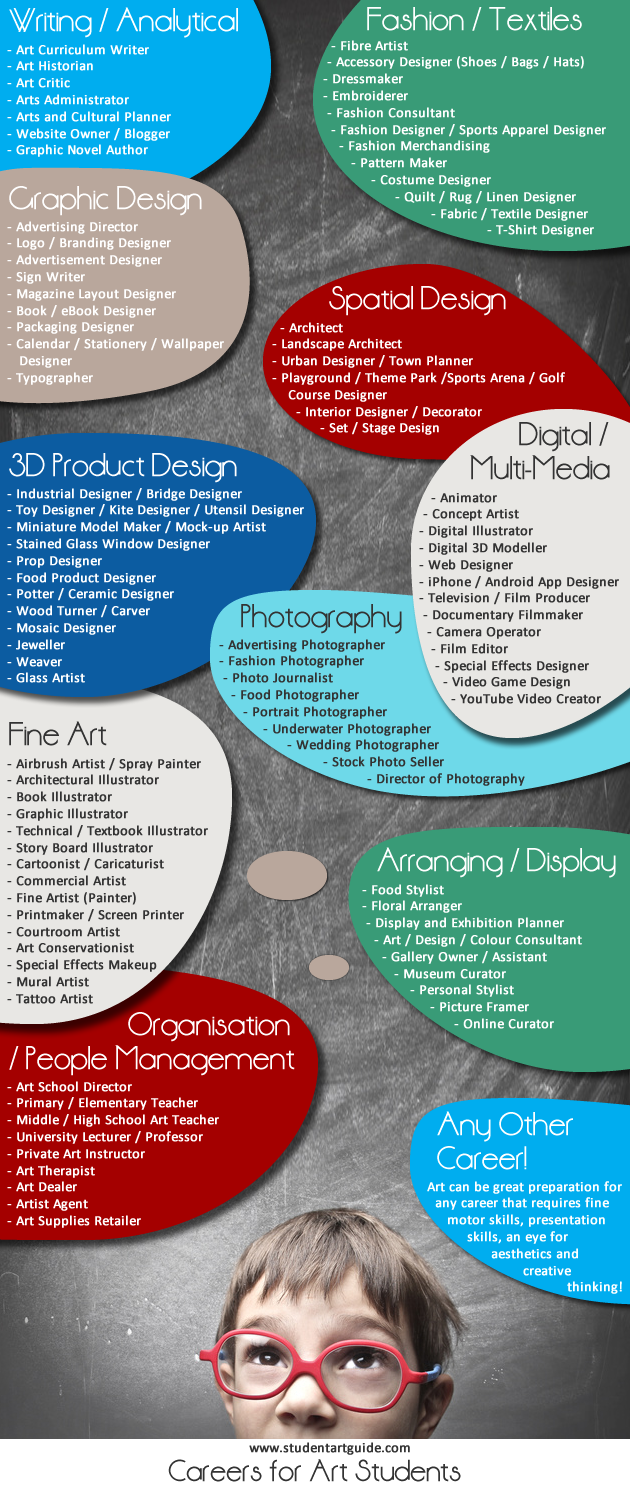
A growing list of art careers
top pics
1. Movie Set / Costume / Special Effects Designer
The Hobbit: The Desolation of Smaug | Weta Digital watch now below or on https://www.youtube.com/watch?v=PGUGF44GJ_E
2. Game Designer
3. T-Shirt and other clothes fashion Designer
4. Magazine Art Director, Graphic Designer, Photographer
5. Graphic Artist / Printmaker / Collage artist, font designer
6. Film Concept Artist
7. Digital and Pet Portrait Artist
8. Upcycle designer for furniture, jewelry and other items
9. Web Based Curator
10. Cake Decorator
11. Online Art Gallery Creator, Artist and Technology Entrepreneur
12. Illustrator
Subjects for Year 11 Students
2 Accounting
2ACCIn this course we will explore further in Accounting by advancing your knowledge in Financial statements, Inventory valuation and making reports and Accounts Receivable Ledger. students will accounting software “ZERO” to do one of the internal Accounting assessment
2 Art Painting
2ARTIn the Level 2 Art course, students will explore visual and conceptual ideas relating to identity, place and a cultural context.
Students will depict and/or interact with their thematic objects, items, textures, and personal identifiers. These elements are then juxtaposed, composed or rearranged together using the manipulation (photoshop) and artist model conventions to create new realities and meanings as art works.
Students are encouraged to use individual agency to make decisions to shape personal responses.
Painting methods and artist approaches will be studied in depth and used in the production of an individual portfolio that is assessed externally.
Work in painting strongly supports the work in printmaking. Students can do both subjects.
NCEA Endorsement is possible in both painting and printmaking.


Careers in Art
Whether you love photography, graphic design, painting or any other art-related speciality, career options are limited only by your imagination. Art education propels people towards creative and unexpected destinations – many of which have not even been discovered yet.
…knowledge is available on every Internet-connected device, what you know matters far less than what you can do with what you know. The capacity to innovate — the ability to solve problems creatively or bring new possibilities to life — and skills like critical thinking, communication and collaboration are far more important than academic knowledge.
https://www.studentartguide.com/articles/art-careers-list
A growing list of art careers
top pics
1. Movie Set / Costume / Special Effects Designer
The Hobbit: The Desolation of Smaug | Weta Digital watch now below or on https://www.youtube.com/watch?v=PGUGF44GJ_E
2. Game Designer
3. T-Shirt and other clothes fashion Designer
4. Magazine Art Director, Graphic Designer, Photographer
5. Graphic Artist / Printmaker / Collage artist, font designer
6. Film Concept Artist
7. Digital and Pet Portrait Artist
8. Upcycle designer for furniture, jewelry and other items
9. Web Based Curator
10. Cake Decorator
11. Online Art Gallery Creator, Artist and Technology Entrepreneur
12. Illustrator
2 Art Printmaking (Digital)
2ARD
The Level 2 Art Digital course is based on an ‘Identity and Imagination’ theme, where the students depict and/or interact with their thematic objects, items, textures, and personal identifiers. These elements are then juxtaposed, composed or rearranged together using the manipulation (photoshop) and influence of their focused pictorial and artist model conventions to create new realities and meanings as art works.
The Level 2 Art Digital course is offered in the visual arts fields of Printmaking and or Photography. This course equips students with the practical and conceptual skills for understanding and participating in the NCEA standards of Visual Arts specifically in the established practices of Printmaking and or Photography.
The work in Level 2 Art Digital strongly supports the work in level 2 Painting. Students can take both options.
Course Endorsement is possible in this subject.
A growing list of art careers
https://www.studentartguide.com/articles/art-careers-list

https://www.youtube.com/watch?v=lNoRrp17SJ4 Click the link to watch
PRINT MAKING TECHNIQUES
This is a short video that gives you the basic run through about printmaking and the techniques offered within the field.

#screenprinting #entrepreneur
https://www.youtube.com/watch?v=xbjd2e-9tgQ Click the link to watch Click the link to watch
Life As A 22-Year-Old Full Time Screen Printer from Home
This is a video about the day in a life of a screen printer who works from home.
His company is called 'aesthetic imprint' which he started when he was 17 yrs old and has slowly progressed growing into his present business at 22 yrs old.
It shows you a true reality of his day to day running and thoughts as he is experiencing it.
2 Biology
2BIOIn this course Students will:
•Explore the diverse ways in which animals and plants carry out the life processes.
•Explore ecological distribution patterns and explain possible causes for these patterns.
•Understand that DNA and the environment interact in gene expression.
•Explain how the interaction between ecological factors and natural selection leads to genetic changes within populations.
2 Building Construction and Allied Trades
2BCTThis course will allow students to improve the skills that they learnt in 1 BCT to better prepare themselves for working in the trades. This course will focus on students using a range of tools and machinery to develop skills and complete projects while showcasing the skills learnt and talents that are developing.
2 Business Studies
2BIZDevelop an understanding of running a business and donating for a good course. Reviewing and then improving and running business again. Students will also develop a knowledge on how to do a survey and carry out research and market their business. They will also work on human Resources issues.
2 Catering
2CAT
Food safety and hygiene are an important part of this course and are covered in depth. Students will continue to develop and improve their practical food cookery skills by producing recipes using a range of food preparation techniques. Topics include using different methods of cookery and a range of different ingredients, including fruit and vegetables, meat, bread, and dairy products. Students will demonstrate competency in a range of unit standards that promote safe food handling, workplace organisation, and the preparation of nutritious food. Emphasis is placed on developing independence, time management, teamwork, and industry - ready practical skills.
2 Chemistry
2CHEIn this course Students will:
· Investigate and measure the chemical and physical properties of a range of groups of substances, for example, acids and bases, oxidants and reductants, and selected organic and inorganic compounds.
. Relate properties of matter to structure and bonding.
· Develop an understanding of and use the fundamental concepts of chemistry (for example, equilibrium and thermochemical principles) to interpret observations.
· Apply knowledge of chemistry to explain aspects of the natural world and how chemistry is used in society to meet needs, resolve issues, and develop new technologies
2 Civics and Future Prep
2CFPCivics education is all about making sure you are ready for adulthood when you leave school. We could almost call this course 'adulting'!
Civics and Future Prep will help build students’ skills surrounding community engagement, public speaking and effective communication with democratic institutions.
In your 2CFP class you will:
- Create a CV and get guidance in how to apply for jobs
- Conduct an inquiry into an area of the Pacific of your choice
- Learn about flatting and renters rights
- Look at savings and investment options
Throughout your two years in CFP you will:
- Look at KiwiSaver and join if appropriate
- Sign up for a MyIRD (Inland Revenue) so you have a tax number
- Sign up for a RealMe so you are ready to access any government or services that require verification
- Enrol to vote
- Open a bank account
2 Classical Studies
2CLSClassical Studies is the study of ancient Greece and ancient Rome. In Year 12 Classical Studies, students explore the ancient Greek world through powerful myths, dramatic wars, and inspiring artworks. This course helps students connect classical ideas to their own lives and cultures, while building skills in analysis, critical thinking, and writing. In Year 13 Classical Studies, students explore the big ideas and beliefs of the ancient world through philosophy, drama, and art — and see how these still influence the world today. This course is ideal for students who enjoy thinking deeply, asking big questions, and making connections between past and present.
See poster attached for further details.

2 Cook Islands Maori
2CKIIn this course we aim to develop understanding in 5 key learning areas and skills of Reading, Listening, Spoken Presentations, Interactions and Writing
2 Dance
2DANLevel 2 NCEA Dance is a practical and theory subject where students will need to combine their knowledge of dance making, dance thinking and dance learning to choreograph and perform dances. Throughout this course students will broaden their dance horizons as well as exploring new movement ideas and concepts to develop their own dance vocabulary.

Dance is an embodied language. Students develop literacy in dance as they learn about, and develop, skills in movement, performance, and choreography. They learn to understand and respond to a variety of dance genres, styles, and forms from a range of contexts, past and present. Teachers enable students to understand and explore dance forms and develop their own ideas, expression, and sense of identity.
Students learn that dance is a holistic experience which links the mind, body, and emotions – integrating thinking, moving, and feeling. They explore dance elements, vocabularies (eg the key features of dance genres or styles), and processes to express personal, group, and cultural identities. Dance also provides space to ask questions, challenge assumptions, promote difference, and provoke alternative thinking.
Dance is a way of strengthening relationships. Through Dance, a number of transferable skills are nurtured that ākonga can carry with them beyond the learning environment, such as collaboration, communication, teamwork, problem solving, and creative thinking. Ākonga carry their identities into the classroom and recognise that their personal prior experiences are valid and valued components of learning in Dance, facilitating an environment that supports whanaungatanga. Working together as a collective and emphasising core values of mutual respect and alofa, dance also supports the nurturing of Vā in our learning spaces. Such values are fundamental to positive learning experiences that will support learners' potential in dance.
Ākonga will continue to deepen their technical expertise and knowledge that underpins Dance as a subject, such as the knowledge about the development of a dance genre or style. As an embodied language, Dance is expressed through movement, which may include locomotor or non-locomotor movement, spatial concepts, the use of positive and negative shapes, relationships of individuals and groups to each other and to their environment, and the effect of timing, as well as rhythmic and energy qualities.
In exploring movement vocabulary and choreography, learners synthesise ideas through dynamic interplays of dance processes and conventions. For example, composition of a dance sequence may involve personal ways of moving that emerge from improvisation and creative developmental work. It may also consist of stylistic techniques and movements usually associated with particular dance genres or styles. Learners will generate and refine ideas through cycles of action to create cohesive, fluid expressions of dance forms. They will reflect and determine which process is appropriate at a specific point. Technologies may help ākonga to curate and develop their performances.

He atua, he tipua, he tangata – Dance is a descendant of culture
The creation and exploration of dance nurtures whakawhanaungatanga
Dance is an embodied language where people can explore and communicate ideas, culture, and identities
Dance provides space to ask questions, challenge assumptions, promote difference, and provoke alternative thinking
Dance involves processes of exploration, selection, refinement, practice, reflection, synthesis, and editing
5 Key Competencies in Dance:
1. Thinking
- participate in processes of refinement, practice, and reflection
- seek to understand the communication of dance
- structure and manipulate specific movements and communicate their meaning
2. Using language, symbols and texts
- understand that dance knowledge and information can be represented in many ways, such as physical, verbal, and written
- interpret and communicate dance as an embodied language
- be able to examine the whakapapa of its many genres, styles, and forms
- recognise that dance is an embodied language with its own structures and systems of communication
- gain a sense of identity through designing dance movements and choreography.
3. Relating to others
- collaborate and communicate with other learners as they engage in dance processes
- gain a sense of community and belonging
- be able to explore te ao Māori
- connect to the wider world by embracing the diversity of people, cultures, and contexts.
4. Managing self
- be able to nurture their curiosity and creativity in order to explore movement as they make new meanings and experiences through dance
- develop self-discipline, perseverance, adaptability, and openness to learning.
5. Participating and contributing
- participate in group settings and understand that this can take many forms, such as leading, following, or observing
- be able to share ideas and offer meaningful contributions, negotiate outcomes, and value the participation and ideas of others when performing and composing movement.
Te toi whakairo, ka ihiihi, ka wehiwehi, ka aweawe te ao katoa - Artistic excellence makes the world sit up in wonder
2 Design and Product Development Technology
2DPD

This course builds on the design knowledge and skills learnt in 1DPD. Students will design a product or a building that will solve a problem in society. They will use advanced design techniques to trial and test their product using a range of tools and processes.
2 Digital Technology
2DGTIn the Level 2 Digital Technology programme, students are given the opportunity to either improve upon the skills they developed in Level 1 or try their hand at producing a different media outcome. Outcomes you may be taught to create are: Scratch games, programs, website development, mobile app development, etc. At the same time, students will be taught how to conduct inquiries critically online and how to use the information they have collected to answer complex research questions, a skill important to any career path students may walk. Using the inquiry they conducted, students will identify a problem they would like to address and develop a digital media outcome to solve said problem.
P-TECH Programme
Students will be part of Year 2 P-TECH Programme (Pathways in Technology), an exciting opportunity for your son/daughter. The program is aimed at giving students opportunities to engage with the world of work so that they can successfully navigate their career.
P-TECH (Pathways in Technology) is a high school/early tertiary program focusing on developing digital skills and job-ready students. It is a partnership between business, high school, and tertiary education. The pathway is five years focusing on NCEA Digital Technologies at high school and an Advanced Diploma in tertiary. P-TECH links student learning to the world of work and entry level roles. As well as technical learning, students also gain opportunities to build work-ready skills, like communication, problem-solving, resilience, self-management and working in teams and with industry mentors.
Level 2 P-TECH students will be attending Manukau Institute of Technology or Media Design School one day a week to complete a Level 4 Certificate in Year 12 and 13.
2 Drama
2DRMLevel 2 NCEA Drama is a subject that will require you as an actor, performer and director to define and understand drama techniques and conventions. In this course you will need to develop your own understanding of improvisation, characterisation skills, devising and script writing to bring an act or play to life. There is an element of collaboration throughout this course for students to develop connections with other students throughout the year.

Who is drama for?
Drama is for everyone.
We all have kōrero pūrākau and stories to share.
Drama helps us to understand cultural perspectives and worldviews and connect with our community. It celebrates and explores te ao Māori, Pacific, and European whakapapa and helps us to prepare for the future by challenging us to explore the attitudes and beliefs of characters in drama from Aotearoa New Zealand and globally.
Through drama, learners explore the lives and worlds of others and develop a deeper understanding of themselves and empathy for others. They will engage with the ways in which drama can uplift and sustain the mana of communities, groups and individuals.
Drama is for the learners of today who will be the adults of tomorrow – adults with an appreciation of who they are in relation to others, where they come from, and what kind of world they would like to live in.
Why study drama?
Drama explores who we are, where we have come from, and where we could go.
Drama draws on the richness of diverse cultures to create new dramatic works.
In drama, learners can make connections between the real world and imagined worlds. Creating characters and situations grows learners’ ability to comment on, challenge, and ultimately transform society. They can use online platforms to explore their ideas and access worldwide audiences.
Drama students demonstrate high engagement, empathy, and courage in their learning because it allows them to have fun while taking creative risks within a safe environment. They quickly learn that they are responsible for themselves and for others.
The collaborative, creative process of drama develops learners' skills in giving and receiving constructive feedback. Drama students learn to share, develop, and extend ideas to realise a shared goal and serve the intention of the drama.
Drama examines and challenges established ideas and prejudices. It encourages critical and creative thinking and innovation. It generates new ideas and reflects on trends in society.
Through participating in and responding to drama, learners develop confidence in expressing their ideas as they seek to communicate with a variety of audiences and thereby influence society.
What is valued knowledge in drama?
Drama is a collaborative art form. Through the practice of ako, learners and teachers support and develop each other’s ideas and practice.
In Drama, learners tell stories and express their identity. They discover how drama can challenge and/or reinforce the status quo. Drama provides opportunities for learners to explore and express Māori, Pacific, and other indigenous heritages. Learners explore and manipulate ideas and take creative risks. They share, rework, construct, and deconstruct work that is dynamic and evolving.
Learners investigate, explore, and practise different ways of creating and structuring drama through using:
- linear, thematic, cyclical, episodic, or non-narrative storytelling
- the elements of drama (role, place, time, situation, action, tension, mood, contrast, focus, symbol)
- a range of dramatic conventions to develop characters and deepen the audience’s engagement
- production technologies (lighting, sound/music, digital projection, properties, makeup, costumes, the set) to create and develop mood and settings (place and time)
- characters and situations brought to life in an imagined world.
In addition, drama students refine and craft the tools of the actor (drama techniques) by learning to:
- use their body (gestures, facial expression, stance and posture, movement) to create and recreate the physical representation of characters, relationships, and situation
- use their voice to communicate convincingly the thoughts and feelings of the characters they portray
- engage with the performance space to develop the audiences’ understanding of character and situation.
Learners’ progression across Levels 6 to 8 is demonstrated by increasing independence and creative vision. They grow their ability to collaborate constructively and serve the intention of the drama.

Drama is influenced by whakapapa and is a way to respond to and share identity, culture, and perspectives
Drama is a collaborative, creative process
Drama weaves wairuatanga through storytelling, communication, and expression
Drama is an act of whakawhanaungatanga; meaning is created through the reciprocal relationship between the drama and audience
5 Key Competencies in Drama:
1. Thinking
- explore ideas physically and in the moment
- respond to creative offers to advance the drama
- put their own thought into action
- respond and adapt their whakaaro (thoughts and ideas) based on mahi tahi (working collaboratively)
- reflect on work and adapt based on feedback
- develop understanding and critical thinking about the context of work; historical, social, cultural, political, and economic, in order to create meaningful drama
- develop research skills in exploring the contexts of dramatic work
- explore their own and others' ideas in work they experience and work they create
- investigate roles, worlds, contexts, attitudes, and themes in drama, using their own prior cultural knowledge.
2. Using language, symbols and texts
- develop their use of language in rehearsal, scripting, and devising processes
- discuss their work and experiment with language used in performance
- understand and use discipline specific vocabulary and develop multi-modal literacies including audio, gestural, linguistic (verbal and written), spatial, and visual
- interpret texts, stories, and direction
- engage with and explore what can be expressed through props, costume, set, technologies, motifs (recurring symbols), text, dialogue, movement, gesture, and conventions.
3. Relating to others
- negotiate, cultivate, and explore a variety of relationships; the relationships between performers, the relationships between characters, the relationship between the performer and the role, and the relationship between the performer and the audience
- practice whanaungatanga and manaakitanga in working with others with care and compassion
- explore the perspectives and experiences of others, increasing their cultural awareness, responsiveness, and acceptance
- understand and play to different strengths in order to enrich the work.
4. Managing self
- develop self discipline and an understanding of their role as part of the group
- practise self-management in practical contexts; arriving to rehearsals on time, learning lines, being prepared, and taking responsibility for different aspects of production (props, costume), theatre and performance protocols
- set goals
- self-review
- accept direction and feedback
- question and critique themselves and others.
5. Participating and contributing
- work together to contribute their own ideas and respond to the ideas of others
- establish kotahitanga in group work, value each others' strengths, and improve the quality of the work
- explore how to adapt and work in different environments with different people and contribute to building a group dynamic that is responsive to the needs of the work and the participants
- develop courage and generosity in making offers to advance the drama and giving feedback as well as openness and humility in accepting feedback and extending the ideas of others.
Te toi whakairo, ka ihiihi, ka wehiwehi, ka aweawe te ao katoa - Artistic excellence makes the world sit up in wonder
2 Economics
2ECOIn this course we will analyse unemployment issues, analyse statistical data relating to economic issues and look at how government policies and contemporary economic issues interact. Students will learn about fiscal policies, monetary policies and other policies used by the government to solve economic problems of the economy. We will look at how economy changed post Covid19
2 English
2ENGIn this course students will develop analysis skills of written and visual texts. They will develop expository writing and report writing skills. To pass the course students must sit the NCEA examinations at the end of the year.
2 Fashion Focus
2FAS2FAS
Students will examine the design and development of Fashion and their effects on what we wear.
They will also look at how textiles and fabrics are made and research what makes them fit for purpose.
Sewing skills will be improved, as will students’ ability to use and alter commercial patterns, as they undertake in-depth practice with domestic and industrial sewing machines, safely, correctly, and to a professional high standard.
We introduce the ethical nature of testing and implementing sustainable practices as essential to Critical Design Thinking.
Students will further their illustration (2D drawing) skills to confidently share design development sketches, share ideas with stakeholders, and refine these conceptual designs based on stakeholders’ feedback.
2 Geography
2GEOTaking Level 2 NCEA Geography at Māngere College offers students a dynamic and engaging way to understand the world around them, with a strong focus on both local and global issues. A key highlight of the course is a field trip to Rangitoto Island, where students get to walk on ancient lava flows and explore volcanic landforms firsthand, bringing classroom learning to life through real-world experience. The course helps students develop valuable skills such as research, data collection, map interpretation, and report writing — all of which are useful for a wide range of future careers and study pathways. Geography at Māngere College is taught with a local focus, using case studies and topics relevant to students’ lives and communities, supported by experienced teachers. It also contributes credits toward NCEA Level 2 and supports university entrance, making it a smart choice for students who enjoy hands-on learning, care about environmental and social issues, and want to build skills that matter.
For more information, please refer to the poster below.

2 Hauora
2HAUIn this course students will:
- Investigate adolescent issues that teenagers have in today’s society
- Understand the reasons for the choices people make that affect their well-being and
- explore and evaluate options and consequences
- Plan strategies to respond to challenging situations
- Analyse how society influences the choices we make
- To critically evaluate Health issues
- To discuss with an open mind various health issues
- To become more aware of the health issues in society
2 History
2HISHistory at Māngere College explores powerful themes through a range of important topics. Students learn about injustice through events like the Dawn Raids, the Black Civil Rights Movement, and Apartheid. They also study issues significant to Aotearoa, such as the Foreshore and Seabed Act, Parihaka, and the Mau Movement. Global topics like World War II, the atomic bomb, and the Vietnam War give students insight into major events that shaped the modern world. These topics help build understanding of the past while developing critical thinking and research skills with trips in between.
For more information, see the poster below.

2 Hospitality
2HOSStudents will gain foundation skills and basic knowledge of a range of Hospitality disciplines including beverage making, basic table service and customer service. A key focus of this course is on communications skills required by the Retail and Hospitality industries and students have a range of opportunities available to them to improve their skills.
2 Indigenous Studies
2IND2 Indigenous Studies is a course that offers Pacific Studies unit standards which will focus on aspects of indigenous cultures. Students can choose their own ethnic/indigenous culture to focus on and compare it to aspects of Pacific cultures. Students will be offered 4 standards to complete throughout the year, altogether worth 18 credits (L2) and 21 credits (L3). This is a highly scaffolded course that enriches our students learning experiences by tapping into their ethnic background and rich cultural experiences.
Although it is not a UE approved, Achievement standard course, Indigenous Studies and Pacific Studies are courses offered at many major universities in Aotearoa including University of Auckland, Waikato University and University of Wellington (Victoria). This subjects also leads into jobs that involve policy making for Pacific peoples. Alongside this academic pathway, students of Indigenous Studies will gain a better understanding and appreciation for their ethnic and cultural background by providing space in our curriculum to explore aspects of their ethnic and cultural backgrounds in depth.
2 Introduction to Automotive
2AUTThis course will introduce students to the Automotive industry and give them an insight into the opportunities available to them as regards employment opportunities as well as teaching them the basics in car servicing and maintenance.
2 Mandarin
2MANIn this course we aim to develop understanding in the key learning areas of Spoken Presentations, Interactions and Writing. We will also develop our skills in Reading and Listening in preparation for our end of year NCEA exams. Learners will be able to use Chinese to communicate information and justify ideas and opinions in different situations.
This course offers 24 credits towards NCEA Level 2. There are three internal standards worth 14 credits and two external standards worth 10 credits.
This course can be endorsed with Merit or Excellence if in a single year you gain 14 or more credits at Merit and/or Excellence within Level 2 Mandarin.
2 Maori
2MAOIn this course we aim to develop understanding and learning in 4 of the 6 language modes associated with learning Te Reo Māori. The 4 key learning areas and skills are Reading, Writing, Listening and speaking.
2 Mathematics (General)
2MATThis course is based on Level 7 of Mathematics in the New Zealand Curriculum. It builds on work done in mathematics at Year 11 and provides a basic mathematical grounding for further study at Year 13. This course is aimed at students who wish to keep open a pathway to the University Approved courses at Level 3.
2 Mathematics with Calculus
2MACThis course is based on Level 7 of Mathematics in the New Zealand Curriculum. It builds on work done in mathematics at Year 11 and provides a basic mathematical grounding for further study at Year 13. Students will be required to sit for at-least two externals at the end of the year depending on the pathway.
This course contributes to Numeracy and is eligible for Course endorsement.
2 Mathematics with Statistics
2MASThis course is based on Level 7 of Mathematics in the New Zealand Curriculum. It builds on work done in mathematics at Year 11 and provides a basic mathematical grounding for further study at Year 13. Students will be required to sit for at-least two externals at the end of the year depending on the pathway.
This course contributes to Numeracy, and is eligible for Course endorsement.
2 Mechanical Engineering Technology
2METThis course will allow students to improve the skills that they learnt in 1 MET to better prepare themselves for working in the trades. This course will focus on students using a range of tools and machinery to develop skills and complete projects while showcasing the skills learnt and talents that are developing.

2 Music
2MUSA highly creative and practical course that involves students continuing to develop their solo and group performance skills and compositional techniques. Students work both individually and collaboratively to prepare for a series of performances and portfolio of original music works. Music study can help develop confidence in your own ability and has many other benefits to a student's holistic development.

Music is a rich part of the diverse cultures of Aotearoa New Zealand. It is a vital part of life for many communities, as an art form that can be used to express histories, knowledge bases, local contexts, language, and aspirations.
Through music, ākonga can develop a deeper understanding of themselves, and explore different contexts and kaupapa. Music can be a waka for learners to connect with their whakapapa and engage with contexts, spirituality, emotions, and ideas of others. They can build confidence in their value as artists that bring their own experiences and culture to musical works, and explore how music relates to their sense of identity.
The experiences, knowledge bases, values, and worldviews of teachers and learners from Māori and Pacific cultural backgrounds are an integral part of developing understanding in this subject. In Music, it is anticipated that learners’ ways of being in the world are harnessed to shape teaching, learning, and assessment. This means that a wide range of music concepts, including whakapapa, aroha, wairua, will be drawn upon.
Learning about music enables ākonga to understand it as a sonic language born of context that communicates layered meaning. They can learn to express and interpret ideas within diverse creative, technological, and cultural frameworks. This can include exploring music concepts related to a music context. Ākonga may work both independently and collaboratively to construct meaning through music.
In this subject, ākonga can develop confidence in their ability to express themselves creatively and emotionally through making original music and performing to an audience. They can learn about music as a craft, with its own structures, elements, tikanga, and symbols.
Participating in music enhances personal wellbeing. An aspiration for music educators is to encourage ākonga to be active participants in music, rather than passive consumers of it. Ākonga can start to understand how learning music can contribute to future study and work pathways across a wide range of areas, including the arts and media, business, community services, education, social sciences, and technology.

Music is an expression of, and a way of connecting with, language, identity, and culture
Music is a sonic language born of context
Music communicates intent through the organisation of sound
Music is a craft that enables people to construct meaning
Music enables people to experience and express feelings
5 Key Competencies in Music:
1. Thinking
- reflect on the impact of decisions they made during the creative process and use this knowledge to inform their future decision-making in music
- think about how people’s diverse experiences and ideas enable the ongoing creation of rich and varied musical outputs across cultures
2. Using language, symbols and texts
- start to understand the symbols and signs within the language of music
- develop understanding of how music makers convey intent and meaning through the organisation and use of music symbols and language
3. Relating to others
- reflect on how making and listening to music elicits feelings and sensations from other people
- understand how other people create and experience music
- gain insight into how audiences engage with music and develop understanding of how listeners are a valuable part of musical experience
4. Managing self
- develop understanding of the impact music can have on their own feelings and wellbeing
- develop the ability to complete successful music projects
- build confidence in upholding the integrity of their musical output
- think about how they can engage with music-making in a way that enhances their own personal wellbeing.
5. Participating and contributing
- experience the creative process of music as an individual and in collaboration with others
- develop skills of the craft independently and in collaboration with others
- reflect on how music projects contribute to communities, depending on whether they are developed independently or in collaboration with others
- think about how they are engaging with the wider music community, including which aspects of learning about music are a personal experience and which may be shared experience.
Te toi whakairo, ka ihiihi, ka wehiwehi, ka aweawe te ao katoa - Artistic excellence makes the world sit up in wonder
2 Physics
2PHYIn this course Students will:
· Investigate physical phenomena (in the areas of mechanics, electricity, electromagnetism, light and waves, and atomic and nuclear physics) and produce qualitative and quantitative explanations for a variety of unfamiliar situations.
· Analyse data to deduce complex trends and relationships in physical phenomena.
· Use physics ideas to explain a technological or biological application of physics.
2 Religious Studies
2RLSYear 12 Religious Studies – Beliefs, Change, and Action in the Modern World
In Year 12 Religious Studies, students explore how religious beliefs and practices continue to shape people’s lives and responses to the world today. Through key topics and real-world examples, students gain a deeper understanding of major world religions and the values they promote. This is a great course for those interested in big questions, cultural understanding, and ethics. All standards are internal and do not carry UE literacy at Y12.
For more information, please see the attached poster.

2 Samoan
2SAMThis course follows Learning Languages in the New Zealand Curriculum up to Level 6 and has an emphasis on communicating in Samoan. The course prepares you to gain knowledge of our Gagana Samoa and Aganu`u (Language and Culture). This course offers 24 credits towards NCEA Level 2. There are three internal standards worth 14 credits and two external standards worth 10 credits.
This course can be endorsed with Merit or Excellence if in a single year you gain 14 or more credits at Merit and/or Excellence within Level 2 Samoan. At least three of these credits must be from externally assessed standards and three from internally assessed standards.
In this course we aim to develop understanding in several key learning areas and skills as follow:
Skills: Listening Reading Presenting
Speaking Writing Debating
Conversation Research Analysing
Specific skills learned
Communication
In selected linguistic and sociocultural contexts, students will:
Understand and produce information and ideas
Express and respond to personal needs and interests
Use cultural knowledge to communicate appropriately
Language Knowledge
Students will:
Recognise and describe ways in which the Samoan language is organised. .
Compare and contrast languages
Cultural Knowledge
Students will:
Recognise and describe ways in which the Samoan culture(s) is (are) organised.
Compare and contrast cultural practices.
2 Sports in Motion
2SMOLevel 2 Sports in Motion
Delivered in partnership with MIT, this course offers a practical pathway into coaching and fitness. Students develop hands-on skills, apply knowledge of skeletal and muscular function to movement, and plan and deliver beginner-level coaching sessions in a safe environment.
2 Sports Leadership
2SPLLevel 2 Sports Leadership
Designed for students who enjoy leading and coaching others, this course involves applying and evaluating leadership strategies to improve group effectiveness. Students practice coaching roles, implement physical activities, and measure their performance against set standards.
2 Sports Science
2SPOA highly practical course which will extend students’ knowledge of bio-physical concepts and social-cultural factors studied in Level 1 Sports Science. Students are given the opportunities to understand, develop and implement aspects of skill improvement, training programs and personal fitness and improve their own personal performance. All our standards encourage critical thinking and challenge assumptions relating to health, fitness and sports performance concepts.
In this course students will:
- use methods and principles of training to improve their own fitness
- apply anatomy and biophysical principles in a sporting context
- perform a sporting activity to meet national standards
- apply risk management strategies in an outdoor Education setting such as mountain biking.
- demonstrate social responsibility through participating in a variety of activities and
- leadership opportunities.
2 Tongan
2TONThis course follows Learning Languages in the New Zealand Curriculum up to Level 6 and has an emphasis on communicating in Lea Faka-Tonga. The course prepares you to gain knowledge of our Lea Faka-Tonga as well as our Tongan Culture and values. This course offers 24 credits towards NCEA Level 2. There are three internal standards worth 14 credits and two external standards worth 10 credits.
This course can be endorsed with Merit or Excellence if in a single year you gain 14 or more credits at Merit and/or Excellence within Level 2 Tongan. At least three of these credits must be from externally assessed standards and three from internally assessed standards.
2 Tourism Studies
2TOUIn this course you will learn about a range of Tourism topics including Tourism as a business in NZ, world and NZ destinations that are popular with tourists and the range of jobs available in the tourism industry. These topics prepare you for Level 3 Tourism and also will prepare you for the workforce or further training.
Te Ao Haka
3TAHTe Ao Haka is a combined Year 12 and Year 13 course that acknowledges Māori performing arts as a discipline grounded in mātauranga Māori, whakapapa, tikanga, language, leadership, creativity, and collective responsibility. It provides you with opportunities to strengthen your cultural identity while developing the knowledge, skills, and critical thinking required to achieve success within NCEA.
You will have opportunity to demonstrate the learning through performance, reflection, analysis, and leadership, aligning with the principles of the MC Whānau framework at Māngere College . Through this course you will experience success through contexts that recognise and value your cultural knowledge and lived experiences.
Subjects for Year 12 Students
3 Accounting
3ACCStudents will develop an understanding of accounting for partnership and prepare company reports for external users. Students will also learn about job costing, management accounting and decision making process. Annual Reports of listed companies and contains five credits for read and write.
3 Art painting
3ARTIn the Level 3 Art course, students will explore visual and conceptual ideas relating to identity, place and a cultural context.
Students will depict and/or interact with their thematic objects, items, textures and personal identifiers. These elements are then juxtaposed, composed or rearranged together using the manipulation (photoshop) and influence of artist model conventions to create new realities and meanings as art works.
Students are encouraged to use individual agency to make decisions to shape personal responses.
Painting methods and approaches will be studied and used in the production of an individual portfolio that is assessed externally.
Work in painting strongly supports the work in printmaking. Students can do both subjects.
NCEA Endorsement is possible in both painting and printmaking.
Students can scaffold visual and conceptual ideas from previous years work in Art.
Painting methods and artist approaches will be studied in depth and used in the production of an increasing individual portfolio that is assessed externally.
Students will use photoshop as a thinking tool in the production of art works and are expected to consistently make individual decisions.
Work in the other Arts discipline Printmaking strongly supports the work in painting.
Course Endorsement is possible in both painting and printmaking.
.


The arts enable people to participate in collaborative and individual pursuits that contribute to community and personal identity. New Zealanders are involved in many art forms and arts-related fields of employment.
For example, they are painters, dancers, musicians, actors, writers, weavers, designers, composers, choreographers, architects, film-makers, educators, historians, curators, producers, therapists, and technicians. Many people also pursue careers outside the arts using analytical, creative, co-operative, entrepreneurial, and problem-solving skills that have been enhanced through learning in the arts.
The arts develop the artistic and aesthetic dimensions of human experience. They contribute to our intellectual ability and to our social, cultural, and spiritual understandings. They are an essential element of daily living and of lifelong learning.
Careers in Art
1. Movie Set / Costume / Special Effects Designer
The Hobbit: The Desolation of Smaug | Weta Digital watch now below or on https://www.youtube.com/watch?v=PGUGF44GJ_E
2. Game Designer
3. T-Shirt and other clothes fashion Designer
4. Magazine Art Director, Graphic Designer, Photographer
5. Graphic Artist / Printmaker / Collage artist, font designer
6. Film Concept Artist
7. Digital and Pet Portrait Artist
8. Upcycle designer for furniture, jewelry and other items
9. Web Based Curator
10. Cake Decorator
11. Online Art Gallery Creator, Artist and Technology Entrepreneur
12. Illustrator
3 Art Printmaking (Digital)
3ARD
The Level 3 Art Digital course is based on an ‘Identity and Imagination’ theme. Students will scaffold visual and conceptual ideas from previous years work in Art. Here students will depict and/or interact with their thematic objects, items, textures, and personal identifiers. These elements are then juxtaposed, composed or rearranged together using the manipulation and influence of their focused pictorial and artist model conventions to create new realities and meanings as art works.
Printmaking and or Photography methods and artist approaches will be studied in depth. These investigations will support the production of an increasing individual portfolio that is assessed externally. Students will use Photoshop as a thinking tool in the production of art works and are expected to consistently make individual decisions.
Level 3 Art Digital offers this course in the visual arts fields of Printmaking and or Photography. This course equips students with the practical, visual and conceptual skills for understanding and participating in the NCEA standards of Visual Arts specifically in the established practices of Printmaking and Photography.
Work in Level 3 Art Digital strongly supports the work in Level 3 Painting. Students can take both options.
Course Endorsement is possible in this subject.
A growing list of art careers
https://www.studentartguide.com/articles/art-careers-list

Click to watch https://youtu.be/lNoRrp17SJ4
PRINT MAKING TECHNIQUES
This is a short video that gives you the basic run through about printmaking and the techniques offered within the field.
#screenprinting #entrepreneur
Click the link to watch https://youtu.be/xbjd2e-9tgQ
Life As A 22-Year-Old Full Time Screen Printer from Home
This is a video about the day in a life of a screen printer who works from home.
His company is called 'aesthetic imprint' which he started when he was 17 yrs old and has slowly progressed growing into his present business at 22 yrs old.
It shows you a true reality of his day to day running and thoughts as he is experiencing it.
3 Automotive
3AUTThis course gives you further opportunities to enhance your practical ENGINEERING and AUTOMOTIVE skills which will allow you to create a pathway into a variety of trade related careers. You will focus on safe work practices, engineering and automotive tasks and machinery. Career pathways include engineering/welding, automotive services, plumbing,roofing and ventilation.

3 Biology
3BIOIn this course Students will:
- · Understand the relationship between organisms and their environment.
- · Explore the evolutionary processes that have resulted in the diversity of life on Earth and appreciate the place and impact of humans within these processes.
- · Understand how humans manipulate the transfer of genetic information from one generation to the next and make informed judgments about the social, ethical, and biological implications relating to this manipulation.
3 Building Construction and Allied Trades
3BCTThis advanced BCT course gives students the opportunity to continue to develop their woodworking skills and management of tools and machinery in preparation for employment, tertiary study or an apprenticeship.
3 Business Studies
3BIZIn this course we will develop a marketing plan for new or existing products. They will then carry out a sustainable business activity with consultation and mentors. They will also learn how to make a product, pitch for the product, sell it and make profit/loss and finally make an annual review of the business.
3 Catering
3CATThis course is career-related. Students will have the opportunity to improve their skill base and knowledge regarding the preparation and presentation of more complex dishes. This course is a must-take if you want to work in the catering or hospitality industry. Demonstrate knowledge of food contamination hazards and control methods used in a food establishment. Also, prepare and cook pasta dishes in a commercial kitchen. Also, prepare and cook basic meat dishes in a commercial kitchen and perform food costing calculations in a commercial hospitality environment. Pasta and meat are a partnership with MIT
3 Chemistry
3CHE- In this course Students will:
- · Investigate and measure the chemical and physical properties of a range of groups of substances, for example, acids and bases, oxidants and reductants, and selected organic and inorganic compounds.
- · Relate properties of matter to structure and bonding.
- · Develop an understanding of and use the fundamental concepts of chemistry (for example, equilibrium and thermochemical principles) to interpret observations.
- · Apply knowledge of chemistry to explain aspects of the natural world and how chemistry is used in society to meet needs, resolve issues, and develop new technologies.
3 Civics and Future Prep
3CFPCivics education is all about making sure you are ready for adulthood when you leave school. We could almost call this course 'adulting'!
Civics and Future Prep will help build students’ skills surrounding community engagement, public speaking and effective communication with democratic institutions.
In your 3CFP class you will:
- Conduct an inquiry into an area of the Pacific of your choice
- Learn about credit options and debt management strategies
- Look at budgeting and financial options
- Learn about purchasing a home
Throughout your two years in CFP you will:
- Look at KiwiSaver and join if appropriate
- Sign up for a MyIRD (Inland Revenue) so you have a tax number
- Sign up for a RealMe so you are ready to access any government or services that require verification
- Enrol to vote
- Open a bank account
All students should finish CFP with a minimum of 14 credits. The teacher will track each student's progress and make adjustments (IEP) where needed. Students who want a UE endorsement can complete AS91599 and AS91600 to replace US28100 and US28103. If students would like an Endorsement they can be entered for AS91429. this is a resource-based exam so students will need some support with this.
3 Classical Studies
3CLSClassical Studies is the study of ancient Greece and ancient Rome. In Year 12 Classical Studies, students explore the ancient Greek world through powerful myths, dramatic wars, and inspiring artworks. This course helps students connect classical ideas to their own lives and cultures, while building skills in analysis, critical thinking, and writing. In Year 13 Classical Studies, students explore the big ideas and beliefs of the ancient world through philosophy, drama, and art — and see how these still influence the world today. This course is ideal for students who enjoy thinking deeply, asking big questions, and making connections between past and present.
See poster attached for further details.

3 Cook Islands Maori
3CKIIn this course we aim to develop learning and understanding of learners in 5 key learning areas and skills of Reading, Listening, Spoken Presentations, Interactions and Writing.
3 Dance
3DANLevel 3 Dance is a chance for year 13 students to explore their own personal voices as a dancer and a choreographer. Students will explore their own interests in movement to create material for assessments during the year. Students will need to choreograph and perform dances taught to them, and begin to develop their sense of identity and originality in movement.

Dance is an embodied language. Students develop literacy in dance as they learn about, and develop, skills in movement, performance, and choreography. They learn to understand and respond to a variety of dance genres, styles, and forms from a range of contexts, past and present. Teachers enable students to understand and explore dance forms and develop their own ideas, expression, and sense of identity.
Students learn that dance is a holistic experience which links the mind, body, and emotions – integrating thinking, moving, and feeling. They explore dance elements, vocabularies (eg the key features of dance genres or styles), and processes to express personal, group, and cultural identities. Dance also provides space to ask questions, challenge assumptions, promote difference, and provoke alternative thinking.
Dance is a way of strengthening relationships. Through Dance, a number of transferable skills are nurtured that ākonga can carry with them beyond the learning environment, such as collaboration, communication, teamwork, problem solving, and creative thinking. Ākonga carry their identities into the classroom and recognise that their personal prior experiences are valid and valued components of learning in Dance, facilitating an environment that supports whanaungatanga. Working together as a collective and emphasising core values of mutual respect and alofa, dance also supports the nurturing of Vā in our learning spaces. Such values are fundamental to positive learning experiences that will support learners' potential in dance.
Ākonga will continue to deepen their technical expertise and knowledge that underpins Dance as a subject, such as the knowledge about the development of a dance genre or style. As an embodied language, Dance is expressed through movement, which may include locomotor or non-locomotor movement, spatial concepts, the use of positive and negative shapes, relationships of individuals and groups to each other and to their environment, and the effect of timing, as well as rhythmic and energy qualities.
In exploring movement vocabulary and choreography, learners synthesise ideas through dynamic interplays of dance processes and conventions. For example, composition of a dance sequence may involve personal ways of moving that emerge from improvisation and creative developmental work. It may also consist of stylistic techniques and movements usually associated with particular dance genres or styles. Learners will generate and refine ideas through cycles of action to create cohesive, fluid expressions of dance forms. They will reflect and determine which process is appropriate at a specific point. Technologies may help ākonga to curate and develop their performances.

He atua, he tipua, he tangata – Dance is a descendant of culture
The creation and exploration of dance nurtures whakawhanaungatanga
Dance is an embodied language where people can explore and communicate ideas, culture, and identities
Dance provides space to ask questions, challenge assumptions, promote difference, and provoke alternative thinking
Dance involves processes of exploration, selection, refinement, practice, reflection, synthesis, and editing
5 Key Competencies in Dance:
1. Thinking
- participate in processes of refinement, practice, and reflection
- seek to understand the communication of dance
- structure and manipulate specific movements and communicate their meaning
2. Using language, symbols and texts
- understand that dance knowledge and information can be represented in many ways, such as physical, verbal, and written
- interpret and communicate dance as an embodied language
- be able to examine the whakapapa of its many genres, styles, and forms
- recognise that dance is an embodied language with its own structures and systems of communication
- gain a sense of identity through designing dance movements and choreography.
3. Relating to others
- collaborate and communicate with other learners as they engage in dance processes
- gain a sense of community and belonging
- be able to explore te ao Māori
- connect to the wider world by embracing the diversity of people, cultures, and contexts.
4. Managing self
- be able to nurture their curiosity and creativity in order to explore movement as they make new meanings and experiences through dance
- develop self-discipline, perseverance, adaptability, and openness to learning.
5. Participating and contributing
- participate in group settings and understand that this can take many forms, such as leading, following, or observing
- be able to share ideas and offer meaningful contributions, negotiate outcomes, and value the participation and ideas of others when performing and composing movement.
Te toi whakairo, ka ihiihi, ka wehiwehi, ka aweawe te ao katoa - Artistic excellence makes the world sit up in wonder
3 Design and Product Development
3DPDStudents will continue to expand and develop their product or architectural design skills allowing them to showcase their talents and exhibit their work. The design process will be extensively applied to situations requiring design solutions and students will have the opportunity to improve their computer aided design work, visual communication and drawing skills.
3 Digital Technology
3DGTIn Level 3 Digital studies/P-TECH programme, students are given the opportunity to either improve upon the skills they developed in Level 2 or try their hand at producing a different media outcome. Outcomes you can be taught to create are: game design, developing computer programs, website development or mobile app development. At the same time, they will be taught how to conduct inquiries critically online and how to use the information they have collected to answer complex research questions, a skill important to any career path students may walk. Using the inquiry they conducted, students will identify a problem they would like to address and develop a digital media outcome to solve said problem.
Students will be attending Manukau Institute of Technology one day a week to complete a Level 4 Certificate in Year 13.
3 Drama
3DRMLevel 3 NCEA Drama is a subject that will require you as an actor, performer and director to define and use drama techniques and conventions in a variety of contexts. In this course you will deepen your own understanding of improvisation, characterisation skills, devising and script writing to bring an act or play to life. There is an element of collaboration throughout this course for students to develop connections with other students throughout the year.

Who is drama for?
Drama is for everyone.
We all have kōrero pūrākau and stories to share.
Drama helps us to understand cultural perspectives and worldviews and connect with our community. It celebrates and explores te ao Māori, Pacific, and European whakapapa and helps us to prepare for the future by challenging us to explore the attitudes and beliefs of characters in drama from Aotearoa New Zealand and globally.
Through drama, learners explore the lives and worlds of others and develop a deeper understanding of themselves and empathy for others. They will engage with the ways in which drama can uplift and sustain the mana of communities, groups and individuals.
Drama is for the learners of today who will be the adults of tomorrow – adults with an appreciation of who they are in relation to others, where they come from, and what kind of world they would like to live in.
Why study drama?
Drama explores who we are, where we have come from, and where we could go.
Drama draws on the richness of diverse cultures to create new dramatic works.
In drama, learners can make connections between the real world and imagined worlds. Creating characters and situations grows learners’ ability to comment on, challenge, and ultimately transform society. They can use online platforms to explore their ideas and access worldwide audiences.
Drama students demonstrate high engagement, empathy, and courage in their learning because it allows them to have fun while taking creative risks within a safe environment. They quickly learn that they are responsible for themselves and for others.
The collaborative, creative process of drama develops learners' skills in giving and receiving constructive feedback. Drama students learn to share, develop, and extend ideas to realise a shared goal and serve the intention of the drama.
Drama examines and challenges established ideas and prejudices. It encourages critical and creative thinking and innovation. It generates new ideas and reflects on trends in society.
Through participating in and responding to drama, learners develop confidence in expressing their ideas as they seek to communicate with a variety of audiences and thereby influence society.
What is valued knowledge in drama?
Drama is a collaborative art form. Through the practice of ako, learners and teachers support and develop each other’s ideas and practice.
In Drama, learners tell stories and express their identity. They discover how drama can challenge and/or reinforce the status quo. Drama provides opportunities for learners to explore and express Māori, Pacific, and other indigenous heritages. Learners explore and manipulate ideas and take creative risks. They share, rework, construct, and deconstruct work that is dynamic and evolving.
Learners investigate, explore, and practise different ways of creating and structuring drama through using:
- linear, thematic, cyclical, episodic, or non-narrative storytelling
- the elements of drama (role, place, time, situation, action, tension, mood, contrast, focus, symbol)
- a range of dramatic conventions to develop characters and deepen the audience’s engagement
- production technologies (lighting, sound/music, digital projection, properties, makeup, costumes, the set) to create and develop mood and settings (place and time)
- characters and situations brought to life in an imagined world.
In addition, drama students refine and craft the tools of the actor (drama techniques) by learning to:
- use their body (gestures, facial expression, stance and posture, movement) to create and recreate the physical representation of characters, relationships, and situation
- use their voice to communicate convincingly the thoughts and feelings of the characters they portray
- engage with the performance space to develop the audiences’ understanding of character and situation.
Learners’ progression across Levels 6 to 8 is demonstrated by increasing independence and creative vision. They grow their ability to collaborate constructively and serve the intention of the drama.

Drama is influenced by whakapapa and is a way to respond to and share identity, culture, and perspectives
Drama is a collaborative, creative process
Drama weaves wairuatanga through storytelling, communication, and expression
Drama is an act of whakawhanaungatanga; meaning is created through the reciprocal relationship between the drama and audience
5 Key Competencies in Drama:
1. Thinking
- explore ideas physically and in the moment
- respond to creative offers to advance the drama
- put their own thought into action
- respond and adapt their whakaaro (thoughts and ideas) based on mahi tahi (working collaboratively)
- reflect on work and adapt based on feedback
- develop understanding and critical thinking about the context of work; historical, social, cultural, political, and economic, in order to create meaningful drama
- develop research skills in exploring the contexts of dramatic work
- explore their own and others' ideas in work they experience and work they create
- investigate roles, worlds, contexts, attitudes, and themes in drama, using their own prior cultural knowledge.
2. Using language, symbols and texts
- develop their use of language in rehearsal, scripting, and devising processes
- discuss their work and experiment with language used in performance
- understand and use discipline specific vocabulary and develop multi-modal literacies including audio, gestural, linguistic (verbal and written), spatial, and visual
- interpret texts, stories, and direction
- engage with and explore what can be expressed through props, costume, set, technologies, motifs (recurring symbols), text, dialogue, movement, gesture, and conventions.
3. Relating to others
- negotiate, cultivate, and explore a variety of relationships; the relationships between performers, the relationships between characters, the relationship between the performer and the role, and the relationship between the performer and the audience
- practice whanaungatanga and manaakitanga in working with others with care and compassion
- explore the perspectives and experiences of others, increasing their cultural awareness, responsiveness, and acceptance
- understand and play to different strengths in order to enrich the work.
4. Managing self
- develop self discipline and an understanding of their role as part of the group
- practise self-management in practical contexts; arriving to rehearsals on time, learning lines, being prepared, and taking responsibility for different aspects of production (props, costume), theatre and performance protocols
- set goals
- self-review
- accept direction and feedback
- question and critique themselves and others.
5. Participating and contributing
- work together to contribute their own ideas and respond to the ideas of others
- establish kotahitanga in group work, value each others' strengths, and improve the quality of the work
- explore how to adapt and work in different environments with different people and contribute to building a group dynamic that is responsive to the needs of the work and the participants
- develop courage and generosity in making offers to advance the drama and giving feedback as well as openness and humility in accepting feedback and extending the ideas of others.
Te toi whakairo, ka ihiihi, ka wehiwehi, ka aweawe te ao katoa - Artistic excellence makes the world sit up in wonder
3 Economics
3ECOIn this course we will develop an understanding of microeconomic concepts, government intervention to correct market failures and efficiency of market equilibrium, Demand and Supply, government Budget and monetary policy and fiscal policy Students will also learn about Inflation and how it effects the economy. There are two internals in this course and one external. This is University Entrance approved subject with with 14 literacy credits.
Out side school learning takes place when students go on a trip to Wellington to learn about interest rate therefore visiting Reserve bank of New Zealand. Tour also include visiting Te Papa Museum, Weta Caves and other new events that is happening in wellington.
3 English
3ENGThis course is university approved and for the student who would like to be university bound. This course has a pre-requisite which means that a student must have passed 14 plus achievement standards in Y12 English. Students need to have a level of independence in their reading and writing skills. There is provision to develop critical response, analysis skills of written and visual texts. Students will develop expository writing and report writing skills. There are two examinations in this course.
3 English - Academic
3ENAStudents will develop a critical response to the analysis of film and develop an informed understanding of literature using critical texts. All writing generated will contribute to the writing portfolio. Students will sit two examinations at the end of the year. This course is a university pre-approved course. Students who take this course must be independent and self directed learners who are proficient in reading and writing to NZ curriculum level 7. This means that in Year 12 English you were able to independently read text, understand and write an analysis independently. This course is designed for the university bound student. The course has a pre-requisite which means that to gain entry into this course you must have achieved 14 achievement standard credits in Year 12.
3 English - Practical
3ENLIn this course we will develop reading and writing skills across a range of NCEA levels 2 and 3 in Practical English. This course is not university approved. It is not for the university bound student. However, it will contribute to your NCEA level 3 certificate.
3 Fashion Focus
3FAS3FAS
In this course we will develop design ideas and use complex procedures to produce a garment for a specific occasion.
Students will continue to improve their sewing ability, pattern management and sewing machine expertise.
The Fashion Design and Development course at Level 3 offers students the opportunity to explore and craft their creativity in the world of fashion, textiles and beyond.
Focusing on both technical skills and conceptual development, Level 3 Fashion prepares students for potential careers in fashion design, textile art, garment production and fashion entrepreneurship. We encourage students to express their unique artistic vision while also gaining practical knowledge of the fashion industry, including design principles, fashion history and garment construction techniques using an ethical and sustainable lens.
By the end of the course will have produced a professional portfolio showcasing their design work, including prototypes and fully constructed garments.
3 Geography
3GEOGeography is the study of how people interact with their environment. It seeks to interpret the world and how it changes over time – past, present, and future.
Level 3 Geography builds on the concepts we explore at Level 1 & 2. There is a focus on social Geography through international examples and case studies in Aotearoa New Zealand.
- Tourism development in Rotorua.
- The event planning and evaluation of Polyfest.
- A contemporary geographic issues that affect people and places.
- The global pattern of Palm Oil.
He aha te mea nui o te ao. He tāngata, he tāngata, he tāngata - What is the most important thing in the world? It is people, it is people, it is people.

Trips: TBC, please see Mr. Ras
This is a Table A University Approved Subject and you will be offered at least 14 internal credits so you can use this as one of your UE subjects.

It was a very rainy day when we visited the Rotorua luge!

How did Tourism attractions change and adapt to different markets during COVID?

3 Hauora
3HAULevel 3 Health focuses on the "bigger picture," examining how well-being is influenced by individuals, communities, systems, and society. Students critically explore contemporary health issues in Aotearoa New Zealand, analyzing how social, cultural, political, and environmental factors shape health equity and access to support.
3 History
3HISHistory at Māngere College explores powerful themes through a range of important topics. Students learn about injustice through events like the Dawn Raids, the Black Civil Rights Movement, and Apartheid. They also study issues significant to Aotearoa, such as the Foreshore and Seabed Act, Parihaka, and the Mau Movement. Global topics like World War II, the atomic bomb, and the Vietnam War give students insight into major events that shaped the modern world. These topics help build understanding of the past while developing critical thinking and research skills with trips in between.
For more information, see the poster below.

3 Hospitality
3HOSThis course is career related. Students will study a number of areas associated with Hospitality and Customer service including Barista coffee making and learning about the origins of coffee and the bean roasting process. Students will also develop skills in customer relations and hospitality and well as learning strategies for working as part of group and dealing with different behavioural styles.
3 Indigenous Studies
3IND3 Indigenous Studies is a course that offers Pacific Studies unit standards which will focus on aspects of indigenous cultures. Students can choose their own ethnic/indigenous culture to focus on and compare it to aspects of Pacific cultures. Students will be offered 4 standards to complete throughout the year, altogether worth 18 credits (L2) and 21 credits (L3). This is a highly scaffolded course that enriches our students learning experiences by tapping into their ethnic background and rich cultural experiences.
Although it is not a UE approved, Achievement standard course, Indigenous Studies and Pacific Studies are courses offered at many major universities in Aotearoa including University of Auckland, Waikato University and University of Wellington (Victoria). This subjects also leads into jobs that involve policy making for Pacific peoples. Alongside this academic pathway, students of Indigenous Studies will gain a better understanding and appreciation for their ethnic and cultural background by providing space in our curriculum to explore aspects of their ethnic and cultural backgrounds in depth.
3 Mandarin
3MANIn this course we aim to develop understanding in the key learning areas of Spoken Presentations, Interactions and Writing. We will also develop our skills in Reading and Listening in preparation for our end of year NCEA exams. Learners will be able to use Chinese to explore and justify varied ideas and perspectives in different situations.
This course offers 24 credits towards NCEA Level 3. There are three internal standards worth 14 credits and two external standards worth 10 credits.
This course can be endorsed with Merit or Excellence if in a single year you gain 14 or more credits at Merit and/or Excellence within Level 3 Mandarin.
3 Maori
3MAOIn this course we aim to develop understanding and learning in 4 of the 6 language modes associated with learning Te Reo Māori. The 4 key learning areas and skills are Reading, Writing, Listening and speaking.
3 Mathematics (General)
3MATThis course is based on Level 8 of Mathematics in the New Zealand Curriculum. It builds on work done in Mathematics at Year 12 and provides a basic Mathematical grounding for further study at Tertiary level. Level 3 Mathematics provides a sound base for study in many fields. Students are offered combination of Mathematics and Statistics standards .
This course is a University Approved subject and contributes to Numeracy
3 Mathematics with Calculus
3MACThis course is based on Levels 7 and 8 of Mathematics in the New Zealand Curriculum. It builds on work done in Mathematics at Year 12 and provides Mathematical grounding for further study at Tertiary level. This course comprises of both Internal and External standards that contribute to the total credits.
This course is a University recognized subject, contributes to Numeracy and is eligible for Course endorsement.
3 Mathematics with Statistics
3MASThis course is based on Levels 7 and 8 of Mathematics in the New Zealand Curriculum. It builds on work done in Mathematics at Year 12 and provides. Mathematical grounding for further study at Tertiary level. This course comprises of both Internal and External standards that contribute to the total credits.
This course is a University Approved subject, contributes to UE literacy (external) and is eligible for Course endorsement.
3 Mechanical Engineering
3METThis is a career related course that gives students the opportunity to further develop their skills in the preparation for moving into the trades, further study or an apprenticeship. Your ability to safely and correctly use mechanical engineering tools, machinery and materials are a key focus of this course.
3 Music
3MUSA highly creative and practical course that involves students further developing their solo performance skills and compositional techniques whilst establishing their own sense of style and voice. Students rehearse for a series of performance programmes and produce a portfolio of original music works. Music study can help develop confidence in your own ability and has many other benefits to a student's holistic development.

Music is a rich part of the diverse cultures of Aotearoa New Zealand. It is a vital part of life for many communities, as an art form that can be used to express histories, knowledge bases, local contexts, language, and aspirations.
Through music, ākonga can develop a deeper understanding of themselves, and explore different contexts and kaupapa. Music can be a waka for learners to connect with their whakapapa and engage with contexts, spirituality, emotions, and ideas of others. They can build confidence in their value as artists that bring their own experiences and culture to musical works, and explore how music relates to their sense of identity.
The experiences, knowledge bases, values, and worldviews of teachers and learners from Māori and Pacific cultural backgrounds are an integral part of developing understanding in this subject. In Music, it is anticipated that learners’ ways of being in the world are harnessed to shape teaching, learning, and assessment. This means that a wide range of music concepts, including whakapapa, aroha, wairua, will be drawn upon.
Learning about music enables ākonga to understand it as a sonic language born of context that communicates layered meaning. They can learn to express and interpret ideas within diverse creative, technological, and cultural frameworks. This can include exploring music concepts related to a music context. Ākonga may work both independently and collaboratively to construct meaning through music.
In this subject, ākonga can develop confidence in their ability to express themselves creatively and emotionally through making original music and performing to an audience. They can learn about music as a craft, with its own structures, elements, tikanga, and symbols.
Participating in music enhances personal wellbeing. An aspiration for music educators is to encourage ākonga to be active participants in music, rather than passive consumers of it. Ākonga can start to understand how learning music can contribute to future study and work pathways across a wide range of areas, including the arts and media, business, community services, education, social sciences, and technology.

Music is an expression of, and a way of connecting with, language, identity, and culture
Music is a sonic language born of context
Music communicates intent through the organisation of sound
Music is a craft that enables people to construct meaning
Music enables people to experience and express feelings
5 Key Competencies in Music:
1. Thinking
- reflect on the impact of decisions they made during the creative process and use this knowledge to inform their future decision-making in music
- think about how people’s diverse experiences and ideas enable the ongoing creation of rich and varied musical outputs across cultures
2. Using language, symbols and texts
- start to understand the symbols and signs within the language of music
- develop understanding of how music makers convey intent and meaning through the organisation and use of music symbols and language
3. Relating to others
- reflect on how making and listening to music elicits feelings and sensations from other people
- understand how other people create and experience music
- gain insight into how audiences engage with music and develop understanding of how listeners are a valuable part of musical experience
4. Managing self
- develop understanding of the impact music can have on their own feelings and wellbeing
- develop the ability to complete successful music projects
- build confidence in upholding the integrity of their musical output
- think about how they can engage with music-making in a way that enhances their own personal wellbeing.
5. Participating and contributing
- experience the creative process of music as an individual and in collaboration with others
- develop skills of the craft independently and in collaboration with others
- reflect on how music projects contribute to communities, depending on whether they are developed independently or in collaboration with others
- think about how they are engaging with the wider music community, including which aspects of learning about music are a personal experience and which may be shared experience.
Te toi whakairo, ka ihiihi, ka wehiwehi, ka aweawe te ao katoa - Artistic excellence makes the world sit up in wonder
3 Physics
3PHYIn this course Students will:
- · Investigate physical phenomena (in the areas of mechanics, electricity, electromagnetism, light and waves, and atomic and nuclear physics) and produce qualitative and quantitative explanations for a variety of complex situations.
- · Analyse and evaluate data to deduce complex trends and relationships in physical phenomena.
- · Use physics ideas to explain a technological, biological, or astronomical application of physics and discuss related issues.
3 Religious Studies
3RLSIn Year 13 Religious Studies, students dive deeper into how religion shapes identity, decision-making, and society — especially within the context of Aotearoa New Zealand. The course explores ethical issues, key beliefs, and the role of both religious and secular worldviews in tackling life’s biggest questions. All standards are internal, making this an accessible and discussion-rich subject.
Please see poster for additional details.

3 Samoan
3SAMThis course follows Learning Languages in the New Zealand Curriculum up to Level 7/8 and has an emphasis on communicating in Samoan. The course prepares you to gain knowledge of our Gagana Samoa and Aganu`u (Language and Culture). This course offers 24 credits towards NCEA Level 3. There are three internal standards worth 14 credits in total and two external standards worth 5 credits each.
This course can be endorsed with Merit or Excellence if in a single year you gain 14 or more credits at Merit and/or Excellence within Level 3 Samoan. At least three of these credits must be from externally assessed standards and three from internally assessed standards.
In this course we aim to develop understanding in several key learning areas and skills as follow:
Skills: Listening Reading Presenting
Speaking Writing Debating
Conversation/Interaction Research Analysing
3 Sports in Motion
3SMOLevel 3 Sports in Motion
In partnership with the Manukau Institute of Technology (MIT), this advanced programme provides a practical pathway into the fitness and recreation industry. Students learn about sports injury prevention, risk management, and officiating, while also designing personalised exercise plans and leading coaching sessions.
3 Sports Leadership
3SPL
In this course students will:
- Learn how to plan and run a safe physical activity session
- Further develop coaching techniques
- Plan and teach a junior class using leadership strategies
- Develop and implement a personal fitness plan
- Consider a range of Leadership strategies
This course offers 16 Achievement Standards credits and a total of 21 credits overall.
3 Sports Science
3SPOA highly practical course which will extend students’ knowledge of bio-physical concepts and social-cultural factors studied in Level 2 Sports Science. Students are given the opportunities to understand, develop and implement aspects of skill improvement, training programs and personal fitness and improve their own personal performance. All our standards encourage critical thinking and challenge assumptions relating to health, fitness and sports performance concepts. In this course students will:
- Apply methods and principles of training to improve their own fitness
- Devise strategies for lifelong well being
- plan and evaluate a fitness programme using their knowledge of anatomy and
- biomechanics
- Analyse a skill performed by themselves and others
- perform a sporting activity to meet national standards
Trips: At least one trip to a challenging outdoor activity such as white water rafting, mountain biking or similar.
3 Tongan
3TONThis course follows Learning Languages in the New Zealand Curriculum up to Level 7 and has an emphasis on communicating in Lea Faka-Tonga. The course prepares you to gain knowledge of our Lea Faka-Tonga as well as our Tongan Culture and values. This course offers 24 credits towards NCEA Level 3. There are three internal standards worth 14 credits and two external standards worth 10 credits.
This course can be endorsed with Merit or Excellence if in a single year you gain 14 or more credits at Merit and/or Excellence within Level 2 Tongan. At least three of these credits must be from externally assessed standards and three from internally assessed standards.
3 Tourism Studies
3TOUStudents will study an in depth course which covers three different areas of the Pacific/Australasia region - these are New Zealand, the Pacific islands and Australia. Students will research accommodation, transport and attractions and activities available to tourists.
Māngere College Pathways Academy (MCPA)
MCPAMangere College Pathways Academy (MCPA)
Focus:
Pathways Academy is designed to give senior students access to a range of trades and vocational opportunities - helping you stay engaged in learning while getting real-world skills.
The program is offered through a partnership between our school and tertiary providers and runs full-time (25–30 hours per week). You’ll be enrolled at school but spend time learning both at school and with a training provider. Some programs may also include work experience.
✅ What’s it all about?
- Learn in both school and tertiary settings
- Gain hands-on experience in areas like construction, health, hospitality, automotive, and more
- Work towards NCEA Level 2 or 3 AND a nationally recognised trades qualification
✅ What’s the purpose?
- Keep you motivated and engaged by offering more learning options
- Give you a head start on a trade or vocational career
- Create clear pathways to employment or further training
- Help schools respond to industry and workforce needs
✅ What are the outcomes?
- You’ll be working toward a Level 2 or 3 trades-related tertiary qualification
- You’ll leave school with skills and experience that employers are looking for

AREAS OF INTEREST
Below is a list of potential courses that may be offered, depending on student interest and the availability of our external providers.
It is essential that students who select MCPA demonstrate commitment, maintain clear communication, and work cooperatively with both the Careers & Pathways Department and our external providers.

Construction/Engineering - Level 2 & Level 3
Construction is a vital industry that shapes communities, creates jobs, and improves society. This course provides the essential skills and knowledge to assist with various stages of construction and engineering under the supervision of experienced professionals. A career in construction requires a solid understanding of building principles, strong interpersonal skills, and excellent organizational abilities.

Electrical - Level 2 & Level 3
Electrical engineering technicians interpret the designs and technical instructions of electrical engineers to ensure accurate implementation. They are also responsible for developing, installing, testing, and maintaining equipment used in the production, transmission, and utilization of electrical power. (Pre-approval required for course entry)

ECE (Early Childhood Education) - Level 2 & Level 3
Early Childhood Education focuses on the essential developmental milestones, skills, and concepts children acquire during their early years. This includes fostering social-emotional development, as well as laying the foundations for numeracy, literacy, and critical thinking.

Automotive Engineering - Level 3
Automotive Engineering, a branch of mechanical engineering, plays a key role in the automotive industry. Automotive engineers design new vehicles and ensure that existing models meet prescribed safety, performance, and efficiency standards.

Building & Landscape – Level 3
In this hands-on course, students will learn how to prepare ground surfaces and lay concrete and paving stones. You’ll gain practical skills in building outdoor structures such as pergolas, planter boxes, and bench seating, while also learning how to design and construct attractive, functional garden spaces.
If you are interested in enrolling in MCPA you will need to submit an exemption through school point and wait while our careers and pathways team assess your eligibility for our program.
Te Ao Haka
3TAHTe Ao Haka is a combined Year 12 and Year 13 course that acknowledges Māori performing arts as a discipline grounded in mātauranga Māori, whakapapa, tikanga, language, leadership, creativity, and collective responsibility. It provides you with opportunities to strengthen your cultural identity while developing the knowledge, skills, and critical thinking required to achieve success within NCEA.
You will have opportunity to demonstrate the learning through performance, reflection, analysis, and leadership, aligning with the principles of the MC Whānau framework at Māngere College . Through this course you will experience success through contexts that recognise and value your cultural knowledge and lived experiences.